8
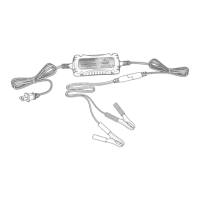
Attach charger clamps to battery connections, as follows, ensuring a good connection (if there is 2.
a mistake, the reverse polarity indicator will light) when the Battery Charger is plugged in:
Negative-Grounded Vehicle: Connect the positive (RED) charger clamp to the positive (POS,
P, +) ungrounded battery terminal. Then, connect the negative (BLACK) charger clamp to the
vehicle chassis, or the engine block (away from the battery).
Do not connect the charger clamp to the carburetor, fuel lines or sheet metal body parts: connect
only to a heavy gauge metal part of the frame or engine block.
Negative-grounded type systems are the most common in today’s vehicles.
Positive-Grounded Vehicle: Connect the negative (BLACK) charger clamp to the negative
(NEG, N, -) ungrounded battery terminal. Then, connect the positive (RED) charger clamp to the
vehicle chassis or engine part (away from the battery). Do not connect the charger clamp to the
carburetor, fuel lines or sheet metal body parts: connect only to a heavy gauge, stable metal part
of the frame or engine block.
Plug Battery Charger power cord into a 110/120-volt AC power outlet.3.
If the Battery Charger is connected correctly the reverse polarity indicator will not be lit. If the 4.
cables are connected incorrectly the reverse polarity LED will be red. Disconnect the Battery
Charger and check your connections.
Select the correct charging rate mode for your battery. It will default to the 4-amp charge rate.5.
During charging the green charge status LED will blink on and off.6.
When the charging is complete the green charge status LED will stay on and “FUL” will be shown 7.
on the LED display panel.
After charging is complete, disconnect the Battery Charger plug from the 110/120-volt AC power 8.
outlet.
Disconnect the cables and clamps in the reverse order in which they were connected. 9.
Disconnect your first cable as far away from the battery as possible.
Charging if Battery is Outside of Vehicle
Check polarity of battery terminals - For top-mounted battery connectors, the positive terminal 1.
(marked POS, P, +) usually has a larger diameter than the negative battery terminal (marked
NEG, N, -). For side-mounted battery connections the positive terminal is red, the negative
terminal is black.
Attach a 24-inch (minimum length) 6 AWG insulated battery cable to the negative battery 2.
terminal (marked NEG, N, -).
Connect the positive (RED) charger clamp to the positive battery terminal (marked POS, P, + or 3.
red).
Stand as far back from battery as possible, and do not face battery when making final 4.
connection.
Position yourself and free end of cables as far away from battery as possible. Carefully connect 5.
the negative (BLACK) charger clamp to the free end of the battery cable connected to the
negative terminal.
Connect the Battery Charger’s power cord to a 110/120-volt AC power outlet.6.
If the Battery Charger is connected correctly the reverse polarity indicator will not be lit. If the 7.
cables are connected incorrectly the reverse polarity LED will be red. Disconnect the Battery
Charger and check your connections.
Select the correct charging rate mode for your battery. It will default to the 4-amp charge rate.8.
During charging the green charge status LED will blink on and off.9.
When the charging is complete the green charge status LED will stay on and “FUL” will be shown 10.
on the LED display panel.
After charging is complete, disconnect the Battery Charger plug from the 110/120-volt AC power 11.
outlet.
Disconnect the cables and clamps in the reverse order in which they were connected. 12.
Disconnect your first cable as far away from the battery as possible.
A marine (boat) battery must be removed and charged on shore. To charge it on
board requires equipment specially designed for marine use.
8
8
Sujete las pinzas en las conexiones de la batería, como sigue, asegurándose de hacer una 2.
buena conexión (si hay un error, la luz del indicador de polaridad inversa se encenderá) cuando
el Cargador de Baterías es enchufado:
Vehículo con Tierra Negativa: Conecte la pinza positiva (ROJA) del cargador al terminal
positivo de la batería sin tierra (POS, P, +). Luego, conecte la pinza del cargador de baterías
negativo (NEGRO) al chasis del vehículo o al bloque del motor (lejos de la batería).
No conecte la pinza del cargador al carburador, tubos de combustible o piezas de hojalata de la
carrocería: conéctela a una pieza metálica de grueso calibre del chasis o del bloque del motor.
Los sistemas de tipo de tierra negativa son los más comunes en los vehículos
actuales.
Vehículo con Tierra Positiva: Conecte la pinza negativa (NEGRA) del cargador al terminal
negativo de la batería sin conexión a tierra (NEG, N, –). Luego, conecte la pinza del cargador
de baterías positivo (ROJO) al chasis del vehículo o al bloque del motor (lejos de la batería). No
conecte la pinza del cargador al carburador, tubos de combustible o piezas de hojalata de la
carrocería: conéctela a una pieza metálica de grueso calibre del chasis o del bloque del motor.
Enchufe el cordón del Cargador de Baterías en una toma de corriente de 110/120 voltios CA.3.
Si el Cargador de Baterías fue conectado correctamente, el indicador de polaridad inversa no se 4.
encenderá. Si los cables fueron conectados incorrectamente, la luz LED de polaridad inversa se
encenderá en rojo. Desconecte el Cargador de Baterías y revise sus conexiones.
Selecciones el modo de tasa de carga correcto para su batería. La tasa predeterminada será de 5.
4 amperios.
Durante la carga la luz LED de estado de carga parpadeará.6.
Cuando la carga está completa la luz LED de estado de carga verde se quedará prendida y 7.
aparecerá “FUL” en el tablero de la pantalla LED.
Después de que la carga esté completa, desconecte el enchufe del Cargador de Baterías de la 8.
toma de corriente de 110/120 voltios CA.
Desconecte los cables y las pinzas en orden inverso al que fueron conectadas. Desconecte su 9.
primer cable tan lejos de la batería como le sea posible.
Carga si la Batería está Fuera del Vehículo
Revise la polaridad de las terminales de la batería - Para conectores de batería montados 1.
encima, el terminal positivo (marcado POS, P, +) tiene usualmente un diámetro mayor que el del
terminal negativo de la batería (marcado NEG, N, –). Para conexiones de batería montadas al
lado, el terminal positivo es rojo y el terminal negativo es negro.
Sujete un cable de batería aislado de 24 pulgadas (longitud mínima) de calibre 6 AWG al 2.
terminal negativo de la batería (marcado NEG, N, –).
Conecte la pinza positiva (ROJA) del cargador al terminal positivo de la batería (marcado POS, 3.
P, + o rojo).
Párese tan lejos de la batería como le sea posible y no le de la cara a la batería al efectuar las 4.
conexiones finales.
Párese con el extremo libre de los cables tan lejos de la batería como le sea posible. Conecte 5.
cuidadosamente la pinza del cargador negativa (NEGRA) al extremo libre del cable de la batería
conectado al terminal negativo.
Conecte el cordón del Cargador de Baterías en una toma de corriente de 110/120 voltios CA.6.
Si el Cargador de Baterías fue conectado correctamente, el indicador de polaridad inversa no se 7.
encenderá. Si los cables fueron conectados incorrectamente, la luz LED de polaridad inversa se
encenderá en rojo. Desconecte el Cargador de Baterías y revise sus conexiones.
Selecciones el modo de tasa de carga correcto para su batería. La tasa predeterminada será de 8.
4 amperios.
Durante la carga la luz LED de estado de carga parpadeará.9.
Cuando la carga está completa la luz LED de estado de carga verde se quedará prendida y 10.
aparecerá “FUL” en el tablero de la pantalla LED.
Después de que la carga esté completa, desconecte el enchufe del Cargador de Baterías de la 11.
toma de corriente de 110/120 voltios CA.
Desconecte los cables y las pinzas en orden inverso al que fueron conectadas. Desconecte su 12.
primer cable tan lejos de la batería como le sea posible.
Una batería marina (de bote) tiene que ser removida y cargada en tierra. Para
cargarla a bordo se necesitan equipos diseñados especialmente para uso marino.


 To Next Page
 Loading...