6
OPERATION
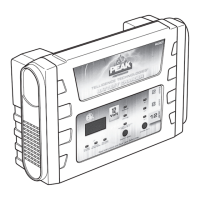
LED Display Panel
Charged Indicator Light – When the battery is fully charged, the green LED will light.
Power Light – The red LED will light to indicate the Battery Charger is plugged into an AC power
source.
Before Charging
• Make sure the Battery Charger is disconnected from the power supply.
• Make sure that the voltage of the battery matches the rated output of the Battery Charger by
referring to the vehicle owner’s manual.
• Check the polarities of the battery terminals: positive for the (+) symbol and negative for the (–)
symbol.
• See CHARGING TIMES on page 7 before charging battery.
Pre-Charge Activation
When starting to charge a battery, the current will depend on the battery’s percent of charge. As the
battery charge level increases, the current reduces. To measure the battery charge level as charging
proceeds, a hydrometer or a voltmeter should be used. Typically 12.6V DC is considered full charge
for a 12-volt battery if the voltage is measured one hour after the Battery Charger is disconnected.
During charging, a nominal 12-volt battery can measure 13.6 volts or higher. If so, it needs to rest
after charging to measure actual state of charge.
EXPLOSION HAZARD
Be aware that a fully charged battery will also cause a low current reading. Attempting pre-
charge activation of a fully charged battery may cause explosion - make sure that battery is
discharged before using this procedure.
Pre-charge activation is the term for the time it takes before a battery begins to
accept a measurable rate of charge - it can be as long as 4-8 hours from the time the charging
process begins. Pre-charge activation is indicated if the ammeter reading is zero and a
hydrometer or voltmeter reading shows that the battery is fully discharged.
The newer, high-calcium-type 12-volt DC batteries may need pre-charge activation if
their charge has been allowed to drop to a very low level. When deeply discharged, this type
of battery will provide only a very low voltage output and will draw less than 1 amp during the
recharging process, until activated.
Charging if Battery Is Installed in a Vehicle
1. Check polarity of battery terminals: For top-mounted battery connectors, the positive (+) terminal
usually has a larger diameter than the negative (–) battery terminal. For side-mounted battery
connections, the positive terminal is red, and the negative terminal is black.
2. There are two different sets of cables that can be used for charging. You can use the battery clip
cable or the ring terminal cable.
When using the ring terminal cable, make sure to use the correct hardware to
connect the cables to the battery. Hardware is not supplied with the Battery Charger.
3. Using the appropriate cable, plug it into the cable connector cord from the Battery Charger.
4. Using the battery clip cable or the ring terminal cable, attach Battery Charger cables to battery
connections as follows.
Negative-Grounded Vehicle: Connect the positive (RED) Battery Charger cable to the positive
(+) ungrounded battery terminal. Then, connect the negative (BLACK) Battery Charger cable to
the vehicle chassis, or the engine block (away from the battery). Do not connect the cable to the
carburetor, fuel lines or sheet metal body parts: connect only to a heavy gauge metal part of the
frame or engine block.
Negative-grounded type systems are the most common in today’s vehicles.
Positive-Grounded Vehicle: Connect the negative (BLACK) Battery Charger cable to the
negative (–) ungrounded battery terminal. Then, connect the positive (RED) Battery Charger
cable to the vehicle chassis or engine part (away from the battery). Do not connect the cable to
the carburetor, fuel lines or sheet metal body parts: connect only to a heavy gauge, stable metal
part of the frame or engine block.
6
OPERACIÓN
Panel de Pantalla LED
Luz Indicadora de Carga – Cuando la batería esté completamente cargada, la luz LED verde se
encenderá.
Luz de Energía – La luz LED roja se encenderá indicando que el Cargador de Baterías está
enchufado a una fuente de energía CA.
Antes de Cargar
• Asegúrese de que el Cargador de Baterías sea desconectado de la fuente de energía.
• Asegúrese de que el voltaje de la batería sea igual a la potencia nominal del Cargador de Baterías
refiriéndose al manual del propietario del vehículo.
• Revise las polaridades de los terminales de batería: positivo para el símbolo de (+) y negativo para
el símbolo de (–).
• Consulte TIEMPOS DE CARGA en la página 7 antes de cargar la batería.
Activación de Pre-carga
Cuando comience a cargar una batería, la corriente dependerá del porcentaje de carga de la batería.
A medida que el nivel de carga de la batería aumenta, se reduce la corriente. Para medir el nivel de
carga de la batería a medida que carga, se debe usar un hidrómetro o un voltímetro. Típicamente
12,6V CC se consideran carga completa para una batería de 12 voltios si el voltaje es medido una
hora después de desconectar el Cargador de Baterías. Durante la carga, el voltaje nominal de una
batería de 12 voltios puede medir 13,6 voltios o más. Si es así, necesita reposar después de la carga
para medir el estado de carga real.
ADVERTENCIA
PELIGRO DE EXPLOSIÓN
Esté enterado de que una batería completamente cargada causara una lectura de corriente
baja. El intentar activación de pre-carga de una batería completamente cargada podrá causar
una explosión - asegúrese que la batería esté descargada antes de usar este procedimiento.
AVISO
Activación de pre-carga es un término para el tiempo que se toma antes de que
una batería comience a aceptar una tasa de carga cuantificable - puede ser tanto como de 4
a 8 horas desde el comienzo del proceso de carga. La activación de pre-carga es indicada si
la lectura del amperímetro es cero y la lectura del hidrómetro o del voltímetro muestra que la
batería está totalmente descargada.
AVISO
Las baterías más nuevas de tipo de alto calcio de 12 voltios CC podrán necesitar
activación de pre-carga si se les ha permitido que su nivel de carga caiga a un nivel muy bajo.
Cuando están profundamente descargadas, este tipo de baterías proporcionaran sólo una
salida de voltaje muy baja y consumirán menos de 1 amperio durante el proceso de recarga,
hasta que son activadas.
Carga si la Batería está Instalada en un Vehículo
1. Revise la polaridad de los terminales de la batería: Para terminales de batería montados en la
parte superior, usualmente el terminal de batería positivo (+) tiene un diámetro mayor que el del
terminal negativo (–). Para conexiones de batería montadas al lado, el terminal positivo es rojo y
el terminal negativo es negro.
2. Hay dos juegos de cables diferentes que pueden ser usados para cargar. Usted puede usar el
cable de batería con pinzas o el cable de terminal de anillo.
AVISO
Cuando use el cable con terminal de anillo, asegúrese de usar los herrajes
correctos para conectar los cables a la batería. Los herrajes no son suministrados con el
Cargador de Baterías.
3. Usando el cable apropiado, enchúfelo dentro del cordón del conector del cable del Cargador de
Baterías.
4. Usando el cable de batería con pinza o el cable con terminal de anillo, sujete los cables del
Cargador de Baterías a las conexiones de la batería de la forma siguiente.
Vehículo con Tierra Negativa: Conecte el cable positivo (ROJO) del Cargador de Baterías al
terminal de la batería positivo (+) sin tierra. Luego, conecte el cable del Cargador de Baterías
negativo (NEGRO) al chasis del vehículo o al bloque del motor (lejos de la batería). No conecte
el cable al carburador, tubos de combustible o piezas de hojalata de la carrocería: conéctelo
solamente a una pieza metálica de grueso calibre del chasis o del bloque del motor.
AVISO
Los sistemas de tipo de tierra negativa son los más comunes en los vehículos
actuales.
Vehículo con Tierra Positiva: Conecte el cable negativo (NEGRO) del Cargador de Baterías
al terminal de la batería negativo (–) sin tierra. Luego, conecte el cable positivo (ROJO) del
Cargador de Baterías al chasis del vehículo o al bloque del motor (lejos de la batería). No
conecte el cable al carburador, tubos de combustible o piezas de hojalata de la carrocería:
conéctelo solamente a una pieza estable metálica de grueso calibre del chasis o del bloque del
motor.


 To Next Page
 Loading...