r,_Ii;ti ;[,]--t kvA:ik_/ il Ir!_lII[*] f
1.
2.
Provide air openings for adequate ventilation in
accordance with Section 5.3 Air for Combustion
and Ventilation, of the National F_el Gas Code,
ANSI Z223 I NFPA 54. ol applicable provisions of
the local building codes Ventilation is required to
prevent overheating of the controls which greatly
reduces the life of the controls Air inlet piping
provides only combustion air to the boiler See
Section D for Air Inlet Piping requirements
Definition:
Unconfined Space: a space whose volume is not
less than fifty (50) cubic feet per I000 Btu/hr of the
total input rating of all appliances installed in that
space. Rooms communicating directly with the space
in which the appliances are installed, through
openings not furnished with doors, are considered
part of the unconfined space
3.
Appliances Located in Unconfined Spaces:
For installations in unconfined spaces, the supply of
air for ventilation can usually be considered
adequate.
Appliances Located in Confined Spaces:
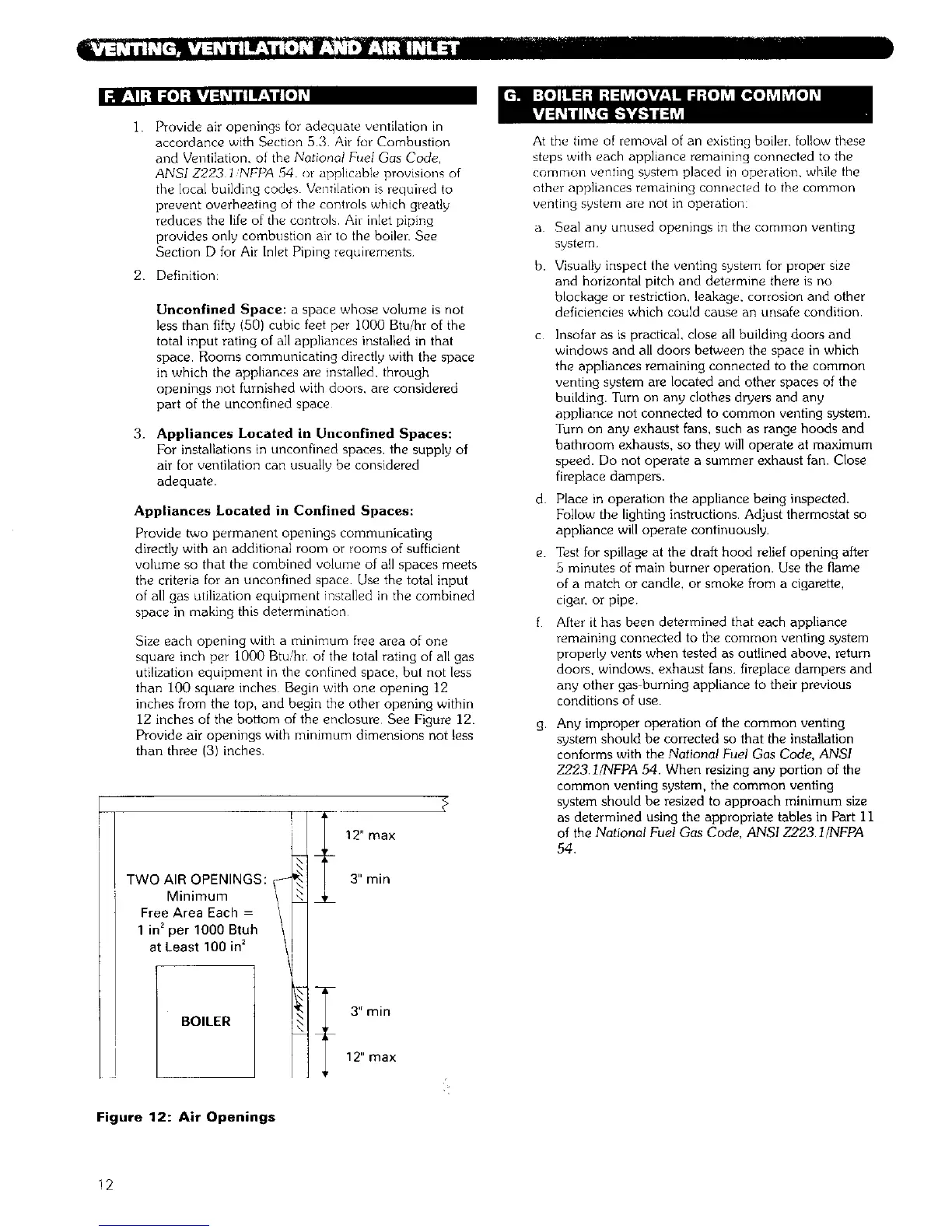
Provide two permanent openings communicating
directly with an additional room or rooms of sufficient
volume so that the combined volume of all spaces meets
the criteria for an unconfined space Use the total input
of all gas utilization equipment installed in the combined
space in making this determination
Size each opening with a minimum free area of one
square inch per I000 Btu/hr. of the total rating of all gas
utilization equipment in the confined space, but not less
than 100 square inches Begin with one opening 12
inches from the top, and begin the other opening within
12 inches of the bottom of the enclosure See Figure 12.
Provide air openings with minimum dimensions not less
than three (3) inches.
TWO AIR OPENINGS:
Minimum
Free Area Each -
1 in 2per 1000 Btuh
at Least 100 in 2
BOILER
12" max
3" min
,L
I 3" min
12" max
Figure 12: Air Openings
At the time of removal of an existing boiler, follow these
steps with each appliance remaining connected to the
common venting system placed in operation, while the
other appliances remaining connected to the common
venting system are not in operation:
a Seal any unused openings in the common venting
system
b.
Visually inspect the venting system for proper size
and horizontal pitch and determine there is no
blockage or restriction, leakage, corrosion and other
deficiencies which could cause an unsafe condition.
C. Insofar as is practical, close all building doors and
windows and all doors between the space in which
the appliances remaining connected to the common
venting system are located and other spaces of the
building. Turn on any clothes dryers and any
appliance not connected to common venting system.
Turn on any exhaust fans. such as range hoods and
bathroom exhausts, so they will operate at maximum
speed. Do not operate a summer exhaust fan. Close
fireplace dampers.
d. Place in operation the appliance being inspected.
Follow the lighting instructions. Adjust thermostat so
appliance will operate continuously.
e.
Test for spillage at the draft hood relief opening after
5 minutes of main burner operation. Use the flame
of a match or candle, or smoke from a cigarette,
cigar, or pipe
After it has been determined that each appliance
remaining connected to the common venting system
properly vents when tested as outlined above, return
doors, windows, exhaust fans. fireplace dampers and
any other gas burning appliance to their previous
conditions of use.
g. Any improper operation of the common venting
system should be corrected so that the installation
conforms with the National Fuel Gas Code, ANSI
Z223.1/NFPA 54. When resizing any portion of the
common venting system, the common venting
system should be resized to approach minimum size
as determined using the appropriate tables in Part 11
of the National Fuel Gas Code, ANSI Z223.1/NFPA
54.
12



 To Next Page