8-60 Command Reference
:MEASure :FREQuency?
[8 [<expected value>[,<resolution>]] [,<(@«1|2|3|4|6»)>]]
Frequency
Traditional frequency measurements. The counter uses the <expected value> and
<resolution> to calculate the Measurement Time (:SENSe:ACQuisition:APER
-
ture).
Example:
SEND®
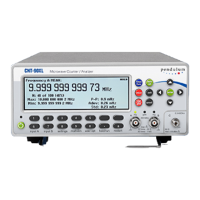
:MEAS:FREQ? 8 (@3)
READ¬ 1.78112526833E+009
This example measures the frequency at input C.
+
The channel is expression data and it must be in parentheses ( ).
Parameters:
<expected value> is the expected frequency,
<resolution> is the required resolution.
<(@«1|2|3|4|6»)> is the channel to measure on:
(@1) means input A
1
(@2) means input B
1
(@3) means input C (RF input option)
(@4) means input E (Rear panel arming input)
(@6) means the internal reference
If you omit the channel, the instrument measures on input A (@1).
1 These channels are prescaled by 2 when measuring frequency, and prescaled by
1 for all other functions. An exception is burst frequency measurements, where you
can choose between the two factors. See the next command and the command
:SENSe:FREQuency:PREScaler:STATe on page 8-94. There is a tradeoff be
-
tween the minimum number of pulses in a burst and the frequency range.
Complies with standards: SCPI 1991.0, confirmed.



 To Next Page