• ACEA Association des Constructers
European Automobiles.
• ECF-3 Engine Crankcase Fluid
Licensing
The Engine Oil Licensing and Certification System by
the American Petroleum Institute (API) and the
Association des Constructers European
Automobilesand (ACRA) is recognized by Perkins.
For detailed information about this system, see the
latest edition of the “API publication No. 1509”.
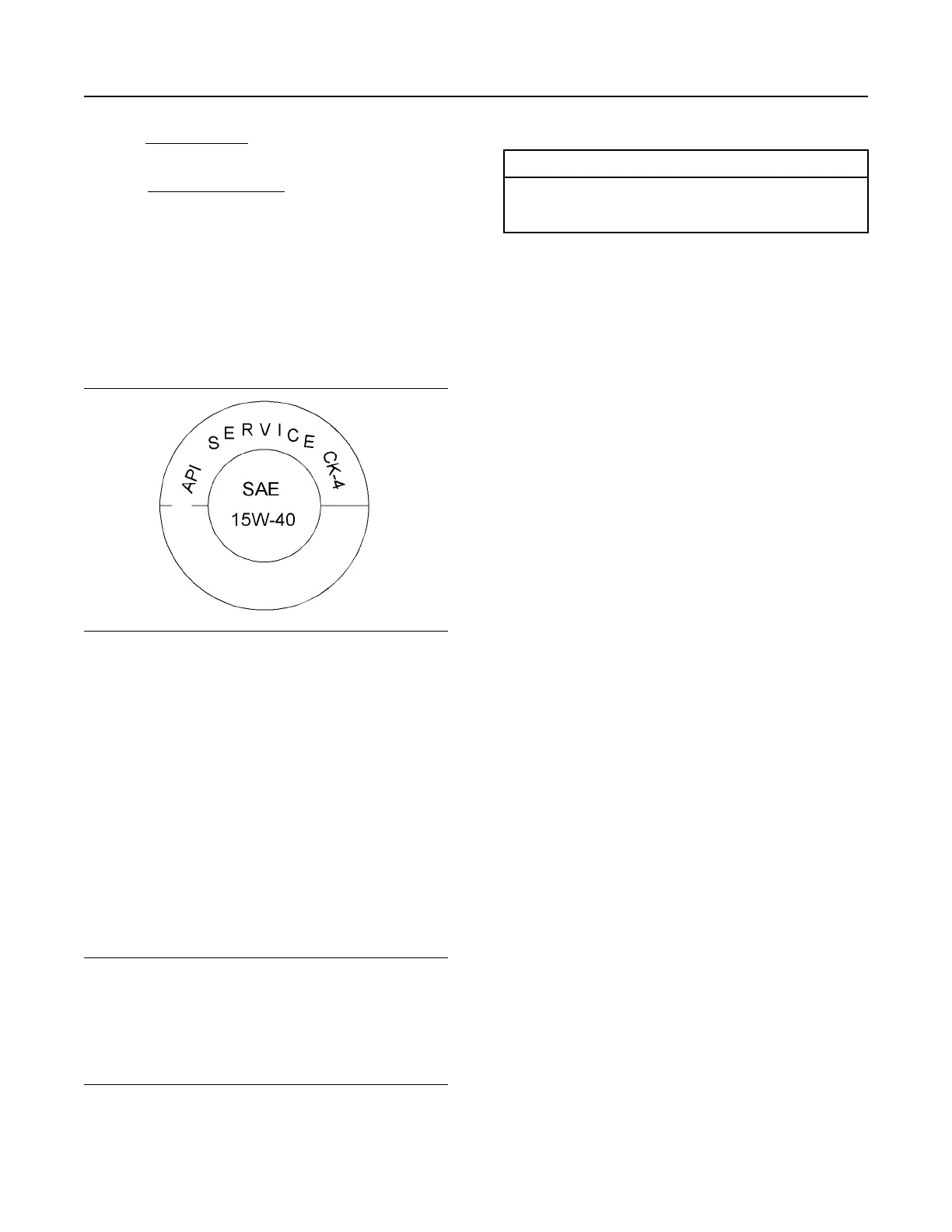
Engine oils that bear the API symbol are authorized
by API.
Illustration 61 g06183768
Typical API symbol
Terminology
Certain abbreviations follow the nomenclature of
“SAE J754”. Some classifications follow “SAE J183”
abbreviations, and some classifications follow the
“EMA Recommended Guideline on Diesel Engine
Oil”. In addition to Perkins definitions, there are other
definitions that will be of assistance in purchasing
lubricants. Recommended oil viscosities can be
found in this publication, “Fluid Recommendations/
Engine Oil” topic (Maintenance Section).
Engine Oil
Commercial Oils
NOTICE
Perkins require the use of the following specifica-
tion of engine oil. Failure to use the appropriate
specification of engine oil will reduce the life of
your engine. Failure to use the appropriate speci-
fication of engine oil will also reduce the life of
your aftertreatment system.
Table 18
Oil Specification
API CK-4
ACEA E9
ECF-3
API CK-4 and ACEA E9 oil categories have the
following chemical limits:
• 0.1 percent maximum sulfated ash
• 0.12 percent maximum phosphorous
• 0. 4 percent maximum sulfur
The chemical limits were developed to maintain the
expected life of the engine aftertreatment system.
The performance of the engine aftertreatment system
can be adversely affected if oil that is not specified in
table 18 is used.
The life of your Aftertreatment system is defined by
the accumulation of ash on the surface of the filter.
Ash is the inert part of the particulate matter. The
system is designed to collect this particulate matter.
There is a small percentage of particulate matter that
is left behind as the soot is burnt. This matter will
eventually block the filter, causing loss of
performance and increased fuel consumption. Most
of the ash comes from the engine oil which is
gradually consumed during normal operation. This
ash is passes through the exhaust. To meet the
designed life of the product, the use of the
appropriate engine oil is essential. The oil
specification that is listed in table 18 has low ash
content.
Maintenance intervals for engines that use
biodiesel – The oil change interval can be adversely
affected by the use of biodiesel. Use oil analysis to
monitor the condition of the engine oil. Use oil
analysis also to determine the oil change interval that
is optimum.
Note: API FA-4 oil is designed for use in selected
on-highway applications and is NOT designed to
support off-road applications, including Perkins
Engines. DO NOT use API FA-4 oil for Perkins
engines. These engine oils are not approved by
Perkins and these engine oils must not be used:
CC, CD, CD-2, CF-4, CG-4, CH-4, and CI-4.
Lubricant Viscosity Recommendations
for Direct Injection (DI) Diesel Engines
The correct SAE viscosity grade of oil is determined
by the minimum ambient temperature during cold
engine start-up, and the maximum ambient
temperature during engine operation.
Refer to illustration 62 (minimum temperature) to
determine the required oil viscosity for starting a cold
engine.
76
SEBU9071-01
Maintenance Section
Fluid Recommendations



 To Next Page