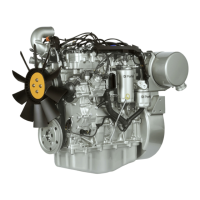
High Pressure Fuel Lines
Contact with high pressure fuel may cause fluid
penetration and burn hazards. High pressure fuel
spray may cause a fire hazard. Failure to follow
these inspection, maintenance and service in-
structions may cause personal injury or death.
After the engine has stopped, you must wait for 10
minutes in order to allow the fuel pressure to be
purged from the high-pressure fuel lines before any
service or repair is performed on the engine fuel lines.
If necessary, perform minor adjustments. Repair any
leaks from the low-pressure fuel system and from the
cooling, lubrication, or air systems. Replace any high-
pressure fuel line that has leaked. Refer to
Disassembly and Assembly Manual, “Fuel Injection
Lines - Install”.
If you inspect the engine in operation, always use the
proper inspection procedure in order to avoid a fluid
penetration hazard. Refer to Operation and
Maintenance Manual, “General hazard Information”.
Visually inspect the high-pressure fuel lines for
damage or signs of fuel leakage. Replace any
damaged high-pressure fuel lines or high-pressure
fuel lines that have leaked.
Ensure that all clips on the high-pressure fuel lines
are in place and that the clips are not loose.
• Inspect the rest of the fuel system for leaks. Look
for loose fuel line clamps.
• Drain the water and the sediment from the fuel
tank on a daily basis in order to ensure that only
clean fuel enters the fuel system.
• Inspect the wiring and the wiring harnesses for
loose connections and for worn wires or frayed
wires. Check for any loose tie-wraps or missing tie-
wraps.
• Inspect the ground strap for a good connection
and for good condition.
• Disconnect any battery chargers that are not
protected against the current drain of the starting
motor. Check the condition and the electrolyte
level of the batteries, unless the engine is
equipped with a maintenance free battery.
• Check the condition of the gauges. Replace any
gauges that are cracked. Replace any gauge that
cannot be calibrated.
i04406817
Water Pump - Inspect
A failed water pump may cause severe engine
overheating problems that could result in the following
conditions:
• Cracks in the cylinder head
• A piston seizure
• Other potential damage to the engine
Illustration 72 g02601196
Typical example
(1) Weep hole
Note: The water pump seals are lubricated by the
coolant in the cooling system.
Visually inspect the water pump for leaks.
Note: If engine coolant enters the engine lubricating
system, the lubricating oil and the engine oil filter
must be replaced. Draining will remove any
contaminate and will prevent any irregular oil
samples.
In order to install a new water pump, refer to the
Disassembly and Assembly Manual, “Water Pump -
Remove and Install”.
SEBU8726 111
Maintenance Recommendations
Water Pump - Inspect


 To Next Page