4
30 User’s Handbook, TPD 1285E, Issue 2
3.152
Self-vent method to eliminate air from the fuel system
If the engine has been stopped by air in the fuel system:
Ensure that fuel has been added to the tank or that the leakage has been corrected.
1 If a manual stop control is fitted, ensure that it is in the “run” position.
2 Operate the starter motor until the engine starts.
If the system or a component in the system has been drained:
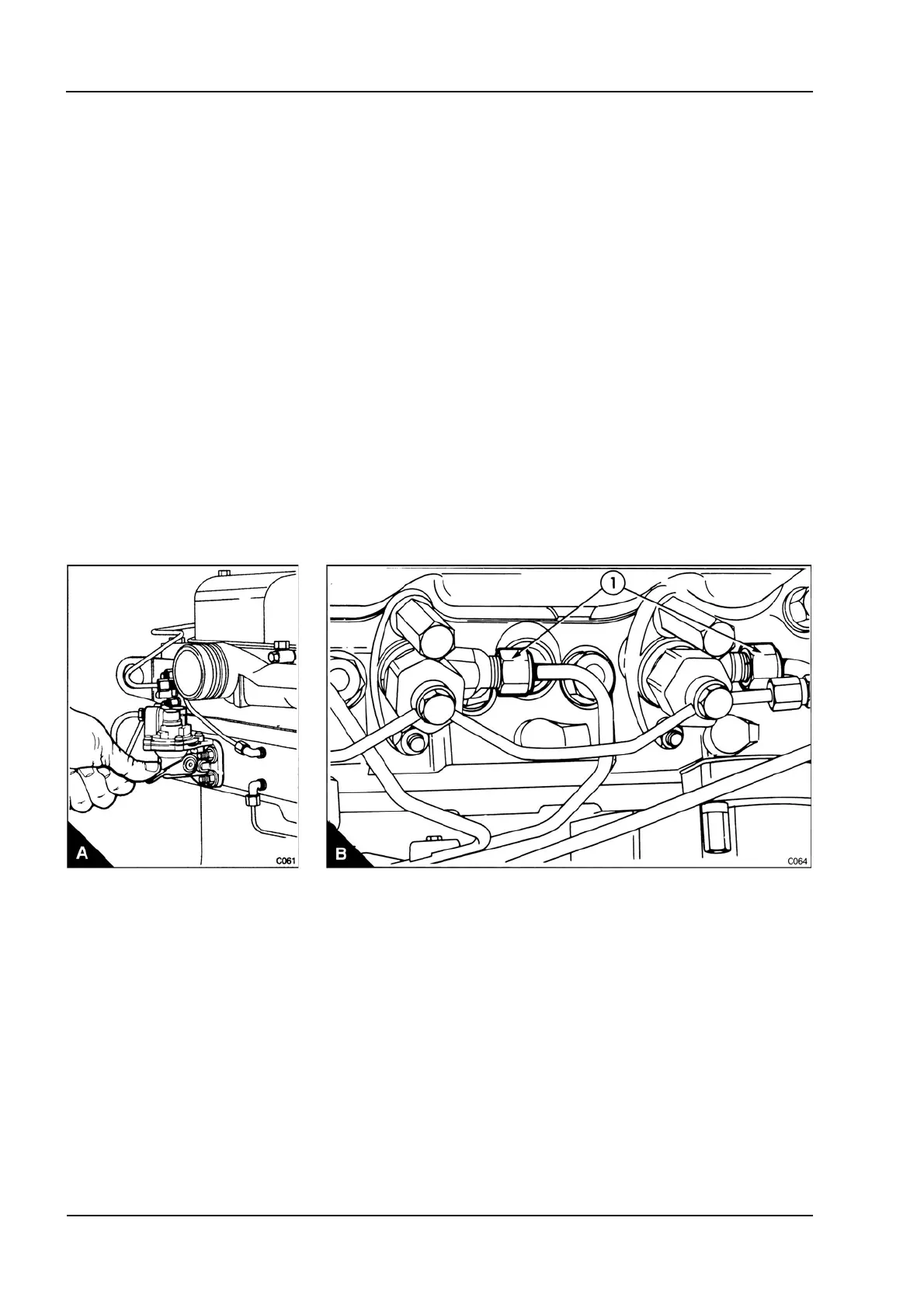
1 Release the vent plug on the fuel filter head. Operate the priming lever of the fuel lift pump (A) until fuel free
of air comes from the vent plug. Tighten the vent plug. If the drive cam of the fuel lift pump is at the point of
maximum lift, it will not be possible to operate the priming lever. In this situation the crankshaft must be turned
one revolution.
Warning! Do not tighten the nuts of the high pressure pipes more than the recommended torque tension. If
there is a leakage from the union nut ensure that the pipe is correctly aligned with the atomiser inlet. Do not
tighten the atomiser union nut more, as this can cause a restriction at the end of the pipe. This can affect the
fuel delivery.
2 Loosen the high-pressure connections (B1) at the atomisers. Ensure that the manual stop control, if one is
fitted, is in the “run” position. Operate the starter motor until fuel, free of air, comes from the pipe connections.
Tighten the connections to 22 Nm (2,2 kgf m).
3 The engine is now ready to start.
Note: If the engine runs correctly for a short time and then stops or runs roughly, check for air in the fuel
system. If there is air in the fuel system, there is probably a leak in the low pressure system.
This document has been printed from SPI². Not for Resale



 To Next Page