20
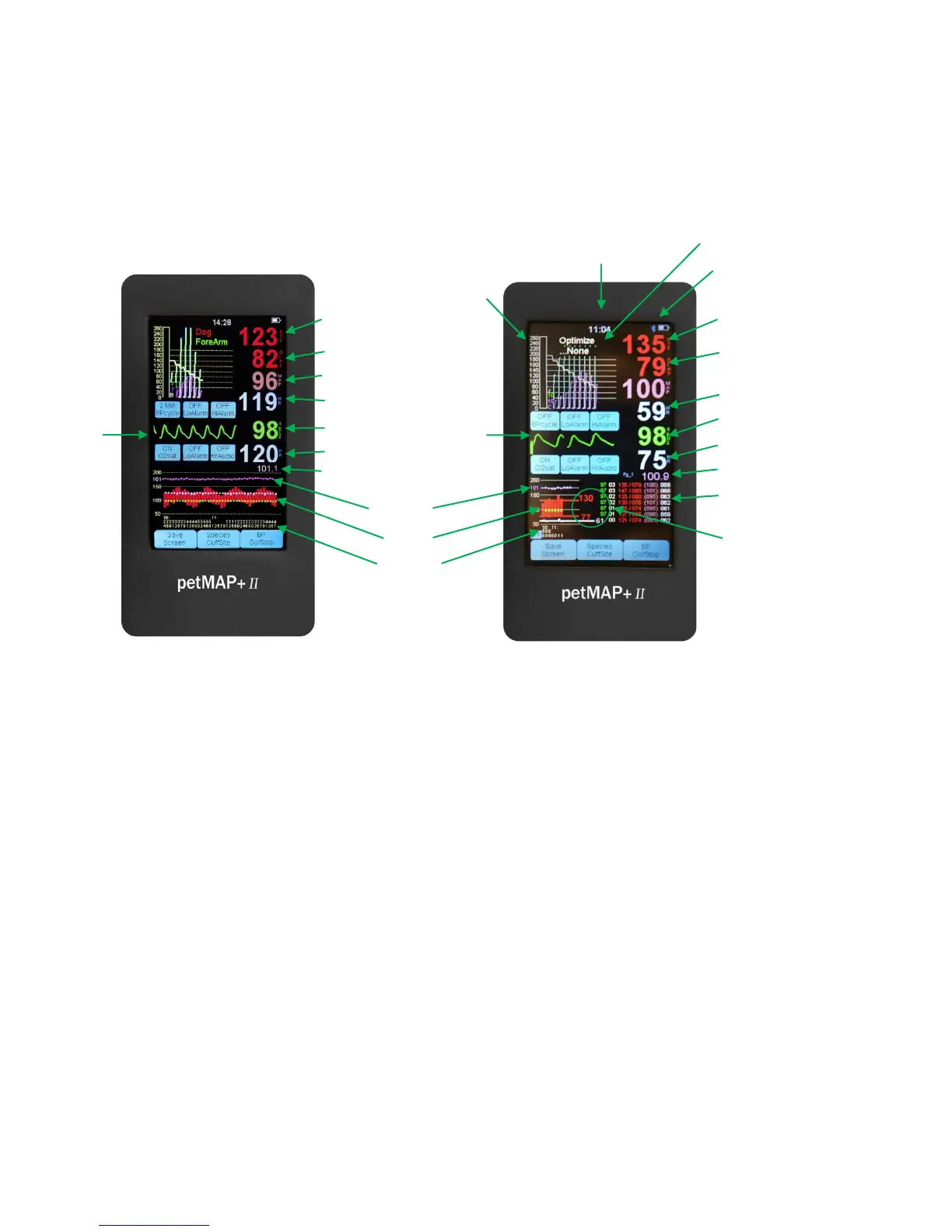
Operating Modes & Displays. Note the diagram for a description of petMAP+II display content.
The OR Mode is activated by selecting a measurement frequency using the “BPcycle” button. The
default mode is Clinic Mode (BPcycle is OFF) in which each BP reading must be started using the “BP
Go/Stop” button.
Touch Screen. The touch screen is the primary method for the user to interact with petMAP+II. The
display has several active areas (buttons) for the user to make selections, but some functions (alarm
cancelation, trend display and selection of Fahrenheit or Celsius temperature display) are invoked by
simply touching the screen in areas without buttons or by touching the temperature display directly.
Generally, selections are made by using a momentary press and release technique. A press and hold
technique on buttons will restore some controls to their OFF position. Some operators find using both
their fingertip and their fingernail at the same time easier than just using the pad of their finger tip since
this fingernail technique allows better visibility of the text displayed on the button. However, any
technique is acceptable as long as nothing sharp is used to press the buttons on the screen.
Time of Day. Time of Day is displayed below the graphical trend in three lines where the top line is the
hour of day and the next two lines are minutes.
BP Trend. The BP trend is displayed as a bar where the top of the bar is the systolic pressure and the
bottom of the bar is the diastolic pressure. Heart rate is displayed in white.
Measurement History. The format for the measurement history is minute of measurement, systolic
value, diastolic value, MAP value (in parenthesis) and heart rate. The top value is the most recent.
Nominal Session
Value (NSV)
OR MODE
BP cycle set
CLINIC MODE
Systolic BP
Diastolic BP
Mean Arterial Pressure
Heart rate (from BP)
SpO
2
SpO2 Heart rate
Temperature
Systolic BP
Diastolic BP
Heart rate (from BP)
SpO
2
SpO2 Heart rate
Measurement History
Temperature
Battery status
Species, Cuff site setting
Cuff
Pressure
BP Trend
Temperature
Trend
Time of Day
SpO2 pleth
wave form
SpO2 pleth
wave form



 To Next Page