EasyManua.ls Logo

Pfaff creative 1472 - Page 131

Pfaff creative 1472
252 pages
Print Icon
To Next Page IconTo Next Page
To Previous Page IconTo Previous Page
Loading...
‘—
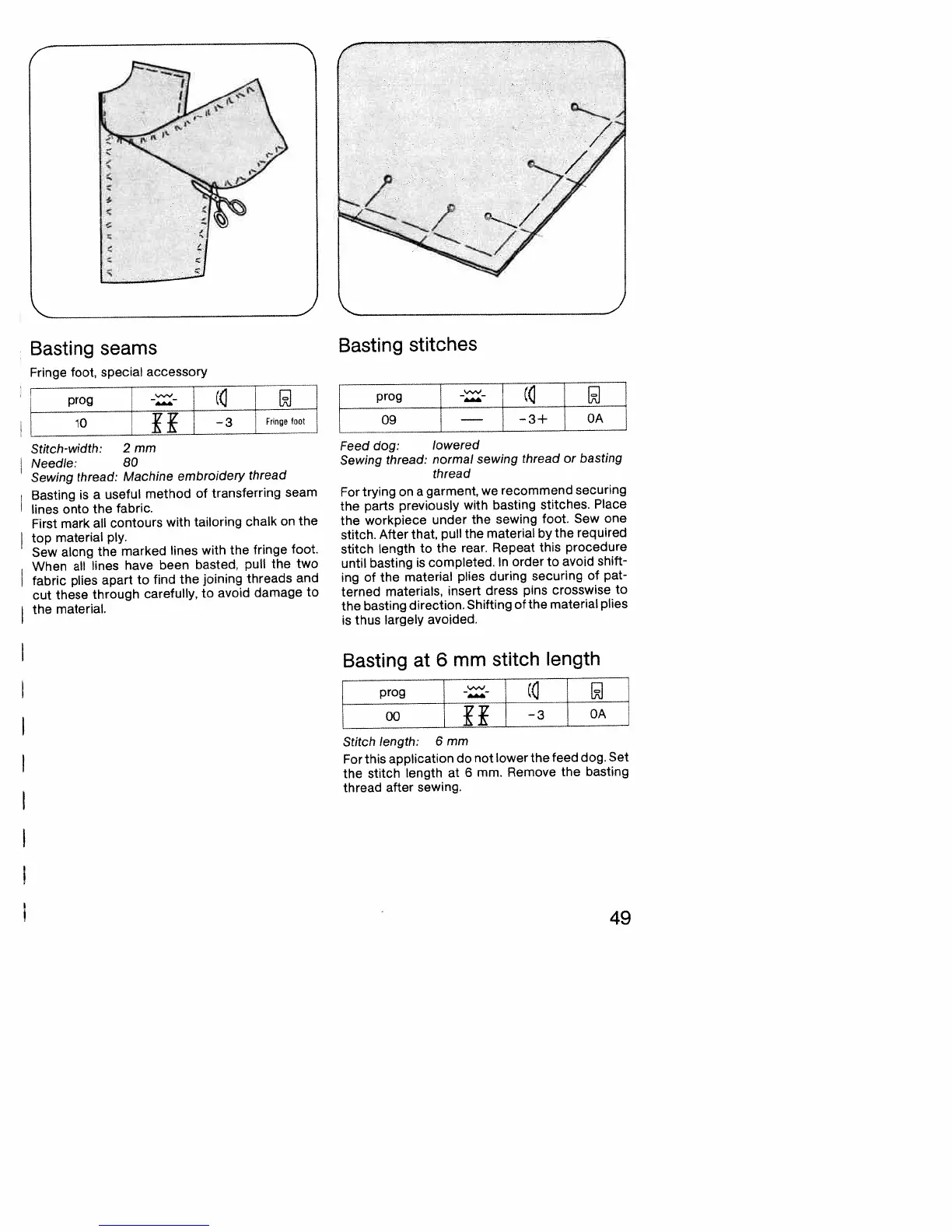
Basting
seams
Fringe
foot,
special
accessory
prog
--
(
10
K
K
—3
Ennge
foot
Stitch-width:
2
mm
Needle:
80
Sewing
thread:
Machine
embroider,’
thread
Basting
is
a
useful
method
of
transferring
seam
lines
onto
the
fabric.
First
mark
all
contours
with
tailoring
chalk
on
the
top
material
ply.
Sew
along
the
marked
lines
with
the
fringe
foot.
When
all
lines
have
been
basted,
pull
the
two
I
fabric
plies
apart
to
find
the
joining
threads
and
cut
these
through
carefully,
to
avoid
damage
to
the
material.
prog
--
ccj
09
-3+
GA
Feed
dog:
lowered
Sewing
thread:
normal
sewing
thread
or
basting
thread
For
trying
on
a
garment,
we
recommend
securing
the
parts
previously
with
basting
stitches.
Place
the
workpiece
under
the
sewing
foot.
Sew
one
stitch.
After
that,
pull
the
material
by
the
required
stitch
length
to
the
rear.
Repeat
this
procedure
until
basting
is
completed.
In
order
to
avoid
shift
ing
of
the
material
plies
during
securing
of
pat
terned
materials,
insert
dress
pins
crosswise
to
the
basting
direction.
Shifting
of
the
material
plies
is
thus
largely
avoided.
Basting
at
6
mm
stitch
length
prog
--
Co
00
KK
-3
GA
Stitch
length:
6
mm
For
this
application
do
not
lower
the
feed
dog.
Set
the
stitch
length
at
6
mm.
Remove
the
basting
thread
after
sewing.
Basting
stitches
49

Table of Contents

Related product manuals