P.O. Box 1306, Newport Beach, California 92663 • Phone: 714-751-0488 • Fax: 714-957-1621 • E-Mail: techservice@newmarpower.com
www.newmarpower.com
14
Routine Checks and Maintenance
Batteries should periodically be “exercised” (slowly discharged
and then recharged) to keep them in top condition. New batteries
may need to be exercised before they will be capable of their full
rating.
If your batteries are not the sealed type, distilled water should be
added to them whenever needed. The electrolyte should cover
the plates by about 1/2”, allowing a small air space at the top.
Do not fill the cells up to the filler cap as this could cause the
battery to sputter out electrolyte when it is being charged. Only
distilled water should be used never plain tap water. Tap water
contains chemicals and elements that can alter the properties of
the electrolyte, including specific gravity. Some chemicals may
also create an insulating coating on the battery plates which will
retard current flow.
The rate that water is lost by the battery is dependent on several
factors; battery condition, ambient temperature, battery use,
charge voltage, etc. It is normal for batteries which are not
maintenance-free to require topping off about once a month.
A battery’s state of charge may be monitored by checking the
specific gravity or by open circuit voltage. You may use the
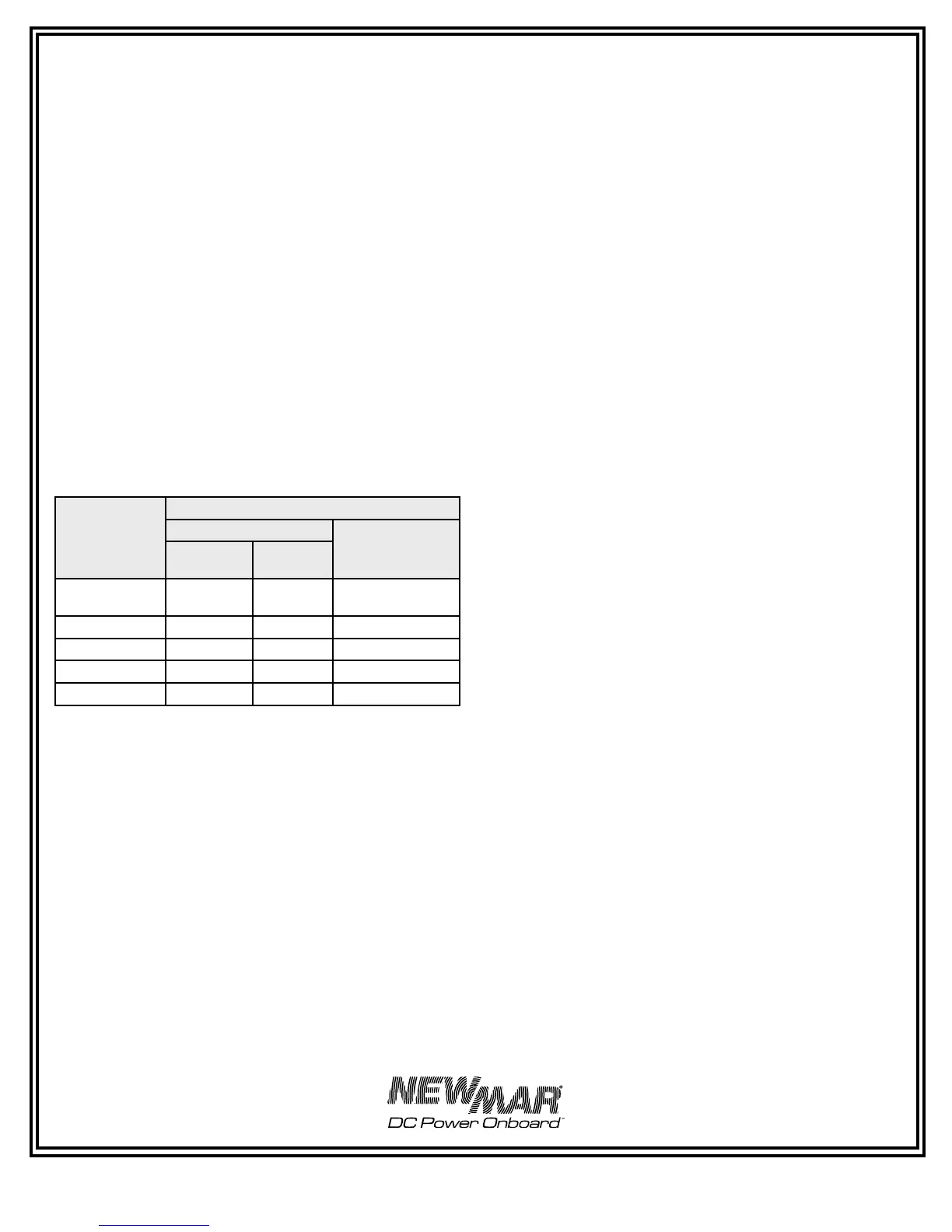
following table to evaluate the condition of your batteries:
Battery Condition Table
* Note: Wait at least 5 minutes after charging or discharging before
checking specific gravity or open circuit voltage. The battery’s
voltage needs to stabilize in order to get an accurate reading.
Troubleshooting Your Battery System
If your battery will not accept or hold a charge, one of the
following conditions may exist:
1. A BAD BATTERY. You may have a battery with an open or
shorted cell, a battery without any “life” left. Check by charging
the battery until all cells have a specific gravity of 1.225 or greater
at 80° F. If you are unable to obtain 1.225 in each cell, replace the
battery.
2. A BAD BATTERY CHARGER. If the battery open circuit voltage
is low and/or the hydrometer indicates your batteries are low, the
battery charger should be providing current to the batteries. If it is
not, check the input fuse and check to see that you have charging
voltage on the output with no battery attached. Note: You will not
get an accurate voltage reading on the output of the charger with
no batteries attached. This is checked merely to ensure that you do
not have an open circuit on the output.
The battery charger has a thermal power reduction circuit to
protect the charger from overheating. If you suspect this is the
case, refer to the INSTALLATION section for information about
proper charger location.
3. ELECTRICAL LEAKAGE. You may have a previously
unsuspected source of current drain from the battery. To check
for a leakage of this sort, disconnect the battery ground cable
and connect an ammeter between the negative battery post
and ground. If you have a reading over .1 amp, there is a source
of current drain from the batteries which must be located and
removed.
IX) REFERENCE APPENDIX
• For more information about boat wiring to conform to U.S. Coast
Guard regulations, write:
Superintendent of Documents
Government Printing Office
Washington, DC 20402
Request: 33 CFR 183 Subpart I
• For information about American Boat and Yacht Council
recommendations for boat wiring, write to:
American Boat and Yacht Council
3069 Soloman’s Island Road
Edgewater, MD 21037
Request: Standards and Recommended
Practices for Small Craft.
AC & DC systems: Section E11
Battery Chargers and Inverters: Section A-31
• For additional installation instructions, refer to:
ANSI NFPA 302
Specific Gravity
Measured by
Hydrometer
State of
Open Circuit Voltage Discharge @ 80° F
12 Volt
System
24 Volt
System
1.265 12.6 or
more
25.2 or
more
Fully Charged
1.225 12.4 24.8 25 % Discharged
1.190 12.2 24.4 50 % Discharged
1.155 12.0 24.0 75 % Discharged
1.120 11.7 or less 23.4 or less 100 % Discharged



 To Next Page