Instructions for Use | Alarms and System Messages
Alarms and System Messages 50
The flow from the device at the end of the expiratory phase is greater than a threshold based on a
typical flow that would result if a 0.25” diameter orifice leak were present in the circuit.
REBREATHING DETECTED
The ventilator detects the potential for the inhalation of exhaled gases. Rebreathing is detected at 3
consecutive breaths for passive circuits and 6 consecutive breaths for Active PAP, Active Flow, or Dual
Check for a partially occluded exhalation port or increase expiratory leak flow.
Ensure the exhalation valve is attached.
performance
during active
The alarm is automatically resolved when exhaled air returns to a non-hazardous level for 6
consecutive breaths.
Device will continue to operate.
summary
This alarm is based on an estimation of the inhaled fraction of carbon dioxide (FiCO
2
the ventilator assigns a percentage of FiCO
2.
When the sum of the percentages for the most recent
breaths exceeds 30%, the alarm is announced. This method of using a running sum of concentration
for the alarm reporting results in a shorter alarm delay when there are higher concentrations of FiCO
2
.
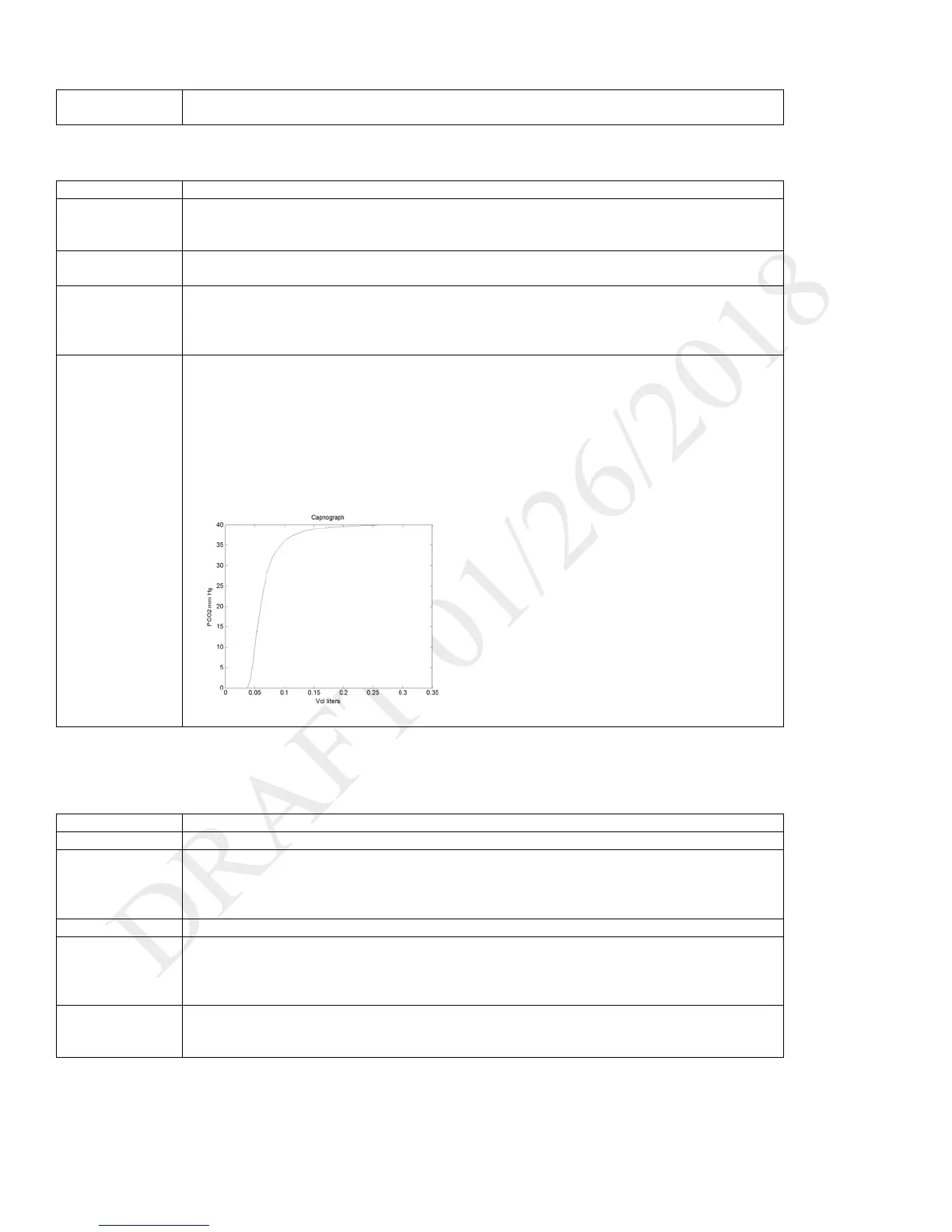
The concentration estimate is based on nominal volumetric capnography curves, measured flow in the
inhalation limb, and patient tidal volume. Any three breaths without rebreathing resets the sum of
percentages to zero.
This figure shows the assumed shape of the capnograph for a given volume of exhaled gases.
VOLUME UNDER DELIVERY
A system limit is reached and the set volume cannot be reached for 3 consecutive breaths.
Check the patient. Verify that the circuit and airway are clear of obstruction. Verify that the high
pressure alarm limit is sufficient. Review all settings including Inspiratory Time, Tidal Volume, and Flow
Pattern. Verify that patient and ventilator are synchronous by examining the waveforms and adjusting
The mode is A/C-VC or SIMV-VC.
performance
during active
Device will continue to operate, attempting to deliver the set therapy
All monitored parameters and alarms will continue to function.
summary
In modes designed to regulate the tidal volume on each breath such as AC-VC or SIMV-VC, the alarm is
generated when the inhaled tidal volume is less than or equal to 85% of the tidal volume setting for 3


 To Next Page