BALANCING
1. It is critical that your airplane be balanced
correctly. Improper balance will cause your
plane to lose control and crash.
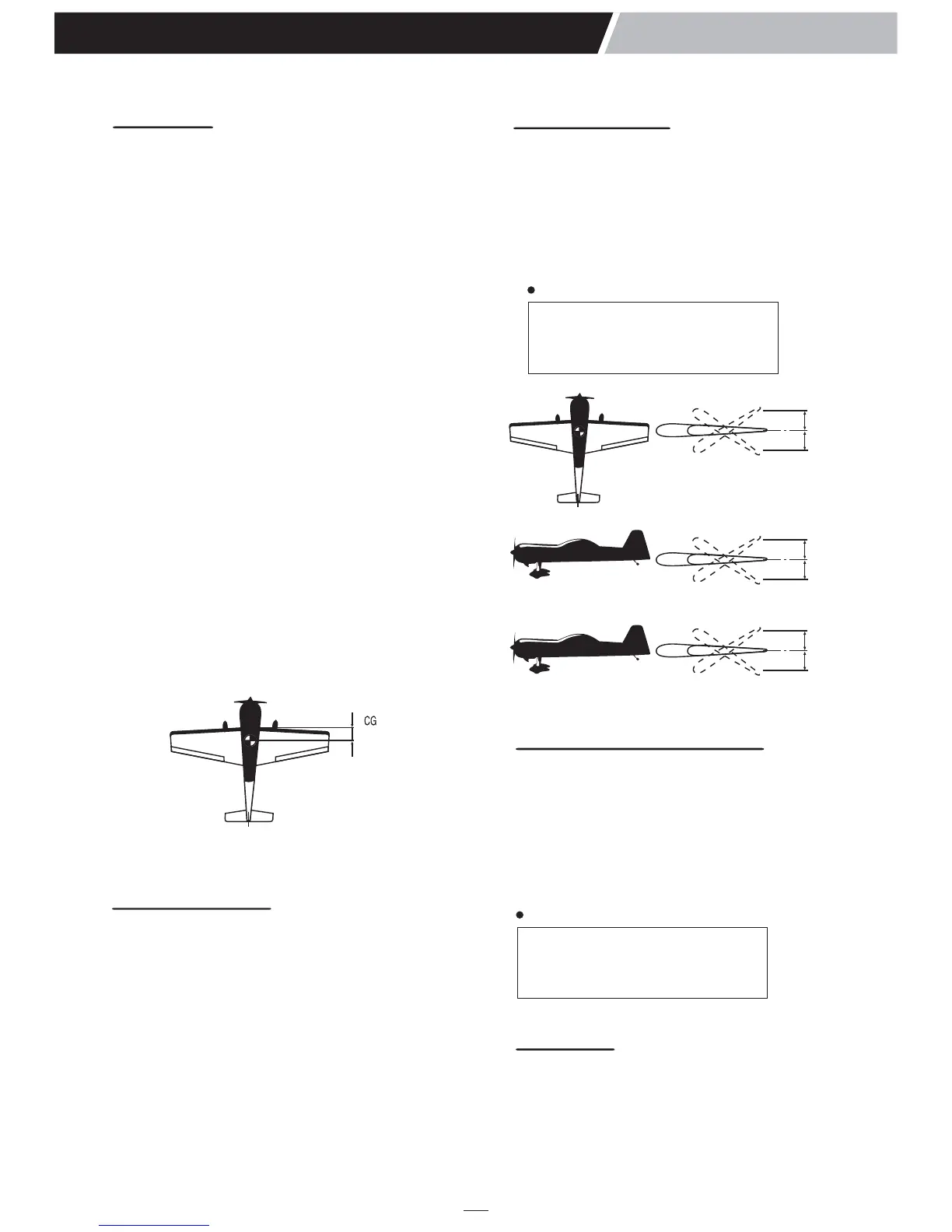
THE CENTER OF GRAVITY IS LOCATED
125mm BACK FROM THE LEADING EDGE
OF THE WING, AT THE FUSELAGE. This
location is recommended for initial test flying
and trimming. There is a 5mm margin forward
and aft. BALANCE A PLANE UPSIDE DOWN
WITH THE FUEL TANK EMPTY.
2. Mount the wing to the fuselage. Using a couple
of pieces of masking tape, place them on the
top side of the wing 125mm back from the
leading edge, at the fuselage sides.
3. Turn the airplane upside down. Place your
fingers on the masking tape and carefully lift
the plane .
4. If the nose of the plane falls, the plane is nose
heavy. To correct this first move the battery
pack further back in the fuselage. If this is not
possible or does not correct it, stick small
amounts of lead weight on the fuselage under
the horizontal stabilizer. If the tail of the plane
falls, the plane is tail heavy. To correct this,
move the battery and receiver forward or if this
is not possible, stick weight into the firewall.
When balanced correctly, the airplane should
sit level or slightly nose down when you lift it
up with your fingers.
125mm
LATERAL BALANCE
After you have balanced a plane on the C.G. You
should laterally balance it. Doing this will help the
airplane track straighter.
5. Turn the airplane upside down. Attach one loop
of heavy string to the engine crankshaft and
one to the tail wheel wire. With the wings level,
carefully lift the airplane by the string. This may
require two people to make it easier.
6. If one side of the wing fall, that side is heavier
than the opposite. Add small amounts of lead
weight to the bottom side of the lighter wing
half's wing tip. Follow this procedure until the
wing stays level when you lift the airplane.
14
EXTRA 300S
Instruction Manual
3d sERVOS
The large control throws require servos with
great centering. The digital servos are second to
none in this department. Digital servos such as
the Futaba S9250 should be used on all control
surfaces of this airplane for optimum
performance.
Ailerons : 15mm up 15mm down
Elevator : 15mm up 15mm down
Rudder : 20mm right 20mm left
Aileron Control
15mm
15mm
Rudder Control
20mm
20mm
Elevator Control
15mm
15mm
CONTROL THROWS
1. We highly recommend setting up a plane using
the control throws listed.
2. The control throws should be measured at the
widest point of each control surface.
3. Check to be sure the control surfaces move in the
correct directions.
LOW RATE
3-D PERFORMANCE SETTINGS
The EXTRA 300S will perform 3-D aerobatics
easily if you use the largest engines
recommended within the engine range. If you
setup your airplane to do 3D maneuvers, you
will need to be throttle conscious; that is,
never apply full throttle on straight and level
flying or in dives to prevent flutter.
Ailerons : 45mm up 45mm down
Elevator : 40mm up 40mm down
Rudder : 45mm right 45mm left
HIGH RATE (FOR 3D)



 To Next Page