English
27
H07024510 / DT2000575 - Rev. 00
* Approximate values.
It is a good rule to purchase timber during the summer (June-July), since woods are cut down mostly in the autumn and you can therefore
be sure that the timber has already been seasoned for approximately 1 year.
Firewood can be classified in two qualities: “good” and “mediocre or poor".
This classification is according to the heat yield of the wood, the longest flame time it provides, its composition and density.
Good fuels
- Recommended timber comes from the family of broadleaf
hardwoods: beech, hornbeam, oak, false acacia, ash, birch,
maple, elm.
- All low-resin and close-grained woods (that is hard and heavy
timber) are most suitable, since they provide the stove with a
steady, continuous flame.
Mediocre or poor fuels
- Timber that is not recommended comes from the family of conifers,
willow, poplar and alder. These light soft woods are resinous and
therefore create more soot, few embers and incandescent sparks,
while requiring more frequent cleaning of the flue and the firebox.
- Another characteristic of softwood is that it gives a lively but short-
lived flame and the consumption is higher for the same heat output.
Unsuitable fuels
- Never use wet wood, tarred wood or pellets.
- It is also best not to use: refuse (rubbish), waste paper; paper briquettes; plywood or chipboard; fibreboard; packaging materials; painted
wood or wood coated with synthetic material, plastic laminates, cardboard or milk cartons.
Under no circumstances use liquid fuel of any kind whatsoever.
All these materials or similar ones could be hazardous for the user, damage the firebox, the flue connection and the flue, and, last
but not least, pollute the environment.
5.0 USE
DT2010329-00
D
T2010043-00
5.1 FUEL
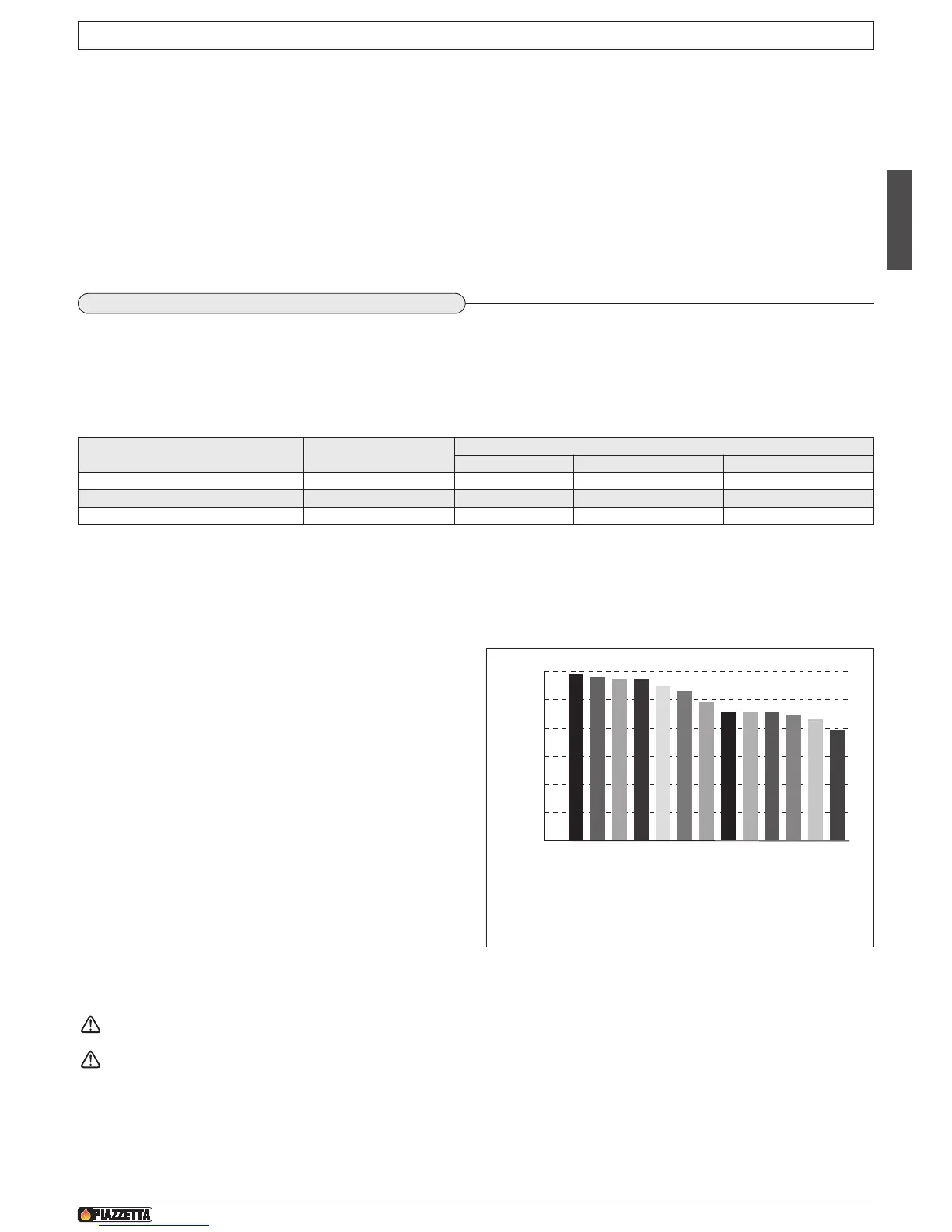
Use well-seasoned and dry wood with less than 20% moisture content.
Wood that is ready to burn must have been dried in the open air sheltered from rain or snow for at least 2 years after having been cut.
The lower the moisture content of the wood the higher its heating power. Freshly cut wood has 50% less heat value than dry wood.
Burning wood that is too wet means wasting most of the calories for evaporation of the water contained in it and, in particular, the walls of
the combustion chamber and the flue become fouled and encrusted thereby affecting efficiency.
The table below shows how the heating power decreases as the moisture content increases.
Certain basic facts can be all-important for best performance and getting the most out of your appliance. Please find below some basic
information intended to be of use with regard to the choice of firewood, the adjustment of the dampers and proper operation of the appliance.
During operation, some parts of the appliance (door, handle, dampers, surround) can reach high temperatures. Therefore exercise great
c
are and take all necessary precautions.
When you need to add wood to the firebox or to adjust the air flow, use the glove or the hand protector provided.
If the door of the product fails to close automatically, operation with the firebox open will only be possible with constant checking of the flame.
D
T2010055-02


 To Next Page