English
33
H07024510 / DT2000575 - Rev. 00
DT2010700-00
6.5 CLEANING THE GLASS (DAILY)
If the appliance is very slow to heat up in the ignition phase due to fuel that isn’t completely dry, this is likely to cause a build-up of tar on
the glass. This will eventually burn off when the appliance is operating at full capacity. If the tar is left to build up over a long period it will
require more effort to remove. We therefore recommend that the glass be cleaned daily before lighting the stove.
T
he glass should be cleaned when cold using ammonia-based degreasing agents and not corrosive substances such as solvents.
Do not use any material that could scratch or spoil the glass, as scratches may develop into cracks or breaks.
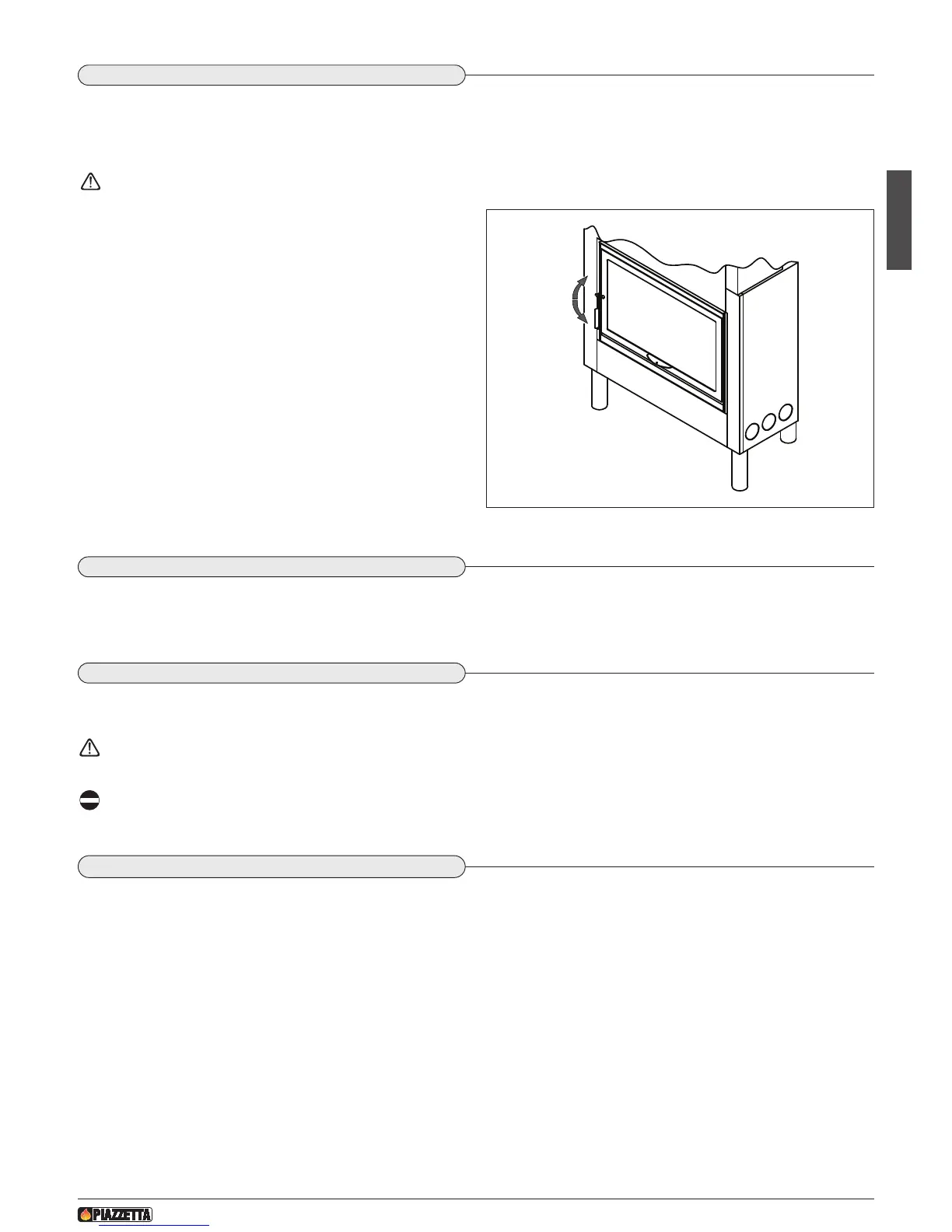
Only for the purpose of cleaning the glass, the hinged-type door may
b
e opened using the door handle tool provided in the kit. Insert the
door handle tool into the relative hole in the door and turn to open
In case of breakage
Every one of our hearths comes with a door fitted with a 4 mm thick
pyroceram panel resistant to thermal shock up to 750°C. This can
only be broken by heavy impact, such as banging the door too hard.
In the event of breakage replace with original Gruppo Piazzetta S.p.A.
parts only.
Do not operate the appliance if the glass is broked or cracked.
Seal control
Proper tightness of the door seal is essential for optimal product
performance. It is therefore recommended that the seals be checked
periodically or after a long period of use for signs of wear or damage.
If necessary replace them using Gruppo Piazzetta S.p.A. original
spare parts.
Fig. 40
D
T2031079-00
D
T2010049-04
6.7 DISPOSAL OF ASHES
Ash from natural (non-treated) wood burned in stoves or open fireboxes is composed mainly of calcium, silicon, potassium and magnesium
oxides. The ashes can therefore be used as a fertiliser for plants or in the garden, albeit not exceeding 2.6 kg per 10m
2
annually.
The ashes should be placed in a metal container with a sealed cover. The sealed container should be placed on a non-combustible
surface at a safe distance from combustible materials until the cinders have been completely extinguished.
Only when they have been fully extinguished can the ashes be thrown away with organic waste, assuming that nails or other non-
organic material are not present.
D
T2010063-00
6.6 CLEANING THE GRATE AND THE ASH TRAY
The grate and the ash tray must be cleaned daily. Using the grate for a whole day contributes to the accumulation of ash or residual combustion
products. If cleaning is not done regularly there will be an excess of residues, which will affect appliance efficiency.
The ash tray also needs emptying regularly, because if it fills up and obstructs the grate grid it will cause appliance malfunction.
DT2010064-00
6.8 CLEANING ALUKER
®
The interior of the unit has been constructed from an innovative material called “Aluker”.
Aluker is based on substances that are completely non-toxic and is heat-resistant up to 1400°C.
In spite of its considerable strength it is not recommended that you throw large pieces of wood forcefully against the bricks.
Aluker darkens when the stove is first lit but returns to its natural colour gradually as the bricks warm up.
Some advice for optimum use of Aluker bricks:
- Don’t use water to put out the fire - leave the bricks to cool by themselves;
- Don’t scratch Aluker bricks with metal objects;
To clean Aluker bricks use an ordinary brush.


 To Next Page