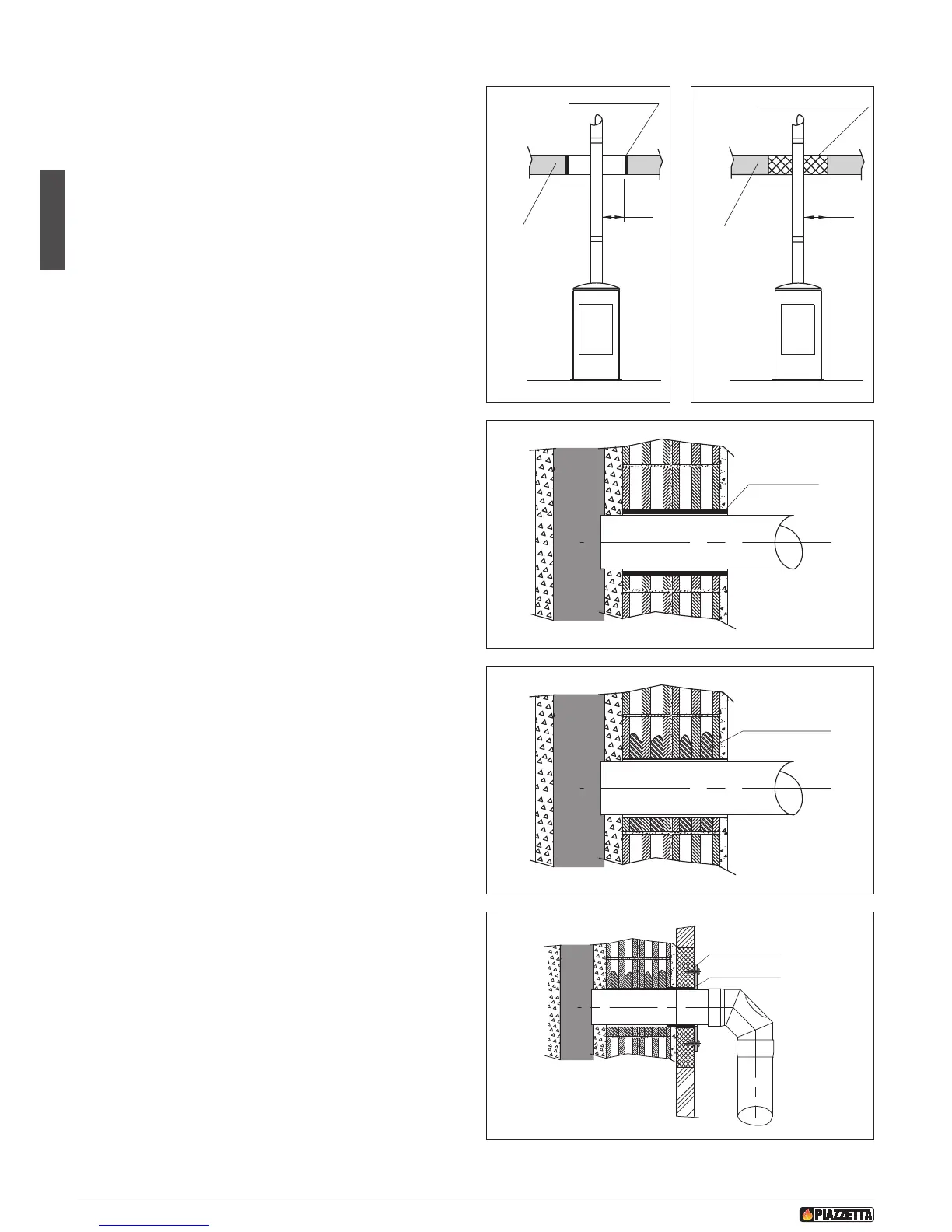
When connecting to the flue there must be a minimum clearance of
4
0 cm from building elements sensitive to heat or from combustible
materials (cladding, wooden beams or ceilings, etc.). See figures 17-
18-19-25-26.
If the flue assembly passes through elements or walls in heat-sensitive
combustible material or through load-bearing walls, create:
-
insulation of at least 20 cm around the flue pipe assembly (for ex-
ample cement mortar, lightweight concrete; Figures 21-25-26.
- otherwise the flue pipe assembly must remain at a safety distance
of 40 cm by inserting a tube of non-flammable and resilient mate-
r
ial. Figure 20.
If the flue pipe assembly passes through non-flammable masonry or
walls:
- the air gaps must be filled with non-flammable, resilient material
with a reduced heat transmission capacity (e.g. lightweight con-
crete); Figure 23.
- otherwise the air gaps must be protected with special protective
tubes. Figure 22.
Check that the connection to the flue is properly sealed to ensure
there is no flue gas leak when the appliance is operating in a vac-
uum.
Check that the pipe is not inserted too far into the flue, thereby re-
stricting the passage of flue gases. Figure 22-23.


 To Next Page