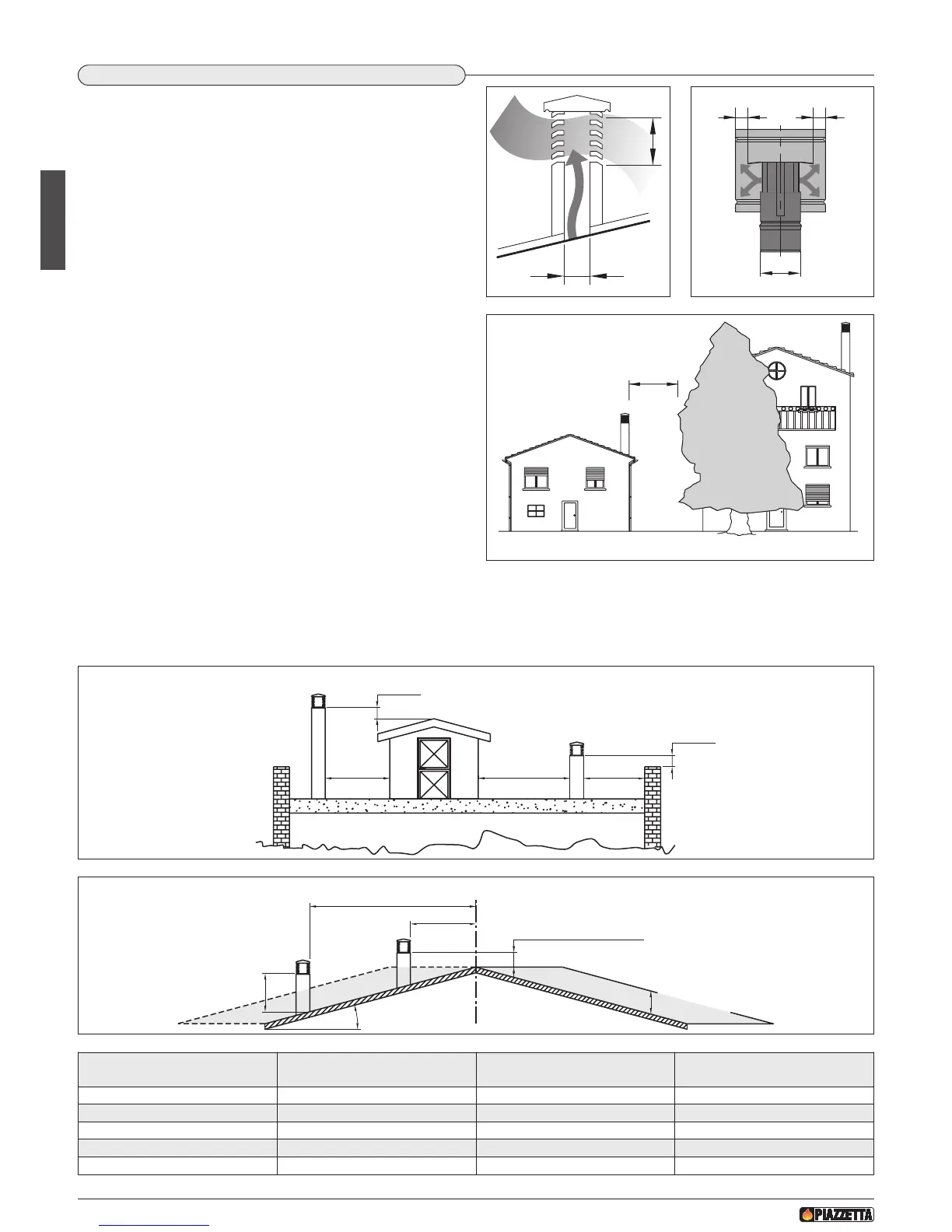
The chimney stack is a device fitted on the top of the chimney that is de-
signed to aid dispersion of the products of combustion in the atmos-
phere.
T
he chimney stack must comply with the following requirements:
- it must have an internal section and shape the same as the flue (A);
- it must have a useful outlet section (B) of not less than twice that of
the flue (A);
- the part of the chimney that emerges from the roof or remains in con-
t
act with the outside (e.g. in the case of a flat roof), must be covered
with brick or tile elements and in any case well insulated;
- It must be built in such a way as to prevent the penetration of rain,
snow and foreign matter into the flue and to ensure that in the event
of winds from all directions and angle, discharge of the combustion
products is assured (chimney stack with down-draught cowl).
Recommended distances for correct chimney operation.
To ensure trouble-free operation of the chimney and allow correct di-
lution of the products of combustion in the air, the chimney stack
must be installed at the distances given below:
- 6-8 metres from any buildings or other obstacles that are higher
than the chimney stack;
- 50 centimetres higher than any obstacles located at a distance less
than 5 metres;
- outside the reflux area. The size and shape of this area differ
according to the angle of inclination of the roof and it is therefore
necessary to adopt the minimum heights shown below.
Example: Check the slope of the roof (column
α
), and the anticipated distance of the chimney stack from the axis of the ridge (column A);
if the distance is greater than “A” the height of the chimney stack may be read in (column H); if the distance is less than “A” the chimney
stack must rise above the ridge by 0.5 metres.


 To Next Page