PIPER
SENECA
II
SERVICE
MANUAL
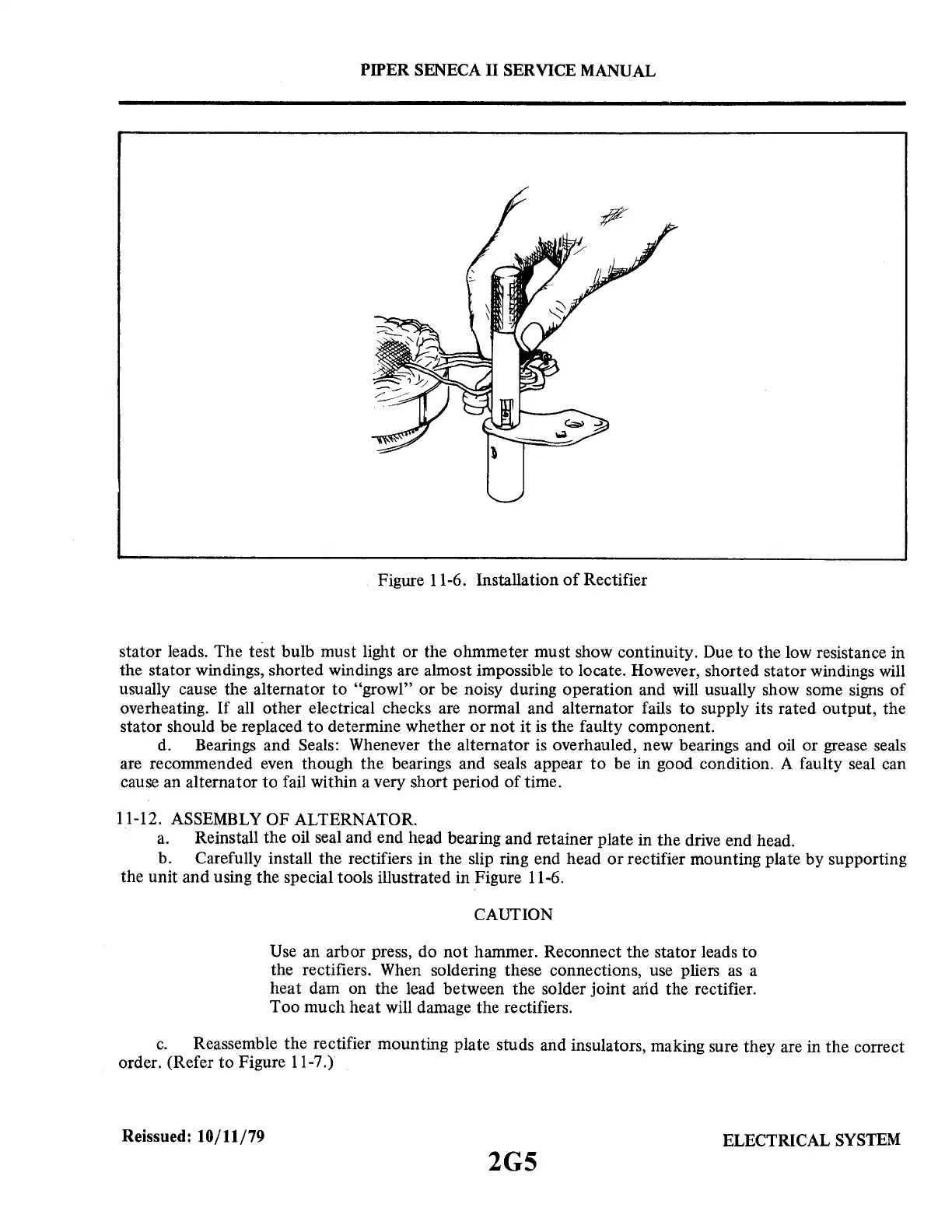
Figure 11-6. Installation
of
Rectifier
stator leads. The test bulb must light or the ohmmeter must show continuity. Due
to
the low resistance in
the stator windings, shorted windings are almost impossible to locate. However, shorted stator windings will
usually cause the alternator
to
"growl"
or
be noisy during operation and will usually show some signs
of
overheating.
If
all other electrical checks are normal and alternator fails
to
supply its rated output, the
stator should be replaced
to
determine whether
or
not
it
is
the faulty component.
d. Bearings and Seals: Whenever
the
alternator
is
overhauled, new bearings and oil
or
grease seals
are recommended even though the bearings and seals appear
to
be in good condition. A faulty seal can
cause an alternator
to
fail within a very short period
of
time.
11-12. ASSEMBLY OF ALTERNATOR.
a. Reinstall the oil seal and end head bearing and retainer plate in
the
drive end head.
b. Carefully install the rectifiers in the slip ring end head
or
rectifier mounting plate by supporting
the unit and using the special tools illustrated in Figure 11-6.
CAUTION
Use an arbor press, do
not
hammer. Reconnect the stator leads to
the rectifiers. When soldering these connections, use pliers
as
a
heat dam on the lead between the solder
joint
arid the rectifier.
Too much heat will damage the rectifiers.
c.
Reassemble the rectifier mounting plate studs and insulators, making sure they are in the correct
order. (Refer
to
Figure 11-7 .)
Reissued: 10/11/79
ELECTRICAL
SYSTEM
2G5






 To Next Page