
 Need help?
Do you have a question about the Polycom agilephone agilis VVX-1500 and is the answer not in the manual?
Your phone has a touch-sensitive screen. Tap menu items, soft keys, and fields. Drag to scroll.
Phone handles one active call and multiple calls on hold. Line keys display status.
Phone displays video in two windows: PIP and larger window. Swap windows during calls.
Instructions for navigating menus, selecting items, and scrolling using soft keys and touch screen gestures.
How to answer calls using the handset, speakerphone, or headset.
How to handle an incoming call when already on an active call using the Answer soft key.
Instructions on how to end a call using the End Call soft key or Line Key.
How to start/stop video, use full screen, swap windows, and exit video options during a call.
How to mute and unmute the microphone during a call using a specific key.
How to place a call on hold and resume a held call using soft keys.
Steps to transfer an active call to another party.
How to enable or disable call forwarding for different scenarios like always, no answer, or busy.
How to quickly dial contacts using speed dial keys or index numbers.
Steps to set up a conference call with multiple parties by calling and using conference soft keys.
How to access and use call lists (missed, received, placed) to redial or save contacts.
How to lock your phone for security and unlock it using a password.
How to add, edit, and search for contacts in the phone's directory.
How to adjust handset, speakerphone, headset, and ringer volumes using physical buttons.
How to change the incoming ring tone for the phone or specific contacts.
How to set up a screen saver using pictures from a USB flash drive.
How to change the phone's background picture using pre-loaded images or USB files.
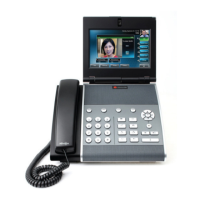
The Polycom VVX-1500 is a business media phone designed for enhanced communication, offering both audio and video capabilities. It features a touch-sensitive screen that serves as the primary interface for navigation and interaction. Users can tap menu items, soft keys (located along the bottom of the screen), and various fields displayed on the touch screen. The screen also supports touch-and-drag gestures for scrolling through lists, providing an intuitive user experience.
The phone is capable of managing one active call and multiple calls on hold simultaneously. The active call is prominently displayed in the center of the touch screen, while calls on hold appear in a row at the bottom. The device supports up to six lines, each assigned to a dedicated Line Key. These Line Keys are arranged in a column on the far-right of the touch screen. Unassigned Line Keys can be configured as Speed Dial Keys. The color of a Line Key indicates its status: green signifies dial tone, an incoming call, or an active call, while blue indicates no active call. Calls displayed on the touch screen are linked to the green Line Key. A vertical bar on the far-right of a Line Key acts as a status indicator, which can be solid green (dial tone available, dialing in progress, or active call), flashing green (incoming call), or flashing red (all calls on hold).
For video communication, the phone displays video in two windows: a small picture-in-picture (PIP) window in the top-right corner and a larger window in the center of the screen. By default, the near-site video (the user's video) appears in the PIP, and the far-site video appears in the larger window. During an active call, tapping the PIP swaps the video displays between the windows. When the near-site video is in the larger window, "Local Camera" is displayed. Users can also switch to full-screen mode by tapping the larger window, and then swap displays within full-screen mode by tapping the PIP. To return to normal viewing, the full-screen video can be tapped.
The phone features several icons to indicate call status: an active call without Polycom® HD Voice™, an active audio call with Polycom HD Voice, an active video call with Polycom HD Voice, an audio-only call, a video call, a call on hold, a conference call, and Do Not Disturb (DND). Other icons include Handset, Headset, Line Key (private and registered), Line Key (shared and registered), Messages, and Missed calls. Utility icons include Mute, Speakerphone, Speed Dial Key, USB flash drive attached and idle, Video stopped, and Video stopped and audio muted.
Navigating the touch screen is straightforward. Users can tap the home icon to enter the Main Menu or return to the idle screen. The Back soft key allows users to go back to the previous menu. Soft keys are selected by tapping them, and the More soft key reveals additional options. Scrolling through lists is done by pressing the touch screen where the list is displayed and dragging a finger up or down, or by tapping the up/down arrows. Items can be highlighted by scrolling and selected by tapping. To enter data into a field, users tap the field name, then the highlighted box. Values in drop-down lists can be scrolled through using the scroll arrows, and a value is selected by tapping its highlighted grey box.
To enter data, users tap the desired field and then the edit icon. A "keyboard" appears on the touch screen for input. Users can toggle between lowercase, uppercase, numerical, and titlecase modes using the abc, ABC, 123, or Abc soft keys. Special characters are accessed via the .&123 soft key, and alphabetic mode is restored with the abc soft key. Text in different languages can be entered using Latin, Katakana, Unicode, Cyrillic, or ASCII soft keys. To delete data, the cursor is positioned to the right of the character, and then the delete icon is tapped. Fields can be enabled or disabled, or field options chosen, by tapping the field name and then the highlighted box, selecting from a drop-down list.
Placing calls can be done by picking up the handset and entering the number via the touch screen or keypad. For speakerphone calls, the New Call soft key or a Line Key is tapped, and the number is entered. With a headset connected, the headset button is pressed, and the number is entered. From a locked phone, calls can be placed by tapping New Call, selecting a number, and then tapping Dial, but only authorized numbers can be dialed.
Answering calls involves picking up the handset, tapping the Answer soft key or the flashing green Line Key for speakerphone calls, or pressing the headset button for headset calls. If a call arrives while another call is active, a call-waiting beep sounds, and the incoming call is displayed. Tapping Answer places the original call on hold. Calls are ended by tapping the End Call soft key. The phone may be configured to allow ending active calls by tapping the associated Line Key.
Video usage requires opening the privacy shutter (above the touch screen) and adjusting the camera barrel (behind the camera). During a video call, tapping the Video soft key allows users to start or stop transmitting video, display full-screen video, or swap video displays. The Back soft key exits video options. Video transmission can be disabled by default through Settings > Basic > Video > Video Call Settings, setting Auto Start Video Tx to Disabled, and saving.
The microphone can be muted during a call by pressing the mute button, which glows red. Mute allows the user to hear other parties but prevents them from hearing the user. Pressing the mute button again turns it off.
Calls can be placed on hold by tapping the Hold soft key. To resume a call, the Resume soft key is tapped. If multiple calls are on hold, the desired call is selected before tapping Resume. If more than three calls are on hold on a Line Key, the up/down arrows are used to select the call. Multiple Line Keys allow resuming the first call on hold on another Line Key by tapping its associated Line Key.
Call forwarding can be enabled from the idle screen by tapping Forward. If multiple lines exist, the desired line is selected. Users choose a forwarding type (Always, No Answer, or Busy), enter a forwarding number, and tap Enable. To disable, the Forward soft key is tapped, the line is selected, and Disable is tapped.
The last placed call can be redialed by pressing the Redial button. Speed Dial Keys (displayed with the contact's name) on the far-right of the touch screen allow quick dialing. Alternatively, the up arrow on the phone console is pressed, the contact is selected from the Speed Dial Information screen, and the call is automatically placed. Speed dial index numbers can be added or edited in the Contact Directory.
Do Not Disturb (DND) prevents the phone from ringing. It is enabled or disabled by pressing the DND button. If multiple lines exist, the desired line is selected, and Enable or Disable is tapped. When DND is enabled, the DND button glows red.
Conference calls can be set up with two other people. To start, the first party is called. Once they answer, the Conference soft key is tapped, placing the active call on hold. The second party is then called. When they answer, the Conference soft key is tapped again, joining all parties. During a conference, users can place it on hold, end it (keeping others connected), split it (placing all participants on hold), or start/stop near-site video transmission. An active call and a call on hold can be joined into a conference by tapping the Join soft key.
Conference participants can be managed by tapping the Manage soft key during a conference call. If the desired participant isn't selected, they are tapped (indicated by a white border). Options include muting the selected participant (Far Mute), making them the "active" participant for video exchange (Select Video), placing them on hold, removing them from the call, or viewing their information. The Back soft key exits conference management.
Call lists (Missed Calls, Received Calls, or Placed Calls) are accessed via the home icon > Features > Call Lists. Users can scroll through calls using the up/down arrows. Options include dialing the call, clearing it from the list, storing the contact in the Contact Directory, or viewing detailed information.
Voice/video mail is accessed by tapping the voicemail icon and following the prompts.
The phone's locking and unlocking feature allows only authorized calling and answering. To unlock or answer a call from a locked phone, the user password (default 123) is required. The password can be changed via home icon > Settings > Advanced > Change User Password. To lock the phone, home icon > Settings > Basic > Lock Phone is selected, and the desired handling for incoming calls is chosen. To unlock, the Unlock soft key is tapped from the idle screen, and the user password is entered.
Customizing the phone includes updating the Contact Directory. Contacts can be added or edited via home icon > Features > Contact Directory. The Add or Edit soft key is tapped, fields are updated, and Save is tapped. Contacts can be searched by tapping home icon > Features > Contact Directory > More > Search, entering characters, and tapping Search.
Volume can be adjusted during a call for the handset, speakerphone, or headset using the volume up/down buttons. Ringer volume is adjusted when the phone is idle using the volume up/down buttons.
Incoming ring tones can be changed via home icon > Settings > Basic > Ring Type. If multiple lines exist, the desired line is selected, and the preferred ring type is chosen and saved. A specific ring tone can be set for a contact by searching for the contact in the Contact Directory, tapping Edit, scrolling to Ring Type, selecting a ring type, and tapping Save.
A screen saver can display user pictures after a period of inactivity. Pictures must be on a USB flash drive, either in the root directory or a folder. The USB flash drive is attached to the USB port on the right side of the phone, behind a flip-down door. To set up a screen saver, home icon > Settings > Basic > Preferences > Picture Frame is selected. The folder name (if applicable) is entered in the Folder field, and the time per image is set. After saving, Screen Saver is selected, Enabled is chosen for the Screen Saver field, and the wait time before display is set. To disable, Screen Saver is selected, Disabled is chosen, and saved.
The background picture can be updated using a picture already on the phone or from a USB flash drive. To update, home icon > Settings > Basic > Preferences > Backgrounds is selected, the desired picture is tapped, and Select is tapped. To set a user's own picture as the background, ensure the picture is on the USB flash drive and the folder is specified (as for screen saver). Then, home icon > Picture Frame is selected, and the up/down arrows are used to display the desired picture, which is then tapped. The new background picture will display as "Local File" on the Backgrounds screen.
 General
| Lines | 6 |
|---|---|
| Bluetooth | No |
| Wi-Fi | No |
| Audio | HD Voice |
| Ethernet Ports | 2 (10/100/1000 Mbps) |
| Protocols | SIP |
| Codecs | G.711, G.722, G.729, iLBC |
| Power Supply | PoE (802.3af) |
| USB Ports | USB 2.0 |



 To Next Page