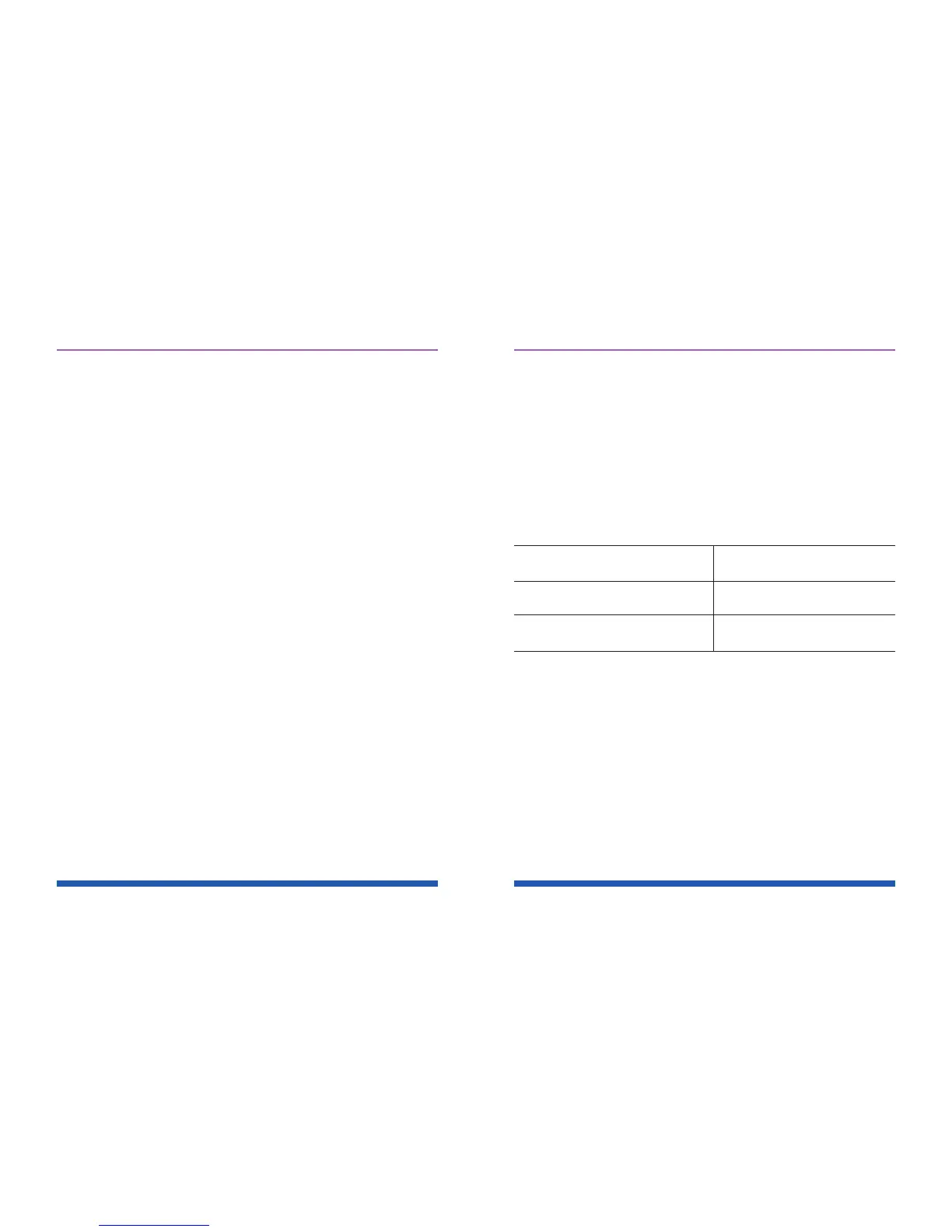
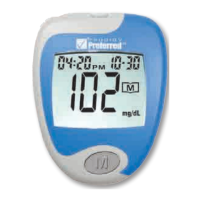
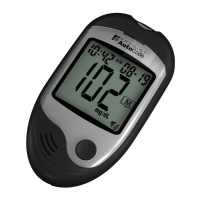
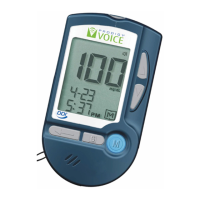
PRODIGY Pocket® Blood Glucose Meter PRODIGY
Pocket® Blood Glucose Meter
Owner’s Manual Owner’s Manual
References:
1
Surwit, R.S., and Feinglos,
M.N.: Diabetes Forecast (1988), April, 49-51.
2
Sacks, D.B:“Carbohydrates.” Burtis,C.A, and
Ashwood,E.R.(ed.),Tietz Textbook of Clinical
Chemistry. Philadelphia:W.B. Saunders Company
(1994),959.
Performance Characteristics
• Accuracy: ±15 mg/dL when glucose <75 mg/dL
±20% when glucose >75 mg/dL
• Precision: This study shows the CV
(correlation variation) is less
than 5%.
• The device has been certied to meet the
following standards:
98/79/EC, IEC 60601-1, IEC 61010-1,
IEC 60601-1-2, IEC61326, and ISO 15197
62 63
Expected Test Results
Please consult your physician to establish
your target ranges. The American Diabetes
Association (ADA) suggests the following targets
for most nonpregnant adults with diabetes.
More or less stringent goals may be appropriate
for each individual.
Glycemic control
Time of Day ADA suggested reading
Preprandial plasma glucose
(before a meal) 70–130 mg/dl
Postprandial plasma glucose
(after a meal) <180 mg/dl
Source: American Diabetes Association
(2012. http://www.diabetes.org/living-with-diabetes/
treatment-and-care/blood-glucose-control/checking-
your-blood-glucose.html)
Your Prodigy
®
meter is designed to help you
and your healthcare professional manage your
diabetes. You must always rely on your healthcare
professional to interpret your test results and to
decide how to treat your diabetes.


 To Next Page