
 Need help?
Do you have a question about the Qiagen TissueLyser II and is the answer not in the manual?
Details correct and safe usage, user qualifications, and approved accessories for the TissueLyser II.
Covers electrical hazards, lethal voltages, and safety precautions for operating the TissueLyser II safely.
Specifies environmental factors like explosive atmospheres, operating temperature, and humidity for safe operation.
Addresses handling of potentially infectious samples and outlines safe laboratory procedures.
Highlights hazards of chemicals and toxic fumes, requiring appropriate protective measures and ventilation.
Warns about moving parts and potential damage or injury if components are not securely attached.
Provides guidance on the proper disposal of used labware and waste according to local safety regulations.
Outlines the structure of the manual and the topics covered in each of its sections.
Defines the primary applications for the TissueLyser II, focusing on molecular biology processes.
Explains how improper adapter use can damage TissueLyser II clamps and recommends approved accessories.
Details the general competence and training needed for users to operate the TissueLyser II.
Explains the bead-milling technology used for sample disruption and homogenization by high-speed shaking.
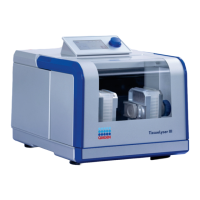
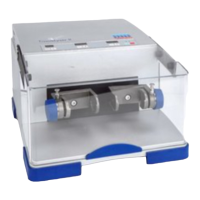
Describes the main features, oscillation frequency, clamps, and safety mechanism of the TissueLyser II.
Details the Adapter Set 2 x 24, its capacity for 48 samples, and cleaning instructions.
Details the Adapter Set 2 x 96, its capacity for 192 samples, and cleaning instructions.
Describes the stainless steel grinding jar set, its capacity for 2 samples, and disruption conditions.
Describes the Teflon grinding jar set, its capacity for 2 samples, and disruption conditions.
Details the single-bead dispensers, their sizes, and their capacity for dispensing beads into sample containers.
Details the 96-well bead dispensers, their sizes, and how they dispense beads into racks of collection microtubes.
Lists the available beads for the TissueLyser II by material, size, and catalog number.
Outlines the types of biological samples that can be disrupted and homogenized using the TissueLyser II.
Provides step-by-step instructions for unpacking the TissueLyser II and verifying its supplied contents.
Guides on how to remove the transport security device screws before operating the instrument.
Specifies the environmental and location requirements for installing and operating the TissueLyser II.
Covers power supply specifications, voltage regulation, surge protection, and proper grounding for the instrument.
Details how to safely transport and repack the TissueLyser II, emphasizing retaining original packaging.
Provides a step-by-step guide on how to securely install adapter sets or grinding jars into the TissueLyser II clamps.
Outlines the procedure for replacing the fuses in the TissueLyser II, including the required fuse type and location.
Guides users through the step-by-step process of disrupting samples using the TissueLyser II's controls.
Explains how to save and store up to nine disruption parameter sets for different applications.
Details how to view the instrument's accumulated operating time and its current software version.
Provides information regarding the warranty period and the scope of servicing for the TissueLyser II.
Describes routine cleaning and maintenance tasks required to ensure the reliable operation of the instrument.
Lists recommended disinfectants and detergents for cleaning the TissueLyser II and its accessories.
Provides general guidelines and precautions for cleaning the TissueLyser II and its components safely.
Outlines periodic checks for the limit switch and brake to ensure correct operation and safety.
Lists common error codes displayed by the TissueLyser II and provides suggested solutions and troubleshooting steps.
Presents detailed technical specifications of the TissueLyser II, including power, dimensions, and environmental conditions.
Provides information on the proper disposal of the TissueLyser II as electronic waste according to regulations.
States the company name and address and how to request the Declaration of Conformity.
Details the terms and conditions of the warranty, including limitations and exclusions for repairs.
Provides space for user notes and remarks related to the operation or maintenance of the instrument.
 General
| Power Supply | 100-240 V, 50/60 Hz |
|---|---|
| Timer | Yes |
| Speed | 3-30 Hz (180-1800 rpm) |
| Noise Level | <70 dB |
| Applications | Tissue disruption, homogenization, and cell lysis |



 To Next Page
