Need help?
Do you have a question about the QNAP TS-431KX and is the answer not in the manual?
Describes the content and purpose of the user guide, including its scope and target audience.
Identifies the intended readers and explains symbols and conventions used throughout the manual.
Provides details on the TS-431KX and TS-431X3 NAS models, highlighting their features.
Lists the technical specifications, including CPU, memory, storage, network, and ports for the NAS.
Details the front and rear panel components, including buttons, ports, and indicators.
Lists all items included in the NAS package, such as the NAS unit, power adapter, and cables.
Provides essential safety instructions for handling, power, system battery, and moving parts.
Outlines the necessary environmental conditions, hardware peripherals, and tools for NAS setup.
Introduces the process of installing hardware components like drives and memory modules.
Step-by-step guide for installing 3.5-inch and 2.5-inch drives into the NAS trays.
Instructions on how to safely remove and install memory modules in the NAS.
Details on connecting and utilizing USB expansion units with the NAS device.
Explains how to install the QTS operating system using Qfinder Pro or the Cloud Key.
Describes how to use the power button and reset button for basic NAS operations.
Explains the meaning of various LEDs on the NAS for system status and network activity.
Details the audio alert signals and the functionality of the USB One Touch Copy button.
Guides on hot-swapping failed drives and recovering unintentionally removed healthy drives.
Troubleshooting steps for when Qfinder Pro or myQNAPcloud cannot locate the NAS.
Provides links to documentation, service portal, downloads, and community forums for assistance.
Defines important terms used in the NAS user guide, such as Cloud Key, Qfinder Pro, and QTS.
Outlines the limited warranty, disclaimers, and liability limitations for QNAP products.
Details the terms and conditions of the GNU General Public License applicable to the software.
Provides CE, FCC, VCCI, BSMI notices and compliance information for the device.
 General
| RAID levels | 0, 1, 5, 6, 10, JBOD |
|---|---|
| Storage drive size | - \ |
| Storage drive capacity | - GB |
| Supported file systems | FAT32, HFS+, NTFS, ext3, ext4 |
| Storage drive interface | Serial ATA III |
| Storage drives installed | Yes |
| Installed storage drive type | HDD |
| Storage drive sizes supported | 2.5, 3.5 \ |
| Supported storage drive types | HDD & SSD |
| Total installed storage capacity | 32 TB |
| Number of storage drives installed | - |
| Number of storage drives supported | 4 |
| Supported storage drive interfaces | Serial ATA II, Serial ATA III |
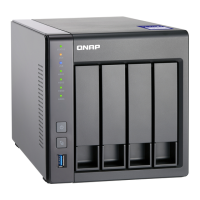
| Chassis type | Tower |
| Cooling type | Active |
| Fan diameter | 120 mm |
| Product color | Black |
| LED indicators | HDD, LAN, Power, SSD, Status |
| Number of fans | 1 fan(s) |
| Cable lock slot type | Kensington |
| Type | NAS |
| Noise level | 19.5 dB |
| Device class | Small & Medium Business |
| Backup features | Cloud, USB drive, iSCSI LUN |
| Browser supported | Apple Safari 7+, Google Chrome, Microsoft Internet Explorer 10+, Mozilla Firefox |
| Security algorithms | 256-bit AES, FIPS 140-2, HTTPS, SNMP, SSH |
| Processor model | Alpine AL-314 |
| Processor frequency | 1.7 GHz |
| Processor manufacturer | Annapurna Labs |
| Operating system version | 4.4.2 |
| Operating system installed | QNAP Turbo System |
| Mac operating systems supported | Mac OS X 10.10 Yosemite, Mac OS X 10.11 El Capitan, Mac OS X 10.12 Sierra, Mac OS X 10.13 High Sierra, Mac OS X 10.14 Mojave, Mac OS X 10.15 Catalina, Mac OS X 10.15.3 Catalina |
| Linux operating systems supported | CentOS 7.0, Ubuntu 14.04 |
| Server operating systems supported | Windows Server 2008 R2, Windows Server 2012, Windows Server 2012 R2, Windows Server 2016, Windows Server 2019 |
| Windows operating systems supported | Windows 10, Windows 10 Education, Windows 10 Education x64, Windows 10 Enterprise, Windows 10 Enterprise x64, Windows 10 Home, Windows 10 Home x64, Windows 10 Pro, Windows 10 Pro x64, Windows 10 x64, Windows 7, Windows 7 Enterprise, Windows 7 Enterprise x64, Windows 7 Home Basic, Windows 7 Home Basic x64, Windows 7 Home Premium, Windows 7 Home Premium x64, Windows 7 Professional, Windows 7 Professional x64, Windows 7 Starter, Windows 7 Starter x64, Windows 7 Ultimate, Windows 7 Ultimate x64, Windows 7 x64, Windows 8, Windows 8 Enterprise, Windows 8 Enterprise x64, Windows 8 Pro, Windows 8 Pro x64, Windows 8 x64 |
| Flash memory | 512 MB |
| Memory slots | 1 |
| Internal memory | 2 GB |
| Memory clock speed | 1600 MHz |
| Memory form factor | SO-DIMM |
| Internal memory type | DDR3 |
| Maximum RAM supported | 8 GB |
| Fan voltage | 12 V |
| AC input voltage | 100 - 240 V |
| Power supply location | External |
| Power consumption (sleep) | 11.65 W |
| Power consumption (typical) | 26.7 W |
| Power supply unit (PSU) capacity | 90 W |
| Ethernet LAN data rates | 10, 100, 1000, 10000 Mbit/s |
| Ethernet LAN data rate supported (max) | 10000 Mbit/s |
| Fiber optic connector | SFP+ |
| USB 2.0 ports quantity | 0 |
| Ethernet LAN (RJ-45) ports | 2 |
| USB 3.2 Gen 1 (3.1 Gen 1) Type-A ports quantity | 3 |
| Cables included | AC, LAN (RJ-45) |
| Storage temperature (T-T) | -20 - 70 °C |
| Operating temperature (T-T) | 0 - 40 °C |
| Operating relative humidity (H-H) | 5 - 95 % |
| Harmonized System (HS) code | 84714100 |
 Weight and Dimensions
| Depth | 219 mm |
|---|---|
| Width | 160 mm |
| Height | 169 mm |

 To Next Page