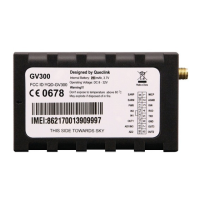
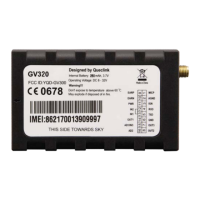
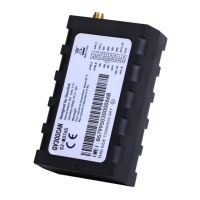
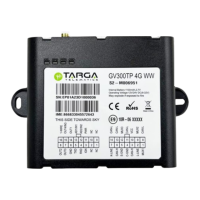
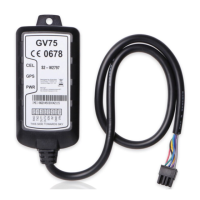
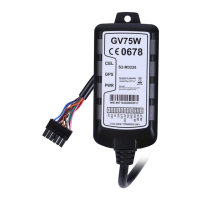
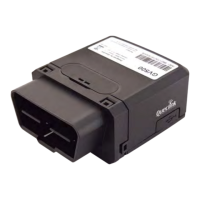
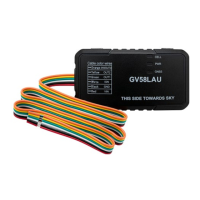
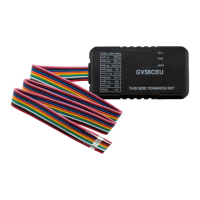
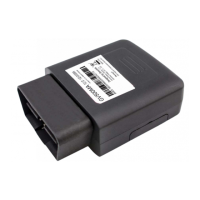
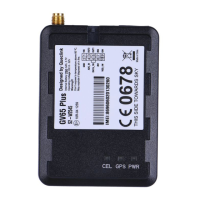
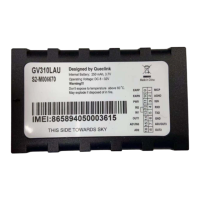
The Queclink GV310LAU is a compact and versatile GNSS tracker designed for a wide array of vehicle tracking applications. Its robust design and comprehensive feature set make it suitable for various monitoring and control tasks in diverse environments. The device is engineered to provide reliable performance, offering superior sensitivity and fast initial positioning thanks to its built-in GPS receiver. This ensures accurate location data, which is crucial for effective vehicle management and security.
One of the primary functions of the GV310LAU is its ability to track vehicles using GNSS technology. This allows for real-time location monitoring, providing businesses and individuals with the ability to keep tabs on their assets. Beyond basic tracking, the device incorporates a built-in 3-axis accelerometer, which significantly enhances its utility. This accelerometer enables advanced functionalities such as motion detection, allowing the device to identify when a vehicle is in motion or at rest. This feature is particularly useful for optimizing power consumption, as the device can enter power-saving modes when no motion is detected, thereby extending battery life.
The GV310LAU also supports sophisticated power management algorithms, which work in conjunction with the accelerometer to maximize operational efficiency. These algorithms intelligently manage the device's power consumption, ensuring that it remains operational for extended periods, even when relying on its internal backup battery. This is a critical feature for applications where continuous tracking is required, even in the absence of external power.
For communication, the GV310LAU supports various cellular bands, including LTE CAT4, WCDMA, and GSM, making it compatible with a wide range of cellular operators in Latin America. This broad compatibility ensures reliable data transmission to backend servers, facilitating continuous monitoring and reporting. The device utilizes the @Track protocol, a full-featured protocol that supports a variety of reports. These reports include emergency alarms, which can be triggered in critical situations, providing immediate alerts. Geo-fence boundary crossings are another key reporting feature, allowing users to define virtual boundaries and receive notifications when a vehicle enters or exits these areas. External power supply monitoring is also supported, providing insights into the vehicle's power status and alerting users to any disconnections or fluctuations. Of course, regular position reports are a core component of the @Track protocol, delivering consistent updates on the vehicle's location.
The GV310LAU is designed with multiple I/O interfaces, which greatly expand its functionality. These interfaces allow the device to monitor and control external devices, making it a central component in a comprehensive vehicle management system. For instance, digital inputs can be used to detect the status of various vehicle components, such as door open/close sensors or panic buttons. The device features three general-purpose digital inputs, all of which are negative triggers, providing flexibility in integration with different sensors. An ignition detection input is specifically designed to monitor the vehicle's ignition status, allowing the device to report when the ignition is turned on or off and to enter power-saving modes accordingly.
In addition to digital inputs, the GV310LAU includes analog input capabilities. One special I/O can be configured as a 0-16V analog input, allowing for the monitoring of analog sensors, such as fuel level sensors or temperature sensors. This versatility enables the device to collect a broader range of data about the vehicle's condition and environment.
Digital outputs are another crucial aspect of the GV310LAU's I/O capabilities. There are three digital outputs, all of which are open drain type with a maximum drain current of 150 mA. Each output includes a built-in overcurrent PTC resettable fuse, providing protection against electrical overloads. These outputs can be used to control external devices, such as relays for immobilizing the vehicle, activating alarms, or controlling other accessories. For example, an output can be connected to a relay to remotely cut off the vehicle's engine or to a LED for visual indications. One of the outputs, OUT1, has a latch circuit, meaning it will maintain its state during a reset, which can be important for certain control applications.
The device also features a serial port/UART interface with dedicated TXD/RXD lines, which are standard RS232 signals. This interface allows for communication with other serial devices, potentially enabling more complex integrations or configurations. Microphone inputs (MICP and AGND) are also available, suggesting potential for voice communication or audio monitoring capabilities, although specific usage would depend on the application. Speaker outputs (EARP and EARN) further support audio functionalities.
Getting started with the GV310LAU involves a few straightforward steps. The case can be easily opened and closed for internal access. Installing a SIM card is essential for cellular communication, and users are advised to do so when the device is powered off and the internal battery is switched to the OFF position. The internal backup Li-ion battery needs to be installed, and its switch must be in the ON position for the battery to be active and chargeable. For enhanced GPS signal reception, an optional external GPS antenna can be connected to the SMA GPS antenna connector; the device automatically detects and utilizes it when connected. Power supply connection is made via the PWR and GND pins, with an input voltage range of 8V to 32V, making it suitable for both 12V and 24V vehicle systems.
Maintenance features include the ability to configure GPS LED and PWR LED behavior using the Manage Tool, allowing users to customize visual feedback. Firmware upgrades can be performed over the air or via a USB data cable, ensuring the device can always run the latest software with new features and improvements. The device also has several troubleshooting indicators, such as LED patterns, to help diagnose common issues like network registration problems, incorrect APN settings, or weak GPS signals.
Safety precautions are emphasized in the manual. Users are advised not to disassemble the device themselves and to avoid exposing it to extreme temperatures or humidity, as this can damage the device or cause the battery to explode. Installation should be firm to prevent falling, and the side with the antenna should face the sky for optimal signal reception. It is also recommended to avoid installing the device under metal surfaces or in enclosed environments that could obstruct GPS and network signals. The GV310LAU is designed to be a reliable and adaptable solution for modern vehicle tracking and management needs, offering a blend of essential tracking, monitoring, and control capabilities within a compact form factor.


 To Next Page
 General