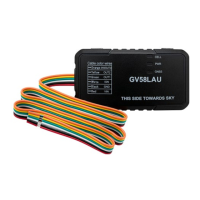
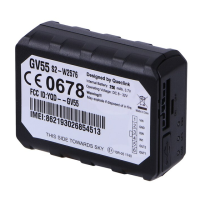
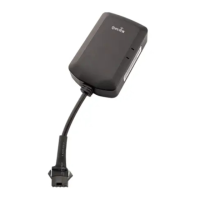
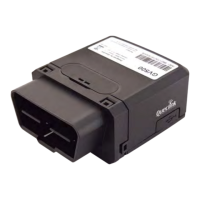
The Queclink GV58CEU is a compact GNSS tracker designed for a wide array of vehicle tracking applications, offering robust monitoring and control capabilities for external devices. Its core function is to provide real-time or periodic location tracking of vehicles, leveraging a highly sensitive built-in GNSS receiver for fast time-to-first-fix. The device supports six-band LTE-FDD in Europe and GSM/GPRS 900/1800MHz, ensuring reliable communication with a backend server and mobile devices for continuous oversight.
A key feature of the GV58CEU is its integrated 3-axis accelerometer, which enables advanced functionalities such as driving behavior monitoring, motion detection, and sophisticated power management algorithms for extended battery life. This allows for detailed insights into vehicle usage and enhanced security. The device utilizes the @Track protocol, supporting a diverse range of reports including emergency alerts, geo-fence boundary crossings, driving behavior anomalies, low battery notifications, and scheduled GNSS position updates. These reports provide comprehensive data for fleet management, asset tracking, and personal vehicle security.
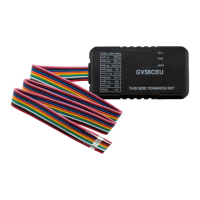
The GV58CEU is equipped with a 9-PIN interface connector, which includes connections for power and various input/output (I/O) functionalities. This interface allows for flexible integration with different vehicle systems and external accessories. The power input pins, VIN (Red) and GND (Black), support a wide voltage range from 8V to 32V, making the device suitable for both 12V and 24V vehicle electrical systems without the need for external transformers. This broad compatibility simplifies installation across a variety of vehicles.
For ignition detection, the IGN (White) pin is provided. It is strongly recommended to connect this pin to the vehicle's ignition key "RUN" position. Alternatively, it can be connected to any non-permanent power source that is active only when the vehicle is running, such as the power source for the FM radio. This ignition signal can be configured to trigger the device to start transmitting information to the backend server when the ignition is on, and to enter a power-saving mode when the ignition is off, optimizing energy consumption.
The device features two digital outputs (Yellow OUT2 and Green OUT1), both of which are open drain type with a maximum drain current of 150mA. These outputs can be used to control external devices, such as relays, enabling remote control functionalities within the vehicle. For instance, they can be configured to activate or deactivate certain vehicle components based on predefined conditions or commands from the backend server.
An analog input/digital input (Blue IN2/AIN1) is also available, configurable to function as either. This input supports a voltage range from 0V to 30V, allowing for the monitoring of various analog sensors or digital signals within the vehicle. This versatility enhances the device's ability to collect diverse data points from the vehicle's environment.
Additionally, the GV58CEU incorporates a 1-WIRE interface, dedicated with two lines for VDD and Data. This interface supports the connection of 1-WIRE devices, such as temperature sensors or iButton readers, further expanding the device's data collection capabilities and enabling more specialized applications like driver identification or cargo temperature monitoring.
Maintenance features for the GV58CEU include a straightforward installation process for the SIM card and internal battery. The device case is designed to be easily opened using a triangular-pry-opener, with four gaps provided for this purpose. When shipped, the case is not completely closed, facilitating initial setup. The SIM card holder is accessible by sliding it up, and the SIM card should be inserted with the gold-colored contact area facing down, aligning with the cut mark. The internal battery is also easily installed within the case. Once the SIM card and battery are in place, the upper cover can be pressed onto the lower cover to ensure a complete and secure closure.
The device's status is indicated by three LEDs: CELL, PWR, and GNSS. These LEDs provide visual feedback on the device's operational status, including network registration, power status, and GNSS signal acquisition. For example, a fast-flashing CELL LED indicates the device is searching for a network, while a slow-flashing LED means it is registered. A solid ON GNSS LED signifies that the GNSS chip has acquired location information. These LEDs can also be configured to turn off after a period of time using a configuration tool, which can be useful for discreet installations or to conserve power.
Troubleshooting guidance is provided for common issues, such as the CELL LED flashing quickly (indicating weak signal or network registration issues) or the inability to get a successful GNSS fix (suggesting a weak GNSS signal or improper device orientation). Solutions include moving the device to areas with better GSM or open sky coverage, ensuring correct backend server IP addresses, and verifying charger connections.
Safety information emphasizes not disassembling the device, avoiding exposure to extreme temperatures or humidity, and refraining from using the device on airplanes or near medical equipment. This ensures the longevity of the device and user safety. The GV58CEU is designed for ease of use and reliability, providing a comprehensive solution for vehicle tracking and monitoring.


 To Next Page
 General