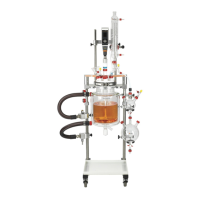
→ Reactor-Ready should only be operated by trained and competent personnel.
→ As with all chemistries, a full risk assessment should be performed prior to starting, and care
should be taken to monitor reactions at all stages.
→ During operation Reactor-Ready should not be left unattended unless in a supervised area.
6.4.1 Optimising thermal performance
The thermal performance, whether heating or cooling, will be affected by:
• Ambient temperature and atmospheric conditions.
• Reactor contents load to be heated/cooled.
• Heating and cooling power of the thermoregulator.
• The nature of the thermofluid.
• The size of the reaction vessel.
Please take care to consider and optimise these parameters if you wish to maximise the performance of
your Reactor-Ready system.
6.4.2 Operating temperature range
With reaction vessels, Reactor-Ready can tolerate a thermofluid temperature between -70°C and
+230°C without damage to the unit. The working reaction temperature range will vary depending on
your thermoregulator, vessel size, contents volume, etc. as stated above.
With filter vessels, the temperature range is reduced due to the nature and composition of the filter
plate materials as follows:
• PEEK filter plate temperature range: -30°C to +180°C
• PTFE filter plate temperature range: -30°C to +120°C
• Silicone O-ring temperature range: -30°C to +180°C
• Viton O-ring temperature range: -20°C to +180°C


 To Next Page