EasyManua.ls Logo

Raymarine Ray54 - User Manual

Raymarine Ray54
112 pages
Print Icon
To Next Page IconTo Next Page
Loading...
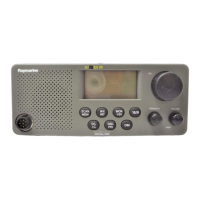
Ray54
Marine VHF
Radio
Owner’s Handbook
Document number: 81231-3
Date: July 2005

Table of Contents

Other manuals for Raymarine Ray54

Questions and Answers

Raymarine Ray54 Specifications

General IconGeneral
TypeVHF Marine Radio
Waterproof RatingIPX7
GPS InterfaceNMEA0183
Power Output25W / 1W
ChannelsInternational and USA
DisplayLCD
Weight0.9 kg

Summary

About this Handbook

Introduction

Describes the Ray54 fixed VHF marine radio, its communication capabilities, and DSC features.

Conventions Used

Explains how keys, LCD indicators, and procedures are represented in the handbook.

Technical Accuracy

States information was correct at printing but may change due to product updates.

Warranty

Advises registering the product for full warranty benefits.

Important Information

FCC Notice

Compliance statement for FCC rules, conditions of operation, and modification warnings.

Station License

Information on licensing requirements for operating the radio, especially for foreign travel.

Operator License

Information on operator licensing requirements and permit applications.

INDUSTRY CANADA

Maritime Mobile Service Identity (MMSI)

Explains the MMSI number requirement for DSC equipment and how to obtain it.

SAFETY NOTICE

Warning about RF energy emission and proper installation/operation.

CAUTION: Navigation Aid

Antenna Mounting and EME Exposure

Safe Compass Distance

Recommends placing the radio away from compasses for accurate readings.

EMC Conformance

States equipment conforms to EMC standards but requires correct installation and use.

Chapter 1: Introduction

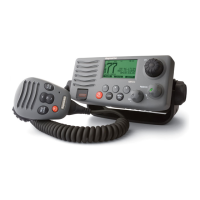
1.1 Ray54 Fixed Station VHF Radio

Introduces the Ray54 VHF radiotelephone and its basic functions.

1.2 Features

Lists key features of the Ray54, such as waterproof rating and display type.

Chapter 2: Installation

2.1 Unpacking and Inspection

Instructions for unpacking the unit and checking supplied components.

2.2 Planning the Installation

Guidance on selecting a location and considering environmental factors for installation.

2.3 Power Connections

Details on connecting the radio to the DC power source, including fuse and wiring.

2.4 External Speaker Connections

How to connect an optional external speaker to the radio.

2.5 Grounding

Recommendations for grounding the unit to the boat’s earth ground system.

2.6 GPS;NMEA Data

How to connect a GPS to provide positional data for DSC calls.

2.7 Antenna Connections

Guidance on connecting the VHF antenna for optimal performance.

Chapter 3: Getting Started

3.1 Keypad and Rotary Knobs

Overview of the main unit and microphone buttons and their functions.

3.2 LCD Display

Explanation of the functional characters and indicators on the Ray54's LCD.

Chapter 4: General Operations

4.1 Turning the Power ON and OFF

Instructions on how to power the unit on and off using the PWR/VOL knob.

4.2 Setting the Volume

How to adjust the loudspeaker volume using the PWR/VOL knob.

4.3 Setting the Squelch

Guide on adjusting the squelch threshold to minimize noise.

4.4 Setting the Power Output

How to switch between high (25W) and low (1W) transmit power.

4.5 Setting the Channel

How to change channels using the microphone or main unit controls.

4.6 Selecting a Weather Channel

How to tune into weather channels and activate weather alerts.

4.7 Selecting the Priority Channel

How to switch to the dedicated Priority Channel 16.

4.8 Selecting the Secondary Priority Channel

How to program and switch to a secondary priority channel.

4.9 Transmitting

Instructions for transmitting using the PTT key and timeout timer.

4.10 Using the Scan Modes

Explains the different scan modes (All, Saved, Priority).

4.11 Adding Channels to Memory

Steps to store channels into memory for Saved Scan.

4.12 Using the Monitor Modes

How to use Dual Watch and Tri Watch modes.

4.13 USER Channel Mode

How to display and scan only saved favorite channels.

4.14 DSC Call Operation

Entry into DSC Call Mode.

4.15 Menu Mode Operation

Entry into Menu Mode for radio setup.

Chapter 5: Digital Selective Calling (DSC)

5.1 DSC Call Function

Explains how to initiate various DSC calls and access logs/phonebook.

5.2 Individual Calls

Details on making and receiving routine DSC calls to specific stations.

5.3 Group Calls

Instructions for making and receiving DSC calls to predefined groups.

5.4 All Ships Calls

How to send and receive general safety or urgency messages to all vessels.

5.5 Distress Calls

Procedures for sending designated or undesignated distress calls.

5.6 Position Request

How to request and receive GPS position data from other stations.

5.7 Call Log

How to view and manage the log of received DSC calls.

5.8 DSC Distress Log

How to view and manage the log of received DSC distress calls.

Chapter 6: Menu Settings

6.1 Menu Function

Overview of radio setup functions accessed through Menu mode.

6.2 DSC Phonebook

How to add, edit, and delete entries in the DSC phonebook.

6.3 Local; Distant

Toggles receiver sensitivity between full (Distant) and attenuated (Local) modes.

6.4 Backlight Adjustment

Adjusts the brightness of the LCD, keypad, and microphone backlight.

6.5 Contrast Adjustment

Adjusts the contrast level of the LCD display.

6.6 GPS;Time Setup

Manual entry of GPS position and UTC time when auto-detection fails.

6.7 Settings

Options for displaying Lat/Lon, Time, Time Zone Offset, Time Format, and COG/SOG.

6.8 Radio Setup

Settings for Frequency Band, Channel Name, Ring Volume, and Key Beep.

6.9 DSC Setup

Configuration for MMSI ID, Group MMSI, Position Reply, and Auto Channel Change.

6.10 Resetting Factory Defaults

Returns radio settings to their original factory defaults.

Chapter 7: Customer Service

7.1 How to Contact Raymarine

Information on contacting Raymarine for support, repairs, and parts.

Appendix A: Specifications

General

Provides general specifications for the Ray54 radio, including size, weight, and environmental ratings.

Appendix B: Channel List

U.S. Marine VHF Channels and Frequencies

Lists US VHF channels, transmit/receive frequencies, and usage.

Canadian Marine VHF Channels and Frequencies

Lists Canadian VHF channels, frequencies, and areas of operation.

International Marine VHF Channels & Frequencies

Lists international VHF channels and frequencies with their uses.

WX Channels (North America only)

Lists weather (WX) channels and their frequencies for North America.

Appendix C: Glossary

Related product manuals