EasyManua.ls Logo

Raytheon Beech Baron E55 - Page 895

Raytheon Beech Baron E55
903 pages
Print Icon
To Next Page IconTo Next Page
To Previous Page IconTo Previous Page
Loading...
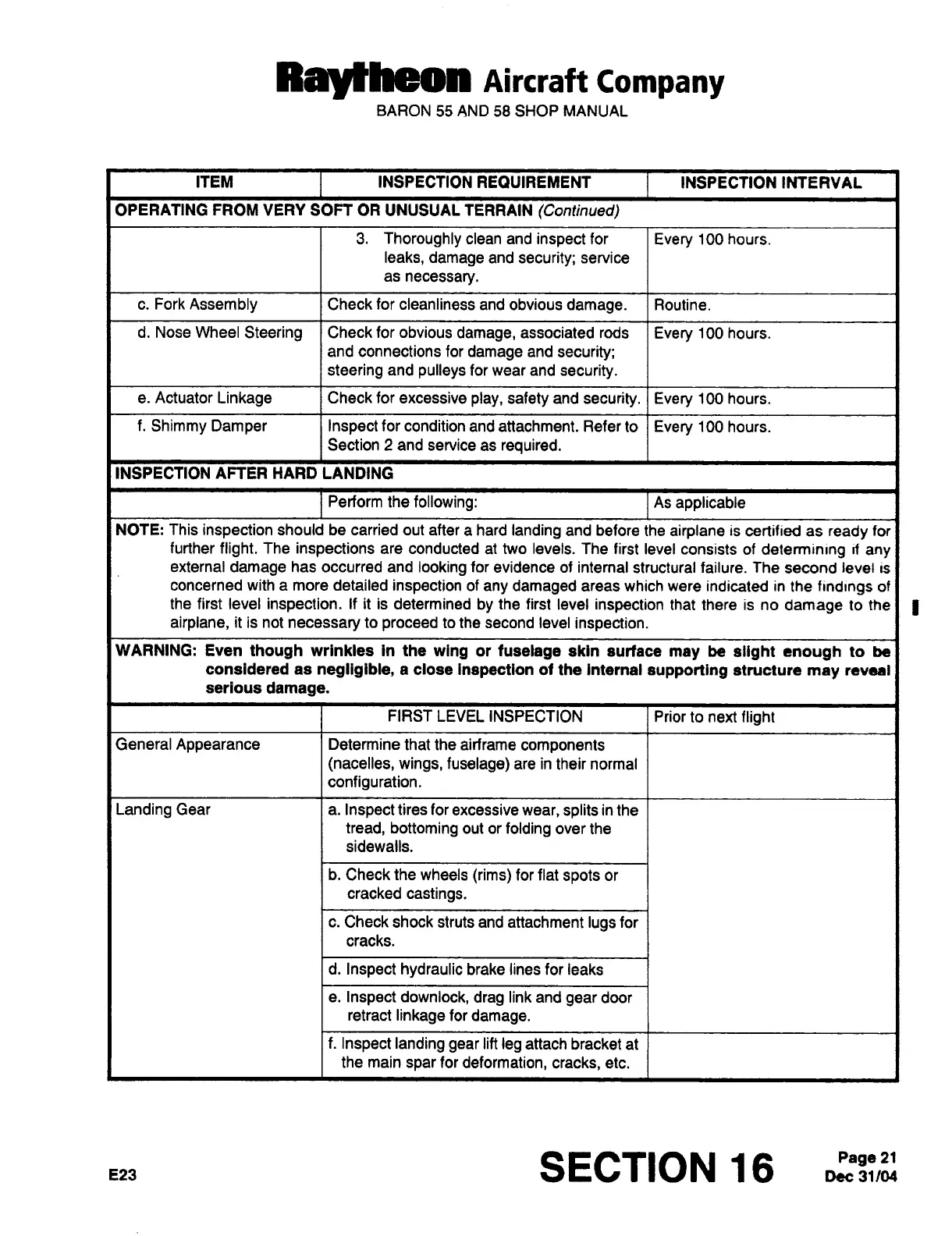
Ray~heon
Aircraft
Company
BARON
55
AND
58
SHOP
MANUAL
ITEM
INSPECTION
REQUIREMENT
INSPECTION
INTERVAL
OPERATING
FROM
VERY
SOFT
OR
UNUSUAL
TERRAIN
(Continued)
3.
Thoroughlyclean
and
inspectfor
Every
100
hours.
leaks,
damage
and
security;
service
as
necessary.
c.
Fork
Assembly
Check
for
cleanliness
and
obvious
damage.
Routine.
d.
Nose
Wheel
Steering
Check
for
obvious
damage,
associated
rods
Every
100
hours.
and
connections
for
damage
and
security;
steering
and
pulleys
for
wear
and
security.
e.
Actuator
Linkage
Check
for
excessive
play,
safety
and
security.
Every
100
hours.
f.
Shimmy
Damper
Inspect
for
condition
and
attachment.
Refer
to
Every
100
hours.
Section
2
and
service
as
required.
INSPECTION
AFTER
HARD
LANDING
Perform
the
following:
As
applicable
NOTE:
This
inspection
should
be
carried
out
after
a
hard
landing
and
before
the
airplane
is
certified
as
ready
for
further
flight.
The
inspections
are
conducted
at
two
levels.
The
first
level
consists
of
determining
If
any
external
damage
has
occurred
and
looking
for
evidence
of
internal
structural
failure.
The
second
level
Is
concerned
with
a
more
detailed
inspection
of
any
damaged
areas
which
were
indicated
in
the
findings
of
the
first
level
inspection.
If
it
is
determined
by
the
first
level
inspection
that
there
is
no
damage
to
the
1
airplane,
it
is
not
necessary
to
proceed
to
the
second
level
inspection.
WARNING:
Even
though
wrinkles
in
the
wing
or
fuselage
skin
surface
may
be
slight
enough
to
be
considered
as
negligible,
a
close
inspection
of
the
Internal
supporting
structure
may
reveal
serious
damage.
FIRST
LEVEL
INSPECTION
Prior
to
next
flight
General
Appearance
Determine
that
the
airframe
components
(nacelles,
wings,
fuselage)
are
in
their
normal
configuration.
Landing
Gear
a.
Inspect
tires
for
excessive
wear,
splits
in
the
tread,
bottoming
out
or
folding
over
the
sidewalls.
b.
Check
the
wheels
trims)
for
flat
spots
or
cracked
castings.
c.
Check
shock
struts
and
attachment
lugs
for
cracks.
d.
Inspect
hydraulic
brake
lines
for
leaks
e.
Inspect
downlock,
drag
link
and
gear
door
retract
linkage
for
damage.
f.
Inspect
landing
gear
lift
leg
attach
bracket
at
the
main
spar
for
deformation,
cracks,
etc.
E23
SECTION
16
Dec
31~04Page
21

Table of Contents

Related product manuals