20
12. Intended Use of the Lathe & Basic
Woodturning Instructions - cont.
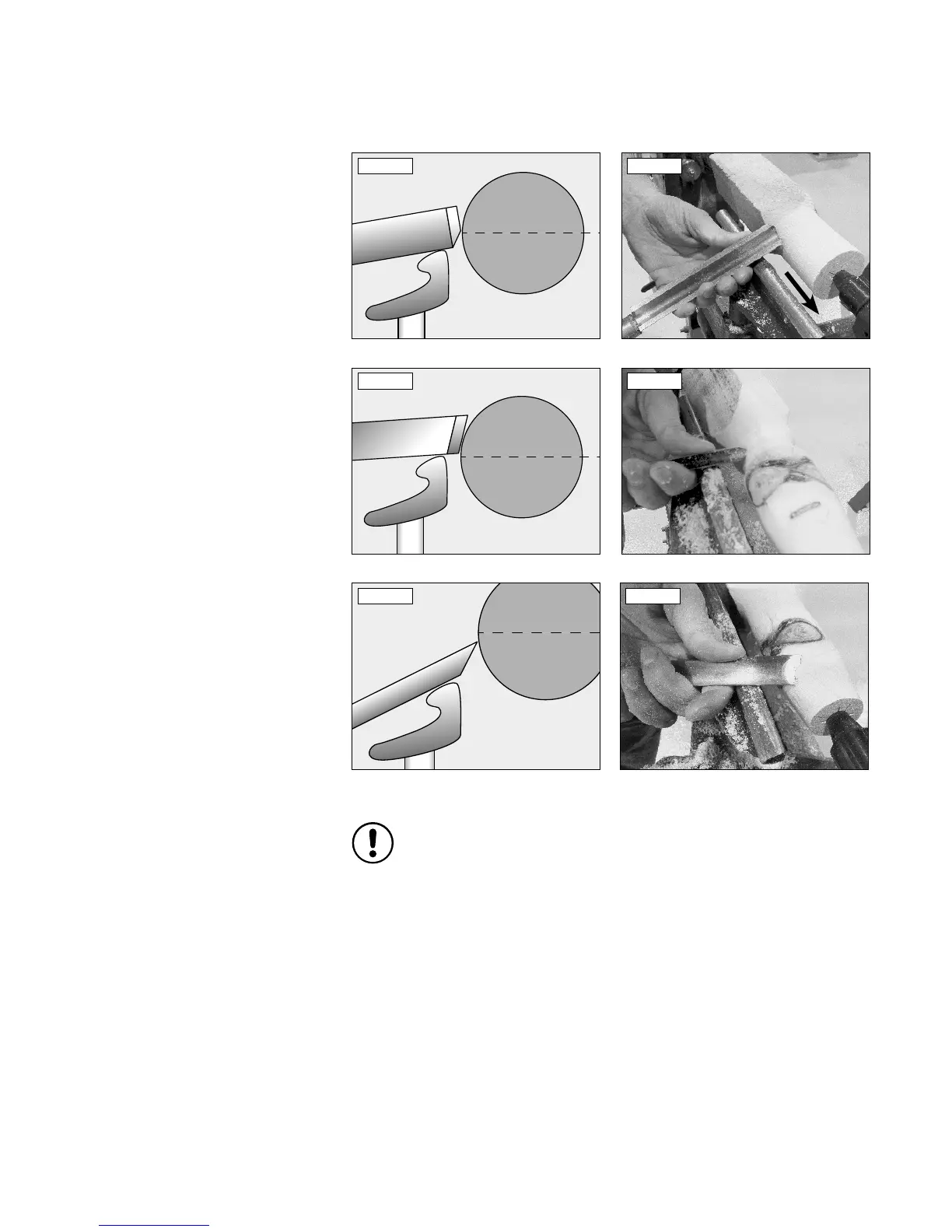
being used. When using a roughing gouge, the
cutting edge should come into contact with
the centre of the workpiece, see fig 12.6. If
using a skew chisel, the cutting edge should be
applied approximately 3/8" (10 mm) above the
centre height, see fig 12.7. A spindle gouge's
cutting edge should come into contact with the
workpiece approximately 3/8" (10 mm) below its
centre, see fig 12.8.
Using the Roughing Gouge
The first step when turning between centres is
invariably to 'rough out' the blank. This involves
taking a square section blank and paring it down
with a roughing gouge to a cylindrical profile,
ready to shape into the final piece. Roughing
gouges are usually sharpened to have the bevel
at a 45º angle. Using the tool rest to support the
blade, offer the blade to the workpiece at an
angle, see fig 12.9. When offering the rough-
ing gouge to the workpiece, the bevel should be
rubbing it, without cutting. To make a cut, gently
raise the handle of the tool in order to bring the
cutting edge into contact with the timber. Using
light passes, move the blade outwards towards
the same edge of the timber which the blade is
facing, fig 12.9. Never move the tool backwards,
as this introduces the risk of splintering the wood
and causing injury.
Using the Spindle Gouge
A spindle gouge is used to shape the final profile
of a spindle and is capable of finer work than a
roughing gouge. It is designed specifically for cut-
ting coves or valleys. The blade should come into
contact with the wood at just below the centre
line. Resting it on the tool rest, apply the blade
to the workpiece at an angle, see fig 12.10,
rubbing the bevel onto it. Raise the handle to
apply the cutting edge and make cuts. As with the
roughing gouge, use controlled and light passes,
trying to not remove too much wood at once.
Never attempt to use a spindle gouge for working
on bowls or hollow form work as the angle of the
cutting bevel of the gouge is too shallow and will
cause it dig in to the work piece or snatch the
tools from your hands.
Using the Skew Chisel
Skew chisels are available in both flat and oval
profiles. The curved profile is favoured by many
as it gives better results more easily. Skew chisels
are ideal for creating beads, refining the profiles
and can be used to create a final smooth finish to
the workpiece. The skew chisel should be applied
to the workpiece horizontally with the blade
resting on the tool rest, fig 12.11, again with
the bevel rubbing the workpiece and raising the
handle to take careful, controlled cuts.
Further Operations
The guidelines above give basic instructions
on some of the most common woodturning
procedures. There are a wide variety of special-
ised chisels and many complementary accessories
available for Record Power lathes which enable
a huge variety of work to be created. For further
instructions on more advanced safe and effective
woodturning, please seek professional training.
Fig.12.8
Fig.12.10
Fig.12.11
Fig.12.6
Fig.12.7
Fig.12.9
Speeds of the Lathe
To ensure the safest possible use of the lathe, it is important to understand which speeds are suited
to which tasks. In general, the slower speeds should be used for the initial turning and roughing out
of large pieces and the slowest speed should be used when large pieces are out of balance. This will
reduce the possibility of the workpiece being thrown from the lathe.
Medium speeds are ideally suited for general purpose work which doesn't place heavy loads on the
spindle of the lathes, for example when creating the profiles of spindles and some smaller
bowl turning.
The fastest speeds should be used only for small diameter work, where the size of workpiece is
relatively small and therefore poses a lower risk of causing damage. Extra care should be taken when
turning at the fastest speeds, using only a relatively light touch.
When sanding, care should be taken to not burn the operator's hands or the workpiece. It is recom-
mended to not exceed the speed used for the last turning operation. If in doubt, use a
slow speed.



 To Next Page