2
Chapter 5
Each battery circuit uses a battery switch that provides
positive battery disconnect, isolates all circuits and aids in
protection against electrical fire and explosion.
At dockside a battery charger takes the place of the engines
alternator to produce direct current.
The shore power cord sends house current through the
battery charger and it is converted to direct current and
charges the batteries through the battery isolator just as
through the engine alternators. In this scenario the main
DC distribution battery charger switch needs to be
activated for the current to flow through to the ship’s
batteries.
Also, the optional generator away from the dock can send
house current through the battery charging system and in
turn charge up the ship’s batteries.
Direct current circuit protection is located in several areas;
dash, AC/DC distribution panel and engine.
The engine resetable breaker powers the key switches as
well as the dash gauges. It does not control the dash
switches such as the blower, bilge pump, etc. Refer to the
engine manufacturer’s owner manual for location and
particulars regarding the engine breaker.
Refer to the technical chapter for specific wiring
schematics. Following is a brief description of selected
DC components.
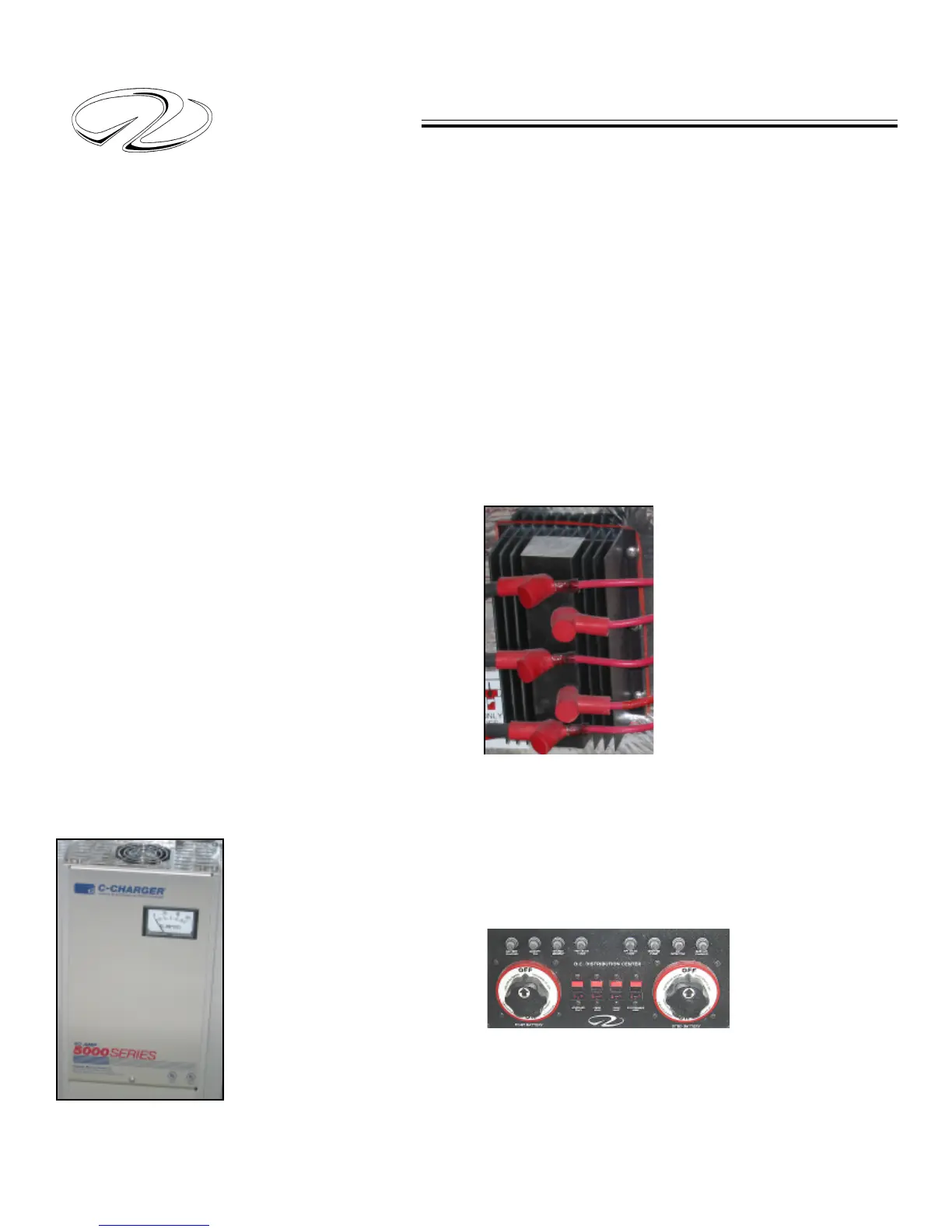
A battery charger is located in
the engine room. Its function
is to keep the engine and house
batteries fully charged to
provide engine starting power
and house DC circuit
workability. The battery
charger operates on 120 volt
AC shore power or optional
generator power to provide the
AC source for the battery
charger to function. The main
AC and the battery charger
breaker need to be energized for the batteries to be
charged. The battery parallel switch can be depressed and
it will use the charged up battery to start each engine. See
the dash illustration in chapter 4 for the parallel switch
location. If the engine batteries are discharged the house
battery will still allow the engines to be started. Once the
engines are started the alternators can then be used to
charge the engine batteries. It is critical to consider the
warnings on carbon monoxide if the engines are run to
charge the electrical system.
BATTERY ISOLATOR
DC DISTRIBUTION CENTER
This model features
2 battery switches.
The port battery
switch controls the
port starting-house
batteries.The
starboard battery switch controls the starboard engine
cranking battery. For additional information, see the
wiring schematics in the technical section.
Some models use a battery
isolator that automatically
senses the charge needed by a
specific battery and then sends
current until that battery is fully
charged. The isolator features a
“gate” that closes when it senses
the battery is fully charged and
won’t allow current to discharge
back through the system. The
battery isolator requires no
periodic care other than
checking for fastener tightness.
BATTERY CHARGER



 To Next Page