4
Chapter 6
STARTING & STOPPING
The following general information covers
starting and stopping your engines. Read
and understand all previous information
on remote controls, fueling and
operational procedures. Pay particular
attention to all labels. Refer to the engine
owner’s manual for in depth propulsion
system information.
Review all pre-departure information. Before starting your
engines make sure all canvas is removed and stored. Start
the engines only in a well ventilated location to avoid CO
buildup. Make sure all battery switches are activated.
Position the remote control handles in the neutral position.
Advance the neutral throttle advance position as instructed
in the engine owner’s manual. Keep passengers seated and
away from controls. Make sure the center windshield
section is closed and locked.
STARTING GUIDELINES
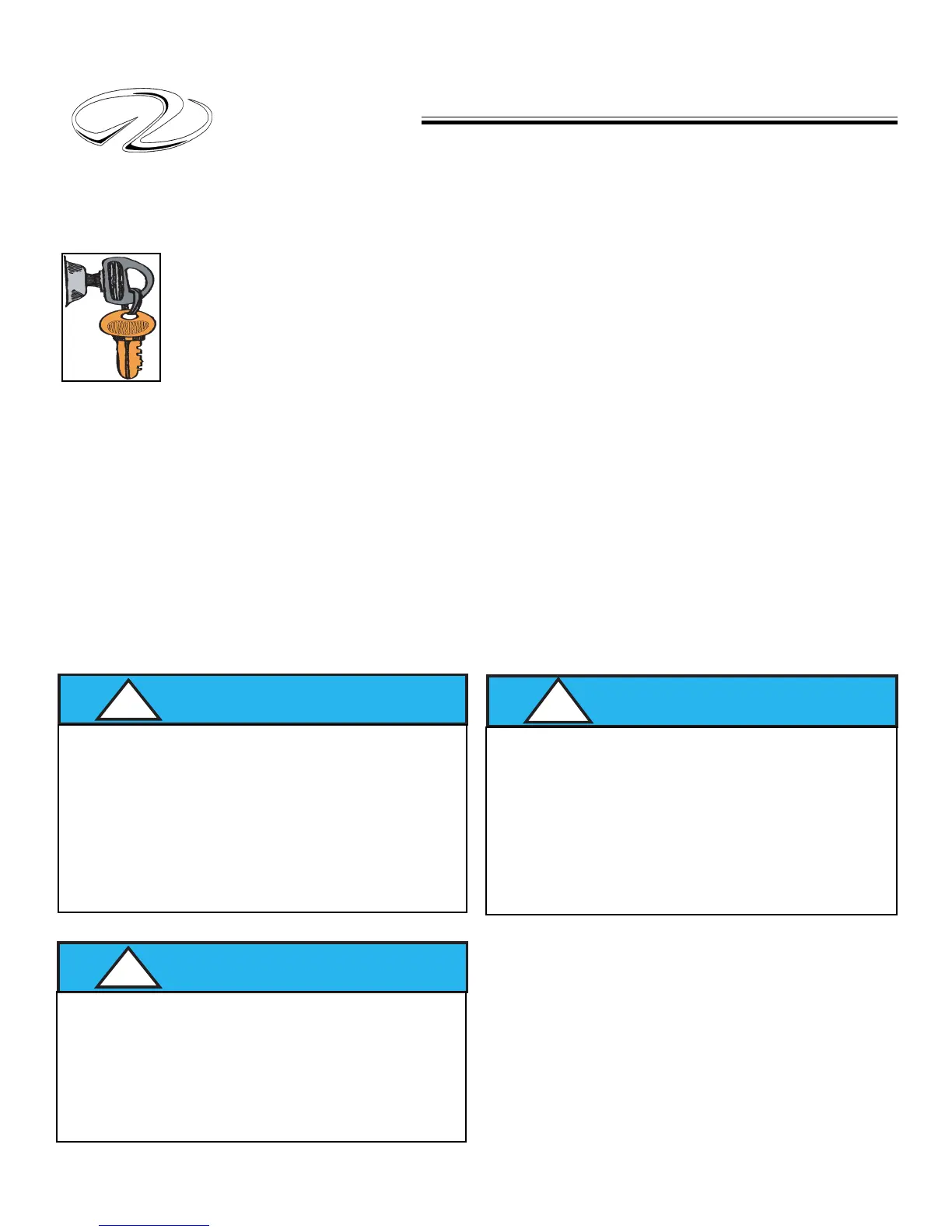
The engines start much like an automobile. Turn the
ignition key to the “ON” position. Then turn the key to
the start position. You will hear the starter cranking over
the engine. When the engine starts release the key switch.
Duplicate the same procedure with the other ignition key.
If the engine does not start, refrain from cranking the
engine over 10-12 seconds. Allow the starter and battery a
chance to recover. Advance the remote control in the
neutral throttle position as recommended in the engine
manual. Do not race the remote control in the neutral
position. Refer to the engine and control chapter and the
manufacturer’s engine owner’s manual for additional
information.
AVOID PERSONAL INJURY OR DEATH!
WHEN ENGINE IS RUNNING
TRANSOM DOOR MUST
BE CLOSED AND LOCKED.
SWIM PLATFORM
AND LADDER MUST NOT BE IN USE.
WARNING
!
TO AVOID ENGINE DAMAGE!
CHECK THE OIL GAUGE
IMMEDIATELY AFTER STARTING.
IF LOW OR NO READING
SHUT DOWN ENGINE IMMEDIATELY
AND INVESTIGATE THE PROBLEM.
CAUTION
!
GASOLINE VAPORS CAN EXPLODE!
BEFORE STARTING ENGINE(S) OPERATE
BLOWER(S) 4 MINUTES
AND CHECK ENGINE COMPARTMENT
FOR GASOLINE LEAKS AND VAPORS.
RUN BLOWER BELOW CRUSING SPEED.
WARNING
!



 To Next Page