3
Equipment Operation
CARBON MONOXIDE DETECTORS
Carbon Monoxide known as CO is indeed the silent killer.
It is a by-product of combustion. CO is invisible, taste-
less, odorless and is produced by all internal combustion
engines, heating and cooking appliances.
The most common forms of CO on board vessels are the
engines, generator and if applicable, propane heating and
cooking devices.
Never operate these devices when people are sleeping. A
slight amount of CO in the human body over several hours
causes headaches, nausea and symptoms close to food poi-
soning, motion sickness or flu. High concentrations can
be fatal within minutes.
HOW THE SYSTEM WORKS
The CO detector uses a mini computer to measure and
accumulate CO levels. It uses the principle of “time -
weighted averaging.” The detector monitors CO concen-
trations, temperature, humidity and time to calculate COHb
levels. To explain COHb, our bodies prefer to absorb CO
to oxygen and COHb is the absorbed ratio stated in a per-
cent.
If the detector senses high levels of CO the alarm will
sound in a few minutes. If lower levels are sensed, the
detector will accumulate the data and sound an alarm when
the appropriate level is reached. Read and understand the CO
owner’s manual in the information pouch.
To turn the CO detector system on:
1. Notice the CO breaker on the 12 volt main DC panel.
It must be turned off in a two-step sequence. This is for
safety purposes. The system should be always left on so
you must flip back the switch before you are able to then
deactivate the breaker.
The CO circuitry works to its best performance when
continually activated plus it accords advanced warning
when entering an area high in CO.
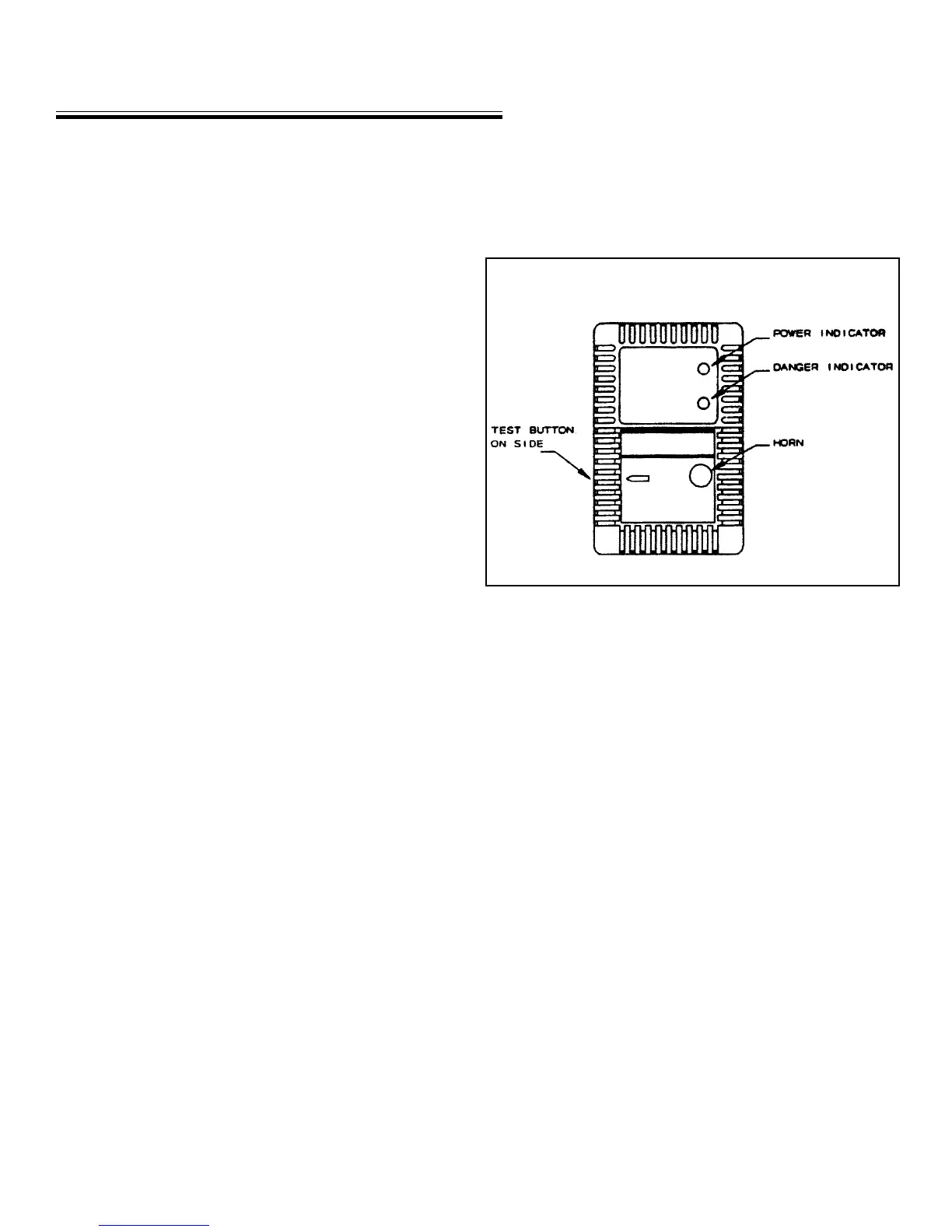
2. When power is applied to the detector, the power indi-
cator (top) will flash on and off, followed by the (red) lower
alarm indicator flashing off and on as part of a 8-14
minute warm-up period. The green (top) power indicator
will indicate a solid green when the unit has reached cor-
rect operating temperature.
3. The test cycle should be activated frequently. Simply press
the button. When it is released, the (top) power indicator
will flash off and the lower indicator light will flash. Then,
the lower indicator will flash off and the upper indicator
light will come back on.
The top indicator light being on solid green indicates nor-
mal operation. Refer to the CO detectors owner’s manual
for an explanation of the test cycle indicators.
4. When an alarm sounds take action immediately. The
danger alarm indicator flashes red and the horn beeps 4
times, pauses and repeats the cycle. This indicates a rate of
10% COHb has been reached.
a. Operate reset/silence button.
b. Call your emergency services (911)
c. Immediately move to fresh air. Do not re-enter the ves-
sel. until emergency personnel have arrived, aired the ves-
sel out and the alarm is in a normal condition.
d. After following steps a-c and your alarm reactivates
within a 24-hour period call a qualified technician to in-
spect the vessel. Note that the CO detector will clear when
the CO concentration has dropped below 70 ppm.
Note: When the ship’s batteries are disconnected at the
battery terminals, the CO detectors will not operate.
CO DETECTOR



 To Next Page