20 | Regency CI1150 Wood Cast Insert
operating instructions
Operating Instructions
With your unit now correctly installed and safety
inspected by your local authority, you are now ready
to start a re. Before establishing your rst re, it
is important that you fully understand the operation
of your draft control.
WARNING
Fireplace Stoves equipped with doors
should be operated only with doors fully
closed. If doors are left partly open, gas
and ame may be drawn out of the replace
stove opening, creating risks from both
re and smoke.
WARNING: To build a re in ignorance
or to disregard the information con-
tained in this section can cause serious
permanent damage to the unit and void
your warranty!
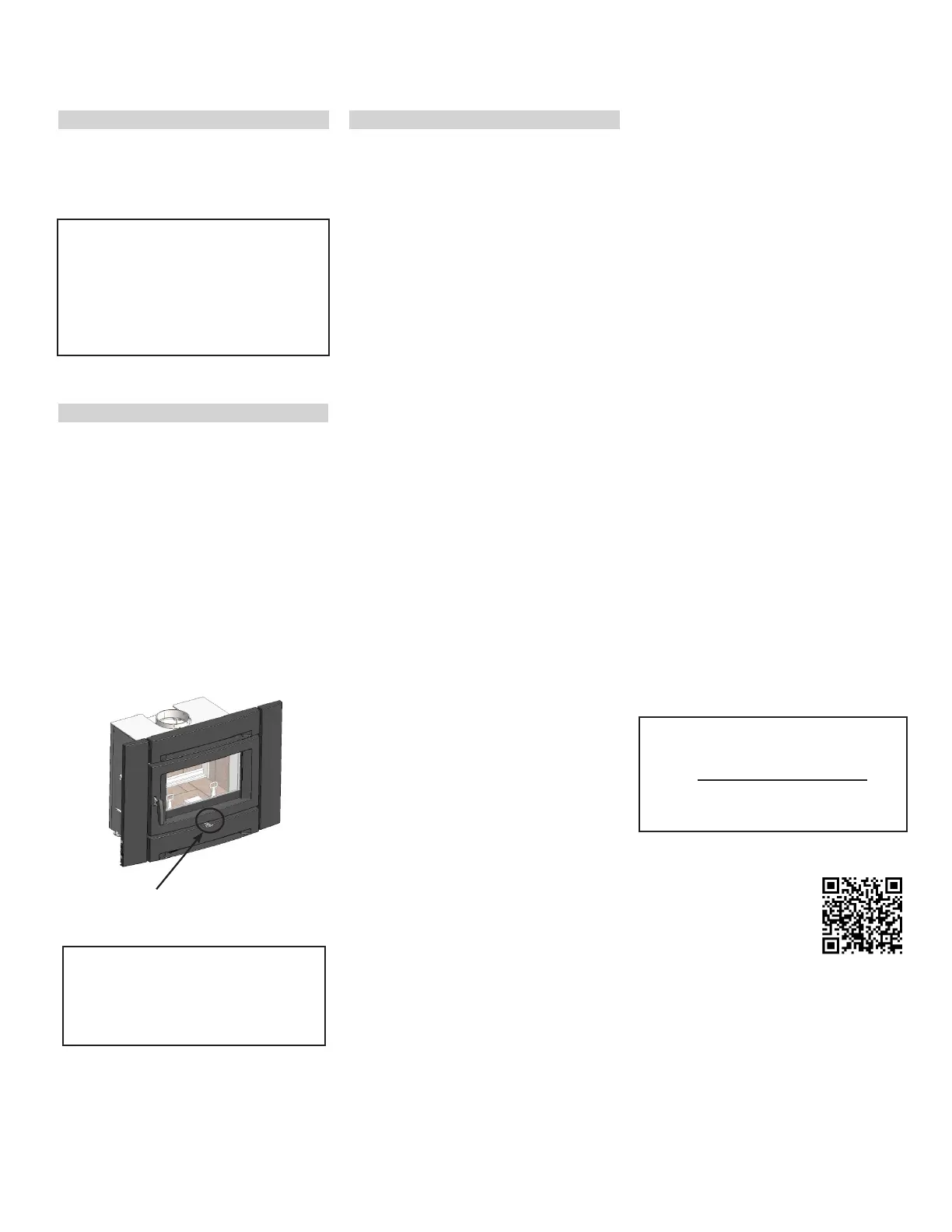
Left - Open Right - Closed
Primary Air Damper
Draft Control
Both the primary and air wash drafts are controlled
by the control slide located on the front left side of
the unit (when facing the unit). To increase your draft
—slide to the left to open, and to decrease—slide to
the right to close. The CI1150 unit has a secondary
draft system that continually allows combustion
air to the induction ports at the top of the rebox.
Draft is the force which moves air from the appliance
up through the chimney. The amount of draft in your
chimney depends on the length of the chimney, local
geography, nearby obstructions and other factors.
Too much draft may cause excessive temperatures
in the appliance. Inadequate draft may cause back
pung into the room and plugging of the chimney.
How to Light & Maintain a
Wood Stove Fire
First Fire
When your installation is completed and inspected
you are ready for your rst re.
THIS UNIT IS DESIGNED TO BURN SEA-
SONED CORDWOOD ONLY. COAL AND BRI-
QUETTES ARE NOT APPROVED.
1. Open rebox door and build a small re using
paper and dry kindling on the rebrick hearth,
DO NOT USE A GRATE. CAUTION: DO NOT
BUILD FIRE TOO CLOSE TO GLASS. Secure
door on the rebox and wait a few minutes for
a good updraft in the ue to establish the re.
(Leaving the door slightly open will help your
re start more rapidly.)
CAUTION: Never leave unit unattended
if door is left open. This procedure is for
re start-up only, as unit may overheat
if door is left open for too long.
2. Add two or three seasoned logs to your re.
Form a trench in the ash bed to allow air to
reach the rear of the rebox prior to closing
the door. Build re slowly.
WARNING: Never build a roaring re in
a cold stove. Always warm your stove
up slowly!
3. During the rst few res, keep the combustion
rate at a moderate level and avoid a large re.
Only after 5 or 6 such res can you operate the
stove at its maximum setting, and only after the
metal has been warmed. Always build up the
re slowly.
4. For the rst few days, the stove will give o an
odour from the paint. This is to be expected as
the high temperature paint becomes seasoned.
Windows and/or doors should be left open to
provide adequate ventilation while this tempo-
rary condition exists. Burning the stove at a
very high temperature the rst few times may
damage the paint. Burn res at a moderate
level the rst few days.
5. Do not place anything on the stove top during
the curing process. This may result in damage
to your paint nish.
6. During the rst few days it may be more dicult
to start the re. As you dry out your rebrick
and your masonry ue, your draft will increase.
7. For those units installed at higher elevations or
into sub-standard masonry replaces, drafting
problems may occur. Consult an experienced
dealer or mason on methods of increasing your
draft.
8. Some cracking and popping noises may be
experienced during the heating up process.
These noises will be minimal when your unit
reaches temperature.
9. All fuel burning appliances consume oxygen
during operation. It is important that you
supply a source of fresh air to your unit while
burning. A slightly opened window is sucient
for the purpose. If you also have a replace
in your home, a downdraft may be created by
your Regency Stove causing a draft down your
chimney. If this occurs, slightly open a window
near your unit.
WARNING: If the body of your unit,
or any part of the chimney connector
starts to glow, you are over ring.
Stop loading fuel immediately and
close the draft control until the glow
has completely subsided.
10. If you have been burning your stove on a low
draft, use caution when opening the door. Open
the door a crack, and allow the re to adjust
before fully opening the door.
11. The controls of your unit or the air supply pas-
sages should not be altered to increase ring
for any reason.
12. If you burn the unit too slowly or at too low a set-
ting your unit will not be operating as eciently
as it can. An easy rule of thumb says that if your
glass is clean, then your ue is clean and your
exhaust is clean. Burn the stove hot enough to
keep your glass clean, you won't need to clean
your ue as often.
IMPORTANT:
During the rst few res, a white lm may de-
velop on the glass front as part of the curing
process. The glass should be cleaned or
the lm will bake on and become very dicult
to remove. Use a non-abrasive cleaner and
NEVER clean the glass while it is hot.


 To Next Page