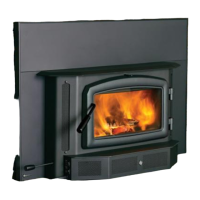
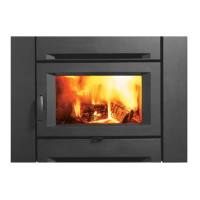
22 | Regency CI1150 Wood Cast Insert
maintenance
Ash Disposal
During constant use, ashes should be removed
every few days.
Ashes should be placed in a metal container with
a tight-tting lid. The closed container of ashes
should be placed on a noncombustible oor or on
the ground, well away from all combustible materials,
pending nal disposal. If the ashes are disposed of
by burial in soil or otherwise locally dispersed, they
should be retained in the closed container until all
cinders have thoroughly cooled.
Safety Precautions
1. Do not allow ashes to build up to the loading
doors! Only remove ashes when the re has
died down. Even then, expect to nd a few hot
embers.
2. Please take care to prevent the build-up of ash
around the start-up air housing located inside
the stove box, under the loading door lip.
3. Never start a re if the ash plug and ash drawer
are not in place. This will cause over ring which
can cause excessive warping of the stove.
Evidence of over ring can void the warranty
on your stove.
4. The rebricks are brittle and can be damaged
if the plug is replaced carelessly or pieces that
are too large are forced through the hole.
Safety Guidelines and
Warnings
CAUTION: do not use chemicals as uids to
start re.
1. CAUTION: Never use gasoline, gasoline type
lantern fuels, kerosene, charcoal lighter fuel,
or similar liquids to start or ‘freshen up’ a re
in your heater. Keep all such liquids well away
from the heater while it is in use.
2. Keep the door closed during operation and
maintain all seals in good condition.
3. Do not burn any quantities of paper, garbage, and
never burn ammable uids such as gasoline,
naptha or engine oil in your stove.
4. If you have smoke detectors, prevent smoke
spillage as this may set o a false alarm.
5. Do not overre heater. If the chimney connector,
ue bae or the stove top begin to glow, you
are over ring. Stop adding fuel and close the
draft control. Over ring can cause extensive
damage to your stove including warping and
premature steel corrosion. Over ring will void
your warranty.
6. Do not permit creosote or soot build-up in the
chimney system. Check and clean chimney at
regular intervals. Failure to do so can result in
a serious chimney re.
7. Your Regency stove can be very hot. You may be
seriously burned if you touch the stove while it is
operating, keep children, clothing and furniture
away. Warn children of the burn hazard.
8. The stove consumes air while operating, provide
adequate ventilation with an air duct or open a
window while the stove is in use.
9. Do not connect this unit to a chimney ue serving
another appliance.
10. Do not use grates or andirons or other methods
for supporting fuel. Burn directly on the bricks.
11. Open the draft control fully for 10 to 15 seconds
prior to slowly opening the door when refuelling
the re.
12. Do not connect your unit to any air distribution
duct.
13. This heater is designed to burn natural wood
only. Higher eciencies and lower emissions
generally result when burning air dried sea-
soned hardwoods, as compared to softwoods
or to green or freshly cut hardwoods.
14. In the event of component failure, replace parts
with only Regency listed parts.
15. Warning: do not abuse glass door such as
striking or slamming shut.
CAUTION: HOT WHILE IN
OPERATION. KEEP CHILDREN,
CLOTHING AND FURNITURE
AWAY. CONTACT MAY CAUSE SKIN
BURNS.
Cleaning & Maintaining Your Wood Stove
CAUTION: DO NOT CONNECT TO, OR
USE IN CONJUNCTION WITH ANY
AIR DISTRIBUTION DUCT WORK
UNLESS SPECIFICALLY APPROVED
FOR SUCH INSTALLATION.
CAUTION: DO NOT BURN GARBAGE
OR FLAMMABLE LIQUIDS SUCH AS
GASOLINE, NAPTHA OR ENGINE
OIL. SOME FUELS COULD GENER-
ATE CARBON MONOXIDE AND ARE
VERY DANGEROUS.
DO NOT BURN:
• Treated wood
• Coal
• Garbage
• Cardboard
• Solvents
• Colored Paper
• Trash
• Salt drift wood
• Cut lumber, plywood, mill
ends.
Burning treated wood, garbage, solvents, colored
paper or trash may result in release of toxic
fumes. Burning coal, cardboard, or loose paper
can produce soot, or large akes of char or y ash,
causing smoke spillage into the room.


 To Next Page