
 Need help?
Do you have a question about the REHM TIGER 180 AC/DC HIGH and is the answer not in the manual?
Welcome message from manufacturer, thanks for trust, quality standards.
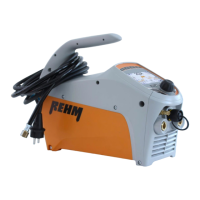
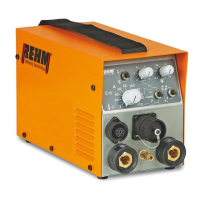
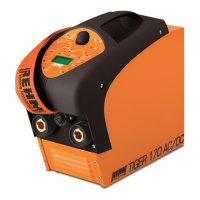
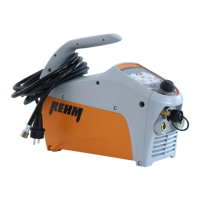
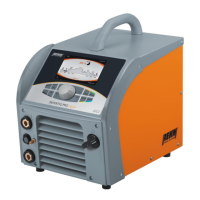
Overview of TIGER units with images and basic process principles.
Explains typographic conventions and symbols used in the manual.
Explains signal words (Danger, Warning, Caution) and their risk implications.
Identifies hazards and risks on the system itself, like electrical shock.
General safety rules, compliance requirements, and intended use.
Shows front/rear views and lists numbered components with their functions.
Illustrates the operating panels for different TIGER models (AC/DC, DC, High).
Details the functions of controls and displays on the operating panel.
Describes the process of switching on the TIGER welding system.
Explains parameter saving, display behavior, and automatic return to default settings.
Explains selecting processes (TIG, Electrode, Booster) and their functions.
Details various welding parameters like current, time, and gas settings.
Explains 4-cycle, 2-cycle, and TIG spot welding modes.
Describes HF ignition methods and welding without HF.
Explains the selection of pulse types (none, conventional, HF).
Details DC negative, AC, DC positive, and Dual Wave polarity settings.
Instructions for loading and saving welding programs.
Briefly mentions current adjustment for electrode welding.
Explains the function of indicator LEDs (Remote Control, Operation, Temperature).
Overview, setting, and explanation of special parameters (SP1-SP7).
Details torch functions, anti-stick, and remote controller usage.
Describes the use and connection of the foot-actuated remote controller.
Notes on matching REHM torches and warranty implications.
Crucial safety warnings before commissioning and operating the unit.
Discusses compliance with standards for increased electrical hazard environments.
Guidelines for safe placement, operation, and transport of the welding unit.
Instructions for connecting the unit to the power supply and observing regulations.
Advice on ensuring adequate ventilation for the cooling system.
Rules for qualified personnel and safety precautions during welding.
Instructions for connecting welding cables, torch, and gas hose.
Details connecting external components and warranty.
Safety precautions for operating and maintaining electric welding units.
Warnings and safety measures related to electrical hazards during operation.
Personal safety measures against arc radiation, noise, and gas bottle hazards.
Precautions to prevent fires caused by slag, sparks, or combustible materials.
Requirements for workplace setup and ventilation for health and safety.
Checklist of pre-operation checks for the system and safety equipment.
Guidelines for connecting the grounding cable for effectiveness and safety.
Overview of TIG welding applications, materials, and tungsten electrode types.
Information on protective gases used in TIG welding and their requirements.
Details on TIG torch lengths, electrode selection, and two-trigger functionality.
Notes on using welding additives and achieving good weld pool results.
Explains AC welding with negative pole on electrode for cooler operation and longer life.
Details DC welding, balance setting, and advantages of high negative share.
Describes HF ignition methods and welding without HF.
Suitability of REHM TIG systems for electrode welding.
Critical safety warnings for fault handling and restart procedures.
Lists common faults, their causes, and remedies for panel, timing, and selection issues.
Lists specific error codes, their causes, and elimination steps for system issues.
Critical safety warnings regarding maintenance and repair by trained personnel only.
Provides recommended intervals for cleaning, functional tests, and visual checks.
Instructions for cleaning the internal components of the unit.
Guidance on environmentally friendly disposal of electrical appliances.
Detailed technical specifications for various TIGER models (voltage, current, power, etc.).
Technical details for the water cooling unit, including power, flow rate, and tank content.
Further technical details like protection types, insulation class, and noise emissions.
Lists available ground and electrode cables with part numbers.
Details pressure reducers and gas hoses for gas supply.
Lists various TIG torch models with part numbers and cooling specifications.
Lists wear parts for different torch models.
Accessories for remote control and carrying/storage cases.
Coolant fluid and adapter cables for accessories.
Schematic diagram for the TIGER 230 AC/DC model.
Schematic diagram for the TIGER 230 AC model.
Schematic diagram for the TIGER 180 AC/DC model.
Schematic diagram for the TIGER 180 DC model.
Explains the identifiers and names of components in the circuit diagrams.
Schematic diagram specifically for the TIGER water cooling unit.
 General
| Brand | REHM |
|---|---|
| Model | TIGER 180 AC/DC HIGH |
| Category | Welding System |
| Language | English |



 To Next Page