14
Start Up Conditions
THERMAL EXPANSION
Water supply systems may, because of such events as high
line pressure, frequent cut-offs, the effects of water hammer
among others, have installed devices such as pressure
reducing valves, check valves, back flow preventers, etc...to
control these types of problems. When these devices are not
equipped with an internal by-pass, and no other measures are
taken, the devices cause the water system to be closed. As
water is heated, it expands (thermal expansion) and closed
systems do not allow for the expansion of heated water.
The water within the water heater tank expands as it is heated
and increases the pressure of the water system. If the relieving
point of the water heater's temperature-pressure relief valve is
reached, the valve will relieve the excess pressure. The
temperature-pressure relief valve is not intended for the
constant relief of thermal expansion. This is an unacceptable
condition and must be corrected.
It is recommended that any devices installed which could create
a closed system, have a by-pass and/or the system have an
expansion tank to relieve the pressure built by thermal
expansion in the water system. Expansion tanks are available
for ordering through a local plumbing contractor. Contact the
The lower thermostat is factory set at a position which
approximates 120°F (HOT) and is adjustable if a different water
temperature is desired. Read all warnings in this manual and
on the water heater before proceeding.
Temperature Settings
HOT - Is a thermostat setting of approximately 120°F,
which will supply hot water at the most
economical temperatures.
A - Is a thermostat setting of approximately 130°F.
B - Is a thermostat setting of approximately 140°F.
C - Is a thermostat setting of approximately 150°F.
VERY HOT - Is a thermostat setting of approximately 160°F.
It is recommended that the dial be set lower
whenever possible.
NOTE: Water temperature range of 120°—140°F recommended
by most dishwasher manufacturers.
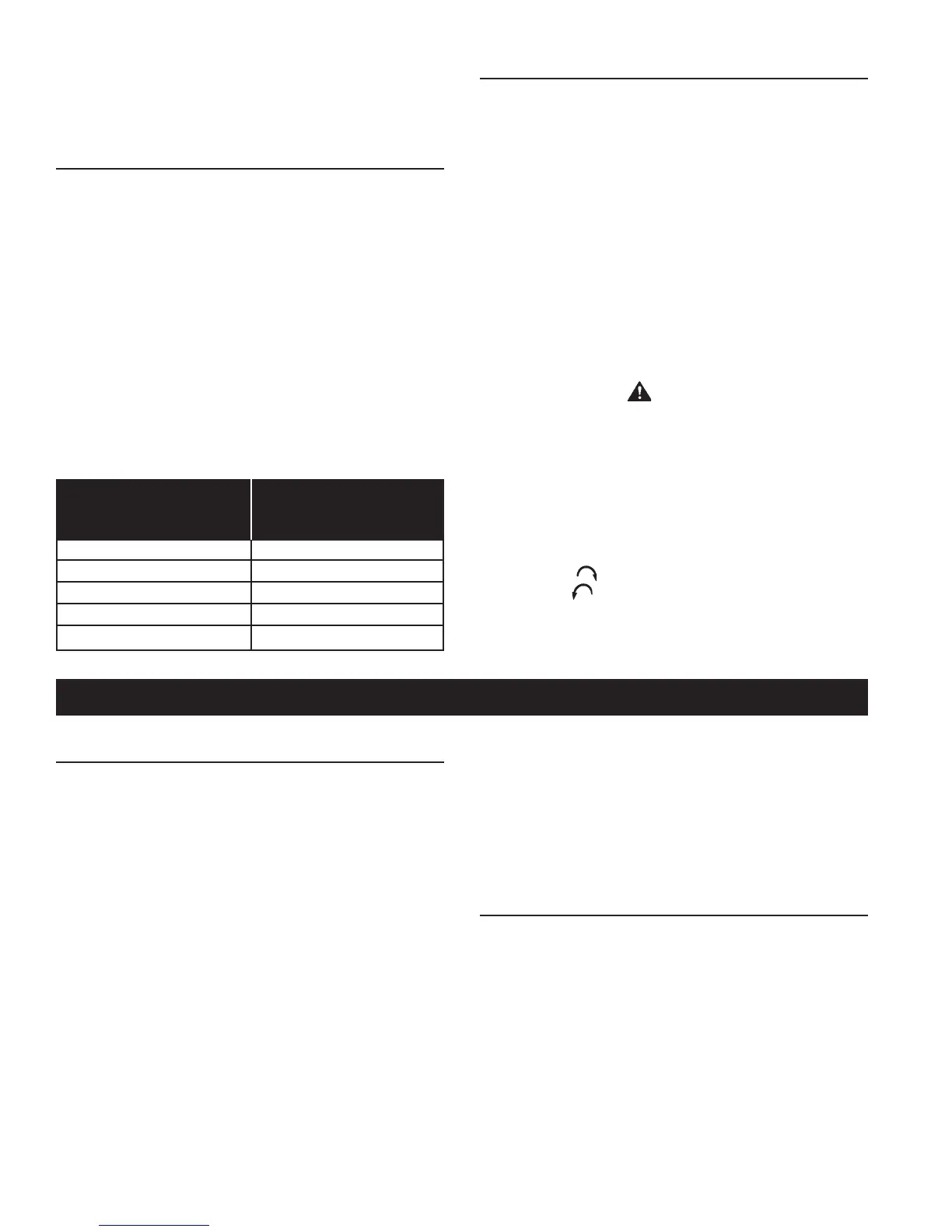
Time to Produce
2nd & 3rd Degree
Temperature Setting Burns on Adult Skin
160°F About 1/2 second
150°F About 1 1/2 seconds
140°F Less than 5 seconds
130°F About 30 seconds
120°F More than 5 minutes
Thermostat Adjustment
On dual element models, both the upper and lower thermostats
have been factory set at HOT (approximately 120°F) to reduce
the risk of scald injury.
The upper and lower thermostats are adjustable if a different
water temperature is desired. Read all warnings in the
“Temperature-Regulation” section before proceeding.
NOTE: It is not necessary to adjust the upper thermostat.
However, if it is adjusted above the factory set point (120°F/
HOT) it is recommended that it not be set higher than the lower
thermostat setting.
To adjust the temperature setting for both upper and lower
thermostats, proceed as follows:
1. Turn “OFF” the electrical power to the water heater at the
junction box.
WARNING
HAZARD OF ELECTRICAL SHOCK! Before removing any
access panels or servicing the water heater, make sure the
electrical supply to the water heater is turned “OFF”. Failure to
do this could result in DEATH, SERIOUS BODILY INJURY, OR
PROPERTY DAMAGE.
2. Take off the (upper and lower) access panel and insulation
block(s) and pad(s).
3. The slotted adjustment (using a screwdriver) can be turned
clockwise (
) to increase the temperature, or counter
clockwise (
) to decrease the temperature.
4. Replace the insulation block, pad and access panel.
5. Turn “ON” the power supply.
FOR YFOR Y
FOR YFOR Y
FOR Y
OUR INFORMAOUR INFORMA
OUR INFORMAOUR INFORMA
OUR INFORMA
TIONTION
TIONTION
TION
local plumbing contractor for assistance in controlling these
situations.
STRANGE SOUNDS
Possible noises due to expansion and contraction of some
metal parts during periods of heat-up and cool-down do not
represent harmful or dangerous conditions.
Operational Conditions
SMELLY WATER
In each water heater there is installed at least one anode rod
(see parts section) for corrosion protection of the tank. Certain
water conditions will cause a reaction between this rod and
the water. The most common complaint associated with the
anode rod is one of a “rotten egg smell”. This odor is derived
from hydrogen sulfide gas dissolved in the water. The smell is
the result of four factors which must all be present for the odor
to develop:
A. A concentration of sulfate in the supply water.
B. Little or no dissolved oxygen in the water.
C. A sulfate reducing bacteria within the water heater. (This
harmless bacteria is non-toxic to humans.)


 To Next Page