20
Use this guide to check a “Leaking” water heater. Many
suspected “Leakers” are not leaking tanks. Often the source of
the water can be found and corrected.
If you are not thoroughly familiar with electric codes, the water
heater, and safety practices, contact a local electrical contractor
and/or the local electric utility to check the
water heater.
CAUTION
Read this manual first. Then before checking the water heater
make sure the electric supply has been turned “OFF”, and never
turn the electric supply “ON” before the tank is completely full of
water.
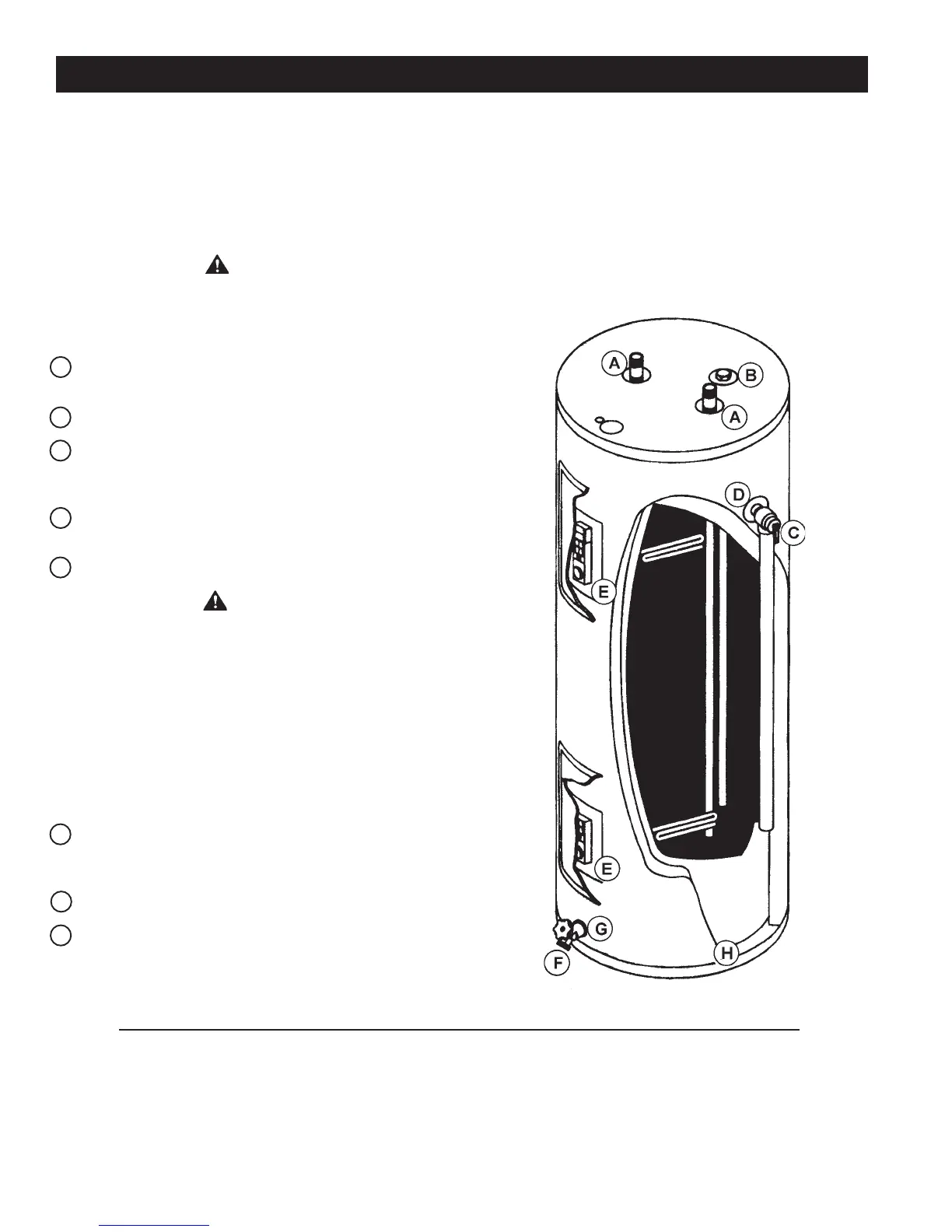
A *Condensation may be seen on pipes in humid weather or
pipe connections may be leaking.
B *The primary anode rod fitting may be leaking.
C Small amounts of water from temperature-pressure relief
valve may be due to thermal expansion or high water
pressure in your area.
D *The temperature-pressure relief valve may be leaking at
the tank fitting.
E The element may be leaking at the tank fitting.
WARNING
HAZARD OF ELECTRICAL SHOCK! Before removing any
access panels or servicing the water heater, make sure the
electrical supply to the water heater is turned “OFF”. Failure to
do this could result in DEATH, SERIOUS BODILY INJURY, OR
PROPERTY DAMAGE.
Turn electrical power “OFF”, remove access panel, insulation
block and pad. If leaking around element, follow proper draining
instructions and remove element. Reposition or replace gasket
on element. Place element into opening and tighten securely.
Then follow “Filling the Water Heater” instructions in the
“Installing the New Water Heater” section.
F Water from drain valve may be due to the valve being opened
slightly. (NOTE: some models may not be equipped with a
drain valve.)
G *The drain valve may be leaking at the tank fitting.
H *Water in the water heater bottom or on the floor may be
from condensation, loose connections or the temperature-
pressure relief valve. DO NOT replace the water heater until
a full inspection of all possible water sources is made and
necessary corrective steps taken.
LEAKAGE CHECKPOINTSLEAKAGE CHECKPOINTS
LEAKAGE CHECKPOINTSLEAKAGE CHECKPOINTS
LEAKAGE CHECKPOINTS
Leakage from other appliances, water lines, or ground seepage
should also be checked.
* To check where threaded portion enters tank, insert cotton
swab between jacket opening and fitting. If cotton is wet,
follow “Draining” instructions in the “Periodic Maintenance”
section and then remove fitting. Put pipe dope or teflon tape
on the threads and replace. Then follow “Filling the Water
Heater” instructions in the “Installing the New Water Heater”
section.


 To Next Page