10
Temperature-Pressure Relief Valve
WARNING
At the time of manufacture this water heater was provided with
a combination temperature-pressures relief valve certified by
a nationally recognized testing laboratory that maintains
periodic inspection of production of listed equipment or
materials, as meeting the requirements for Relief Valves and
Automatic Gas Shut-off Devices for Hot Water Supply Systems,
and the current edition of ANSI Z21.22 • CSA 4.4 and the code
requirements of ASME. If replaced, the valves must meet the
requirements of local codes, but not less than a combination
temperature and pressure relief valve certified as meeting the
requirements for Relief Valves and Automatic Gas Shut-off
Devices for Hot Water Supply Systems, ANSI Z21.22 • CSA 4.4
by a nationally recognized testing laboratory that maintains
periodic inspection of production of listed equipment or
materials.
The valves must be marked with a maximum set pressure
not to exceed the marked hydrostatic working pressure of the
water heater (150 lbs. p.s.i.) and a discharge capacity not less
than the water heater input rate as shown on the model rating
plate. (Electric heaters - watts divided by 1000 x 3412 equal
BTU/Hr. rate.)
Your local jurisdictional authority, while mandating the use of a
temperature-pressure relief valve complying with ANSI Z21.22
• CSA 4.4 and ASME, may require a valve model different from
the one furnished with the water heater.
Compliance with such local requirements must be satisfied
by the installer or end user of the water heater with a locally
prescribed temperature-pressure relief valve installed in the
designated opening in the water heater in place of the factory
furnished valve.
For safe operation of the water heater, the relief valves must
not be removed from their designated openings or plugged.
The temperature-pressure relief valves must be installed
directly into the fitting of the water heater designated for the
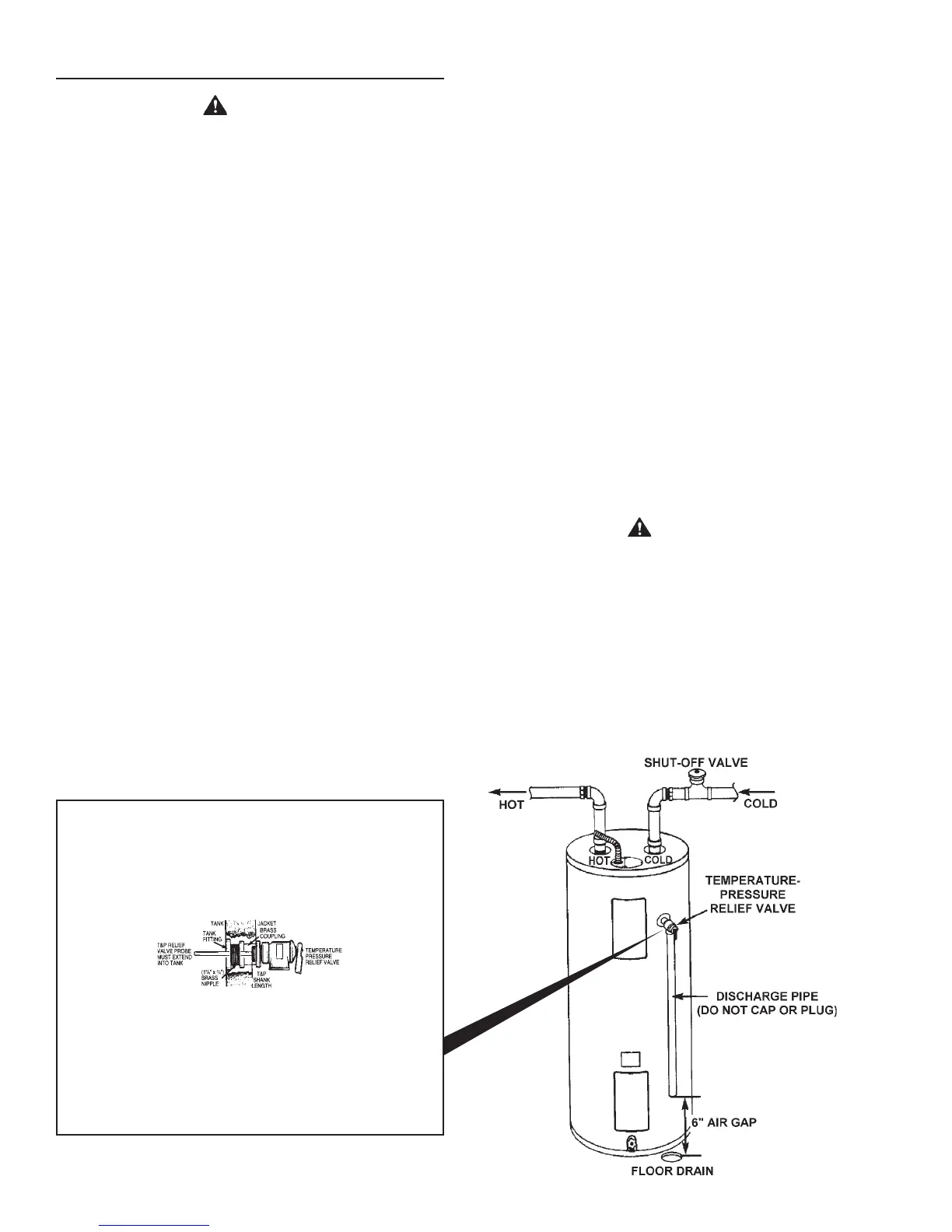
relief valve. Provide tubing so that any discharge will exit only
within 6 inches above, or at ant distance below the structural
floor. Be certain that no contact is made with any live electrical
part. The discharge opening must not be blocked or reduced
in size under any circumstances. Excessive length, over 30
feet, or use of more than four elbows can cause restriction and
reduce the discharge capacity of the valve.
No valve or other obstruction is to be placed between the relief
valves and the tank. Do not connect tubing directly to discharge
drain unless a 6" air gap is provided. To prevent bodily injury,
hazard to life, or property damage, the relief valves must be
allowed to discharge water in quantities should circumstances
demand. If the discharge pipes are not connected to a drain or
other suitable means, the water flow may cause property
damage.
The Discharge Pipe:
• Must not be smaller in size than the outlet pipe size of the
valve, or have any reducing couplings or other restrictions.
• Must not be plugged or blocked.
• Must be of material listed for hot water distribution.
• Must be installed so as to allow complete drainage of both
the temperature-pressure relief valve, and the discharge
pipe.
• Must terminate at an adequate drain.
• Must not have any valve between the relief valve and tank.
WARNING
The temperature-pressure relief valve must be manually
operated at least once a year. Caution should be taken to ensure
that (1) no one is in front of or around the outlet of the
temperature-pressure relief valve discharge line, and (2) the
water manually discharged will not cause any bodily injury or
property damage because the water may be extremely hot.
If after manually operating the valve, it fails to completely reset
and continues to release water, immediately, close the cold
water inlet to the water heater, follow the draining instructions,
and replace the temperature-pressure relief valve with a new
one.
This water heater is provide with a combination Temperature-Pressure Relief Valve listed as complying
with the standard for Relief Valves and Automatic Gas Shut-off Devices for Hot Water Supply Systems,
ANSI Z21.22 and the code requirements of ASME.
Your local jurisdictional authority, while mandating the use of a Temperature-Pressure Relief Valve
complying with ANSI Z21.22 and ASME, may require a valve model different from the one furnished
with the water heater.
Compliance with such local requirements must be satisfied by the installer or end user of the water
heater with a locally prescribed Temperature-Pressure Relief Valve installed in the designated
opening in the water heater.
• If a short shank (less than 2”) temperature-pressure relief valve is to be installed (as shown),
a nipple and coupling must be used.
• If a long shank (2” or longer) is to be installed, do not use the nipple and coupling.
“Install Temperature-Pressure protective equipment required by local codes, but not less than a
combination Temperature-Pressure Relief Valve certified as meeting the requirements for Relief
Valves and Automatic Gas Shut-off Devices for Hot-Water Supply Systems, ANSI Z21.22 by a nationally
recognized testing laboratory that maintains periodic inspection of production of listed equipment
or materials. The valve must be oriented, provided with tubing, or otherwise installed so that discharge
can exit only within 6 inches above, or at any distance below the structural floor, and cannot contact
any live electrical part.”
For safe operation of the water heater, the Relief Valve must not be removed or plugged.
See manual heading - “Temperature-Pressure Relief Valve” for installation and maintenance of Relief
Valve, discharge line and other safety precautions.
WARNING “RELIEF VALVE OPENING”


 To Next Page