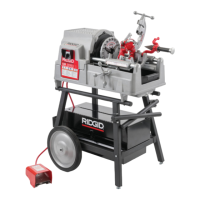
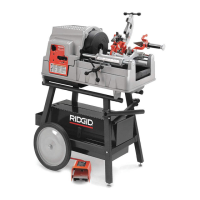
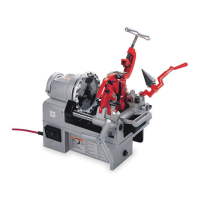
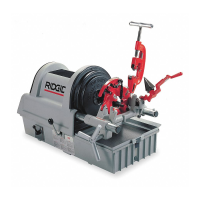
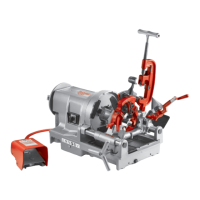
The RIDGID 535 Manual Pipe and Bolt Threading Machine is an electric motor-driven tool designed for threading, cutting, and reaming pipe, conduit, and rod (bolt stock). It centers and chucks the workpiece, rotating it to perform these operations. The machine offers both left-hand and right-hand rotation, selectable via a FOR/OFF/REV switch. An automatic oiling system ensures that the work is flooded with thread cutting oil during threading, optimizing performance and prolonging die life. Additionally, the 535 Threading Machine can be used as a power source for roll grooving equipment, attaching to the carriage rail to form standard roll grooves on various pipe sizes and materials.
Important Technical Specifications:
- Threading Capacity:
- Pipe: 1/8" through 2"
- Bolt: 1/4" through 2"
- Geared Threaders: Pipe 2 1/2" through 6"
- Chuck: Speed Grip Chuck with replaceable Jaw Inserts
- Rear Centering Device: Scroll Operated, rotates with chuck
- Operating Speed: 36 RPM or 54 RPM (depending on the model)
- Motor: Universal, 1/2 HP
- Volts: 120V Single Phase AC 25-60 Hz (230V available on request)
- Amps: 15 Amps (36 RPM) / 18 Amps (54 RPM)
- Controls: Rotary Type FOR/OFF/REV Switch & ON/OFF Foot Switch
- Pump: Gerotor-Type (self-priming for current models; older models may require priming)
- Cutter:
- No. 820 - Roll-Type Cut-Off, Self-Centering, Full Floating (Pipe 1/8" through 2", Bolt 1/4" through 1")
- No. 821 - Blade-Type Cut-Off, Self-Centering, Full Floating, Dovetail-Type Cut-Off and Chamfering Tool (Pipe 1/2" through 2")
- Reamer: No. 341 - Positive-Locking, 5-Flute Cone, Right Hand (1/8" through 2")
- Weight: 260 lbs. (Less Die Head & Dies)
- Standard Equipment (Model No. 535 Manual Threading Machine with Foot Switch):
- 1 - No. 811-A Universal Quick-Opening Die Head
- 1 - No. 341 Reamer
- 1 - No. 820 Cutter
- 1 - Set 1/2" - 3/4" Universal Alloy Dies
- 1 - Set 1" - 2" Universal Alloy Dies
- 1 - Gallon Premium Oil
- 4 - Hex Wrenches
- 1 - Spare E-1032 Cutter Wheel
Usage Features:
The RIDGID 535 is designed for efficient and safe operation, with several features enhancing its usability:
- Foot Switch Control: A critical safety feature, the foot switch allows the operator to quickly shut off the motor by removing their foot, providing better control and reducing the risk of entanglement, especially given the machine's high torque. The foot switch should always be present and functional.
- Directional Switch (FOR/OFF/REV): This rotary switch allows for easy selection of forward, off, or reverse rotation, accommodating both right-hand and left-hand threading operations (though left-hand threading requires an optional pump kit and special die head).
- Die Head Options: The machine supports various die heads, including Quick-Opening, Self-Opening, and Semi-Automatic types, offering flexibility for different threading needs.
- Quick-Opening 811A Die Head: Requires manual rotation of a throwout lever to open dies upon thread completion.
- Self-Opening 815A Die Head: Automatically opens the dies when the die head trigger contacts the end of the pipe.
- Semi-Automatic Die Head: Requires a tap on the handle for dies to release when the end of the pipe is flush with the end of the number 1 die.
- Pipe and Bolt Threading: Capable of threading a wide range of pipe and bolt sizes, with specific die sets available for NPT, NPSM, BSPT, and BSPP threads, as well as UNC, UNF, and BSW bolt forms.
- Integrated Cutter and Reamer: The No. 820 Cutter and No. 341 Reamer are machine-mounted, allowing for convenient cutting and reaming of pipe ends before threading. These tools swing into position for use and back up when not needed.
- Length Gauge: The machine carriage includes a length gauge for precise cutting, allowing operators to set the desired length by aligning the cutter wheel with the stock end and adjusting the pointer.
- Rear Centering Device: This scroll-operated device, tightened with a handwheel, secures the pipe and prevents oscillation, which is crucial for achieving high-quality threads.
- Speed Grip Chuck: The front chuck uses replaceable jaw inserts and is tightened with a handwheel, "hammering" the jaws tightly around the pipe for a secure grip.
- Oil System: An automatic oiling system floods the work with thread cutting oil during operation, ensuring proper lubrication and cooling for optimal thread quality and extended die life. The reservoir holds approximately seven quarts of oil.
- Workpiece Support: For long or heavy pipes (extending more than four feet beyond the machine), pipe supports (e.g., VJ-99, RJ-99) are recommended to prevent tipping and oscillation.
- Mounting Options: The machine can be mounted on universal stands (100A, 150A, 200A) or securely bolted to a stable bench using four 5/16" bolts.
Maintenance Features:
Regular maintenance is crucial for the longevity and safe operation of the RIDGID 535 Threading Machine. The manual outlines several key maintenance procedures:
- Daily Inspection:
- Verify the machine is unplugged and the directional switch is OFF.
- Clean speed chuck jaws with a wire brush.
- Inspect jaw inserts for wear and replace if necessary.
- Ensure the foot switch is present and attached.
- Check the power cord and plug for damage or modifications.
- Inspect for broken, missing, misaligned, or binding parts.
- Lubrication:
- Apply grease to shaft bearing grease fittings every 2 to 6 months, depending on usage frequency.
- Apply a moderate coat of lubricating grease to the large gear each time bearings are lubricated.
- Oil System Maintenance:
- Replace thread cutting oil when it becomes dirty or contaminated. A drain plug is provided for easy oil removal.
- Clean the oil filter screen, located in the bottom of the oil reservoir, to ensure proper oil flow. The screen can be pulled out after loosening a securing screw and cleaned with solvent and compressed air.
- The manual emphasizes using RIDGID Thread Cutting Oil for high-quality threads and maximum die life.
- Jaw Insert Replacement: When the teeth on jaw inserts become worn and fail to hold the workpiece, the entire set should be replaced. The process involves using a screwdriver to manipulate the insert and locking pin.
- Motor Brush Replacement: Motor brushes should be checked every six months and replaced if worn to less than 1/2". If the commutator is worn, its outer dimensions should be turned, and the mica undercut before replacing brushes.
- Priming Oil Pump: Current 535 machines feature a self-priming gerotor-type pump. Older Model A vane-type pumps (prior to June 1, 1996) may require priming by removing a button plug and primer screw, then filling the pump with oil.
- Machine Storage: The machine should be stored indoors, well-covered, in a locked area out of reach of children and untrained users to prevent accidental starting and serious injury.

 Need help?
 General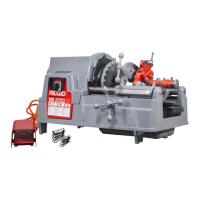

 To Next Page