12
Troubleshooting
There are a wide variety of symptoms that can be related to something as simple as a blown fuse. The braking Unit, the
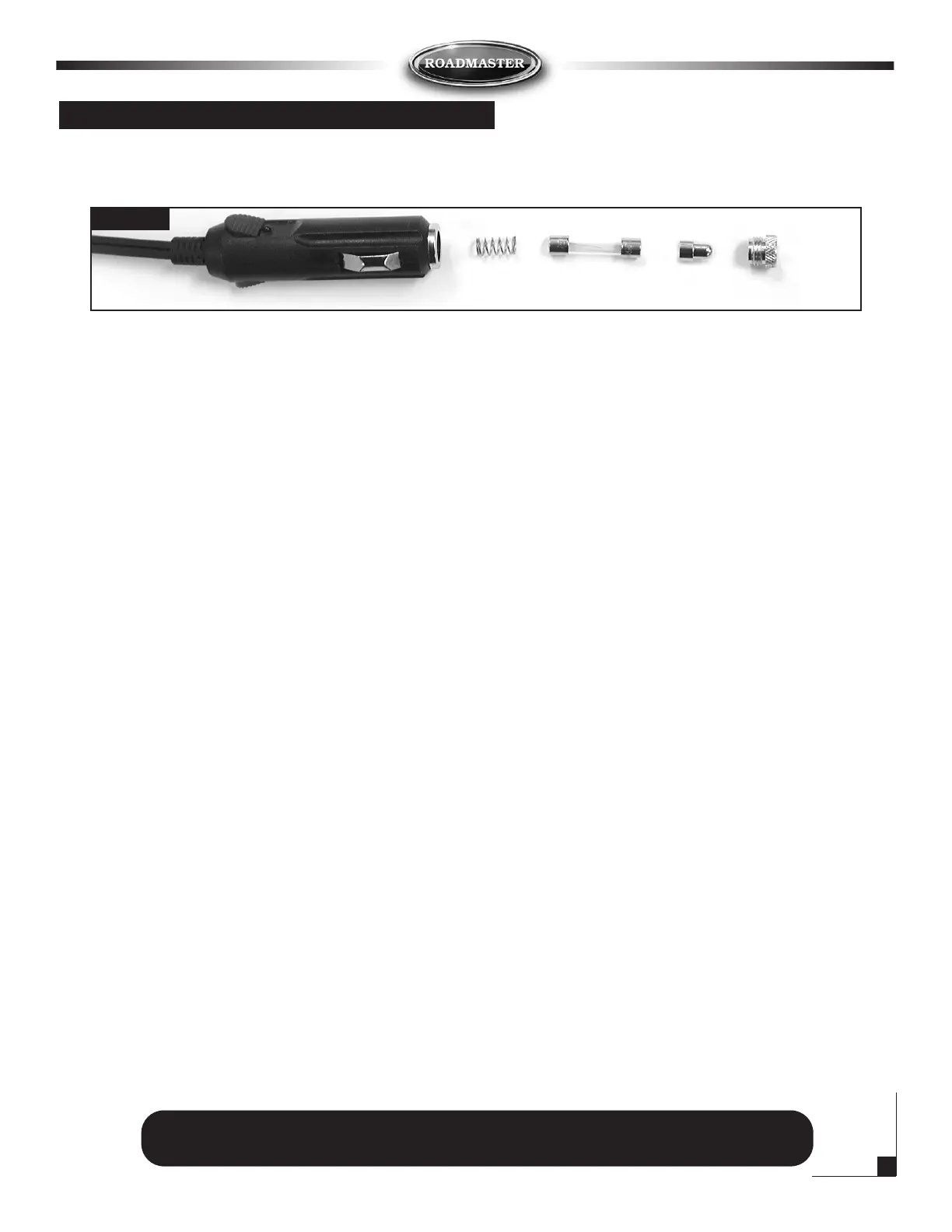
Receiver, and the Transmitter each have their own fuse built into the end of the power cord. Simply unthread the ring at
the end of the plug to remove the fuse. Be careful not to lose the spring inside. See figure 5.
12 volt plug
Spring Fuse Screw cap
Symptom: The red light on the system continually flashes and does not stop.
Solution: This is your low battery voltage alarm. Please refer to the section titled “Brake Alert Operation” to see
what this means and what to do.
Symptom: Red light flickers over rough terrain or when not braking.
Solution: a.) Whenever the RV decelerates, the Unit’s module board will call for braking and send a signal to
the Receiver in the motorhome causing the red light to illuminate. As a result, you may see the red light
flicker on and off as you go over bumps and potholes (when not braking). It is important to know that
when the red light flashes momentarily, that your brakes are NOT yet activated. In this case, the system
anticipated braking, but then stopped calling for brakes as the deceleration immediately went away.
In short, it is possible for the red light to flicker over rough terrain or slow deceleration, and that this is no
cause for concern as your brakes are not actually depressed unless the red light stays on longer than
momentarily.
b.) If the light is flickering too often, increase sensitivity setting by 1 to make the system less sensitive
to rough terrain. It is important to note however, that the Unit may require more than light stopping
before it will activate.
Symptom: The yellow light remains lit on the Receiver and the red light flashes every 5 seconds or so.
Solution: The reset button on the Receiver has been depressed too long causing the Receiver to go into the
reprogramming mode. This can usually be resolved by unplugging the Receiver. Reconnect and test for proper
operation. If the Receiver is not getting the signal from the Transmitter, then you will need to reprogram the
Receiver as outlined in the section titled “Recoding BrakeAlert”.
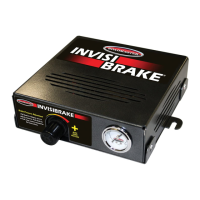
Symptom: My Unit will not fit properly in my vehicle.
Solution: On some vehicles (such as the Jeep Liberty) the door jamb curves in sharply at the bottom restricting the floor
space required for the Unit, In this event, you may be able to raise the feet on the unit to gain adequate clearance.
An additional one inch of height can be gained by using Roadmaster’s optional feet extenders part number 9337-4 (set of 4).
Symptom: The test button is being depressed by the dashboard, it’s too close to the dash.
Solution: In order to alleviate this problem you need to adjust the position of the unit. Do this by:
a.) Lowering the braking system by threading the feet into the unit.
b.) Lowering the braking system further by removing the feet from the unit.
c.) Installing optional cylinder arm extender part number 9336 (1.5 inch) or 9336-3 (3.5 inch)
to allow the unit to sit farther back from the dash board and still reach the brake pedal.
Symptom: The pedal clamp does not fit my brake pedal securely.
Solution: Use a pair of channel locks or pliers to bend the five tabs of pedal clamp assembly to better fit pedal.
Contact Roadmaster in the rare event that your pedal clamp cannot be made to fit your brake pedal. Please have make,
model and whether transmission is manual or automatic when calling Roadmaster.
Symptom: Air cylinder will not extend to connect to pedal clamp.
Solution: Air cylinder is full of air which will not allow pedal clamp to extend. Release air by holding air relief button.
Figure 5
FAILURE TO INSTALL AND OPERATE THE BRAKING SYSTEM AS INSTRUCTED MAY RESULT IN
UNIT TO MALFUNCTION, PROPERTY DAMAGE, PERSONAL INJURY OR DEATH.



 To Next Page