4
Important Notices / Installation
B. IMPORTANT NOTICES
WARNING
WARNING. Read and adhere to the following. Failure to
do so may result in severe or fatal injury.
1. Read and follow the instructions in this manual.
2. Heater to be used only in the hazardous locations
indicated on the heater’s data plate.
3. Heater is for dry indoor use only. Do not immerse in water.
Do not store or use in areas exposed to rain or snow.
4. Heater is to be connected and serviced only by a qualied
electrician experienced with hazardous location equipment.
5. Installation, piping, and wiring of the heater must adhere to
all applicable codes.
6. It is essential that any unit heater that will be used in a
hazardous (classied) location is equipped with an electric
motor approved for such service, and the temperature of
the heat transfer medium is below the ignition temperature
of the atmosphere. Refer to applicable electrical codes for
additional information.
7. Disconnect heater from power supply at integral
disconnect or fuse box before opening enclosures or
servicing heater. Lock the switch in the “OFF” (open)
position and/or tag the switch to prevent unexpected
power application. IF INTEGRAL DISCONNECT IS BEING
SERVICED, verify that power has been disconnected
at fuse box or main panel. Lock the switch in the
“OFF” (open) position and/or tag the switch to prevent
unexpected power application.
8. Do not operate heater in atmospheres which are corrosive
to steel or aluminum, unless it has been coated with a
factory approved protective coating.
9. For steam service use only single-pass models. Refer
to Section D. Model Coding, page10 for number of
passes in heat exchanger.
10. Refer to heat exchanger data plate for pressure and
temperature limits.
11. Heater must be kept clean. When operating in a dirty
environment, regularly clean the nned tubes, fan and fan
guard. Follow the recommended maintenance procedures.
Refer to Section A. Heater Maintenance Checklist,
page3 for details.
12. Use factory approved replacement parts only.
13. If there are any questions or concerns regarding the
heater, contact the factory. Refer to the last page of this
manual for details.
14. HVAC uids must be non-ammable, non-compressable,
non-explosive and non-toxic.
15. Do not operate the heater with any of the louvers fully
closed or overriding their stops.
16. Do not operate heater in ambient temperatures above
104°F (40°C).
17. See applicable electrical codes for seal requirements in
eld installed conduits. Factory installed conduits require
no further sealing.
18. Base of the heater is to be mounted a minimum of 7.9ft
(2.4m) above the oor. Refer to Section C. Installation,
page4 for details.
C. INSTALLATION
WARNING
WARNING. Warranty will be void if instructions are not
followed.
The installation instructions provide a general guideline for the
installation and wiring of the heater.
All applicable codes must be adhered to.
C.1 Mechanical
1. For optimum heating, the heaters should be installed as
follows:
1.1 There are no obstructions that may impede the
heater’s air inlet or discharge.
1.2 The air discharge is directed into open areas and not
at occupants.
1.3 The air discharge is not directed at a thermostat.
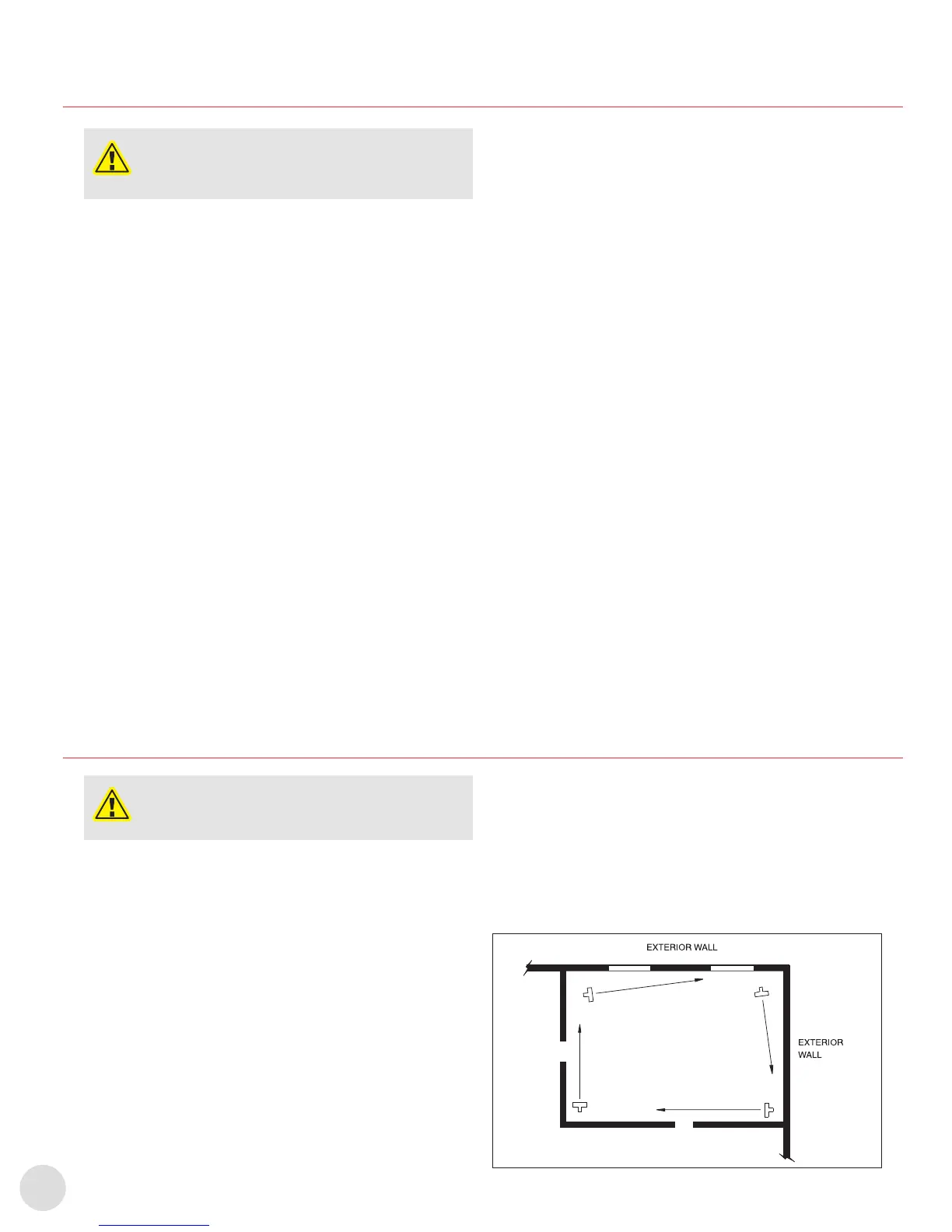
1.4 The air discharge is directed across areas of heat
loss, such as doors and windows (Figure1).
1.5 The air discharge is directed along, and at a slight
angle towards, exterior walls (see Figure1).
1.6 If equipment freeze protection is important, direct air
discharge at equipment.
1.7 Air discharge streams support each other and create
a circular air ow. It is not required that the heater’s
air throw reaches the next heater.
1.8 For warehouses or large workshops it may be
acceptable to use fewer, larger heaters.
1. Read and follow the instructions in this manual.
2. Heaters are to be installed and serviced only
by qualified personnel experienced in electrical and
piping work.
3. Installation, piping, and wiring of he heater must
adhere to all applicable codes.
4. It is essential that any unit heater that will be used
in a hazardous (classified) location is equipped with
a electric motor approved for such service, and the
temperature of the heat transfer medium is below
the ignition temperature of the atmosphere.
5. Do not operate heater in atmospheres which are
corrosive to steel or aluminum, unless it has been
coated with a factory approved protective coating.
6. For steam service use only single-pass models.
Refer to model coding (page 7) for number of
passes in heat exchanger.
7. Refer to heat exchanger data plate for pressure
and temperature limits.
8. Heater must be kept clean. When operating in
a dirty environment, regularly clean the finned
tubes, fan and fan guard. Follow the recommended
maintenance procedures. Refer to the “Heater
Maintenance Checklist” section for details.
9. Use factory approved replacement parts only.
10. If there are any questions or concerns regarding
the heater, contact the factory. Refer to the last
page of this manual for details.
WARRANTY W I LL B E V OID
I F INSTR U C TIONS ARE NO T F O L LOW E D
INSTALLATION
The installation instructions provide a general guideline for the installation and wiring of the heater.
All applicable codes must be adhered to.
MECHANICAL
LOCATION
1. For optimum heating, the heaters should be installed as
follows:
a. There are no obstructions that may impede the heater’s
air inlet or discharge.
b. The air discharge is directed into open areas and not at
occupants.
c. The air discharge is not directed at a thermostat.
d. The air discharge is directed across areas of heat loss,
such as doors and windows (see Figure 1).
e. The air discharge is directed along, and at a slight angle
towards, exterior walls (see Figure 1).
f. If equipment freeze protection is important, direct air
discharge at equipment.
g. Air discharge streams support each other and create a
circular air flow. It is not required that the heater’s air
throw reaches the next heater.
h. For warehouses or large workshops it may be
acceptable to use fewer, larger heaters.
- 3 -
FIGURE 1
IMPORTANT NOTICES
WARNING:
Read and adhere to the following. Failure to do so may result in severe or fatal injury.
Figure1


 To Next Page
 Loading...