Need help?
Do you have a question about the S&A CW-5200 Series and is the answer not in the manual?
Steps to test flow switch and relay issues for chiller alarms.
Testing baffle and Hall flow switches by manipulating wires for alarm diagnosis.
Lists reasons and outlines testing for alarms without water circulation.
Diagnosing power supply or pump failure based on voltage checks.
Checking the DC pump rotor for choking or wear as a potential solution.
Addresses E1 alarm for ultrahigh room temperature and its causes/solutions.
Details E2 alarm for ultrahigh water temperature, reasons, and troubleshooting methods.
Testing fan input voltage and thermostat output for E2 alarm.
Testing compressor voltage, capacitor, and overload protector for E2 alarm.
Checking refrigerant leakage and solenoid valve issues for E2 alarm.
Diagnoses compressor rotor malfunction based on vibration and heating.
Explains E3 alarm for ultralow room temperature and its resolution.
Addresses E4 alarm for room temp sensor failure and its causes/testing.
Covers E5 alarm for water temp sensor failure and its causes/testing.
Testing fuse and switching mode power supplies for machine failure.
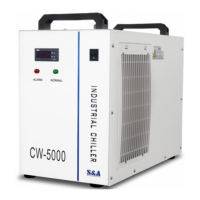
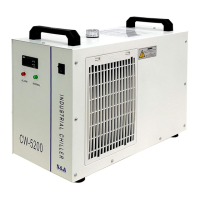
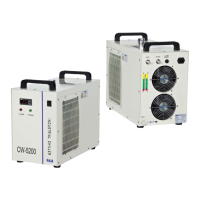
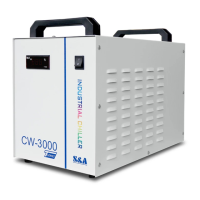
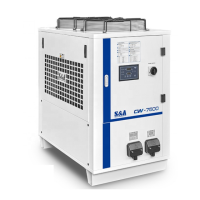
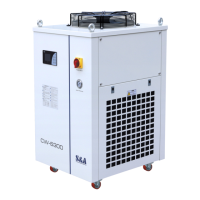
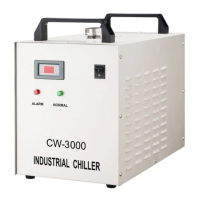
This document outlines the malfunction testing and repair procedures for the S&A CW-5000/5200 Series Industrial Chiller. This chiller is designed to provide cooling for industrial applications, ensuring stable operation of connected equipment by maintaining a consistent water temperature.
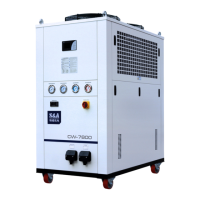
The S&A CW-5000/5200 Series Industrial Chiller serves as a crucial component in various industrial setups, primarily to dissipate heat generated by machinery. Its core function is to circulate cooled water through a system, absorbing heat from the application and then releasing that heat into the ambient environment. This process is managed by a temperature controller, specifically the T-503 model for the CW-5000 series, which monitors and regulates the water temperature to prevent overheating of the connected equipment. The chiller is equipped with a refrigeration system, including a compressor, condenser, and evaporator, to achieve the necessary cooling. A pump circulates the water, and a flow switch ensures that water is indeed moving through the system, triggering an alarm if circulation is interrupted.
The chiller is designed for straightforward operation and includes several features to ensure reliable performance and user awareness. When the chiller is powered on, it initiates water circulation. The temperature controller displays the current water temperature and allows for setting the desired temperature. In normal operation, a green light indicates proper functioning.
A key usage feature is its alarm system, which provides immediate feedback on potential issues. Alarms are indicated by a red light flash and, in the case of the T-503 controller, an audible buzzer accompanied by a specific error code display. These codes, such as E1 for ultrahigh room temperature, E2 for ultrahigh water temperature, E3 for ultralow room temperature, E4 for room temperature sensor failure, and E5 for water temperature sensor failure, guide the user in diagnosing problems. The alarm sound can be temporarily suspended by pressing any button on the controller, but the visual display of the alarm condition persists until the underlying issue is resolved.
For optimal performance, the chiller requires a ventilated location, with specific clearances for air inlet (at least 30cm from obstructions) and air outlet (at least 50cm). Regular cleaning of the dust gauze is also essential to maintain efficient heat exchange and prevent the accumulation of dust on the condenser. The chiller operates with purified water, and users are advised to ensure the water level in the tank is above the pump inlet.
The manual provides comprehensive guidance for troubleshooting and repairing common malfunctions, emphasizing a systematic approach to maintenance.
Alarm with Water Circulation (Red Light Flash): If the chiller alarms with a red light flash while water is circulating, the first step is to perform a short-circuit test by connecting the chiller's outlet and inlet with a 1-meter water pipe.
Water Current On and Off, Alarm Continues (Red Light Flash): This scenario suggests issues with pipe choking, switching mode power supplies, or the DC pump.
Alarm Without Water Circulation (Red Light Flash): This type of alarm often indicates a low water level, an issue with the switching mode power supplies, or a DC pump failure.
Temperature Controller T-503 Alarms (with Code Display): The manual provides specific troubleshooting for each error code:
Machine Does Not Work When Power Is On:
Overall, the manual emphasizes a step-by-step diagnostic process, often involving visual inspection, voltage checks with testing tools, and component replacement as necessary. This structured approach allows users or technicians to effectively identify and resolve issues, ensuring the longevity and optimal performance of the S&A CW-5000/5200 Series Industrial Chiller.
 General
| Refrigerant | R-410A |
|---|---|
| Temperature Control Range | 5-35°C |
| Power Supply | 220V 50Hz |
| Tank Capacity | 50L |
| Precision | ±1°C |


 To Next Page