EasyManua.ls Logo

Sansui AU-6500 - STEREO UPGRADES; 4-Channel System Integration; Electronic Crossover Setup

Sansui AU-6500
27 pages
Print Icon
To Next Page IconTo Next Page
To Previous Page IconTo Previous Page
Loading...
UPGRADING
YOUR
STEREO
4-Channel
Stereo
System
The
sound
we
hear
daily
is
a
mixture
of
the
sound
that
reaches
our
ears
straight
from
the
sound
source—be
it
a
musical
instrument,
a
jet,
a
man’s
mouth
cr
what
have
you—and
the
‘indirect
sounds’
that
arrive
at
our
earsonly
after
they
are
reflected
off
various
surfaces,
such
as
the
walls,
ceiling
and
so
forth.
Four-channel
recordings
are
made
using
two
microphones
in
the
front
of
the
concert
hall
and
two
in
the
rear
(to
simplify
the
explanation).
The
‘indirect
sounds’
with
their
complicated
waveforms
are
mainly
picked
up
by
the
two
microphones
in
the
rear,
and
reproduced
out
of
the
two
rear
speakers
in
a
4-channel
stereo
set-up
for
greatly
enhanced
‘ambience’
effects.
The
effect
is
almost
as
if
the
original
live
performance
were
re-played
right
in
your
own
room.
|
This
new
approach
can
now
be
yours
simply
by
adding
certain
equipment—mainly,
a
Sansui
4-
channel
rear
amplifier
with
its
unique
QS
(RM)
synthesizer
decoder
matrix
(patents
pending),
and
a
second
pair
of
speaker
systems—to
your
2-channel
stereo
system.
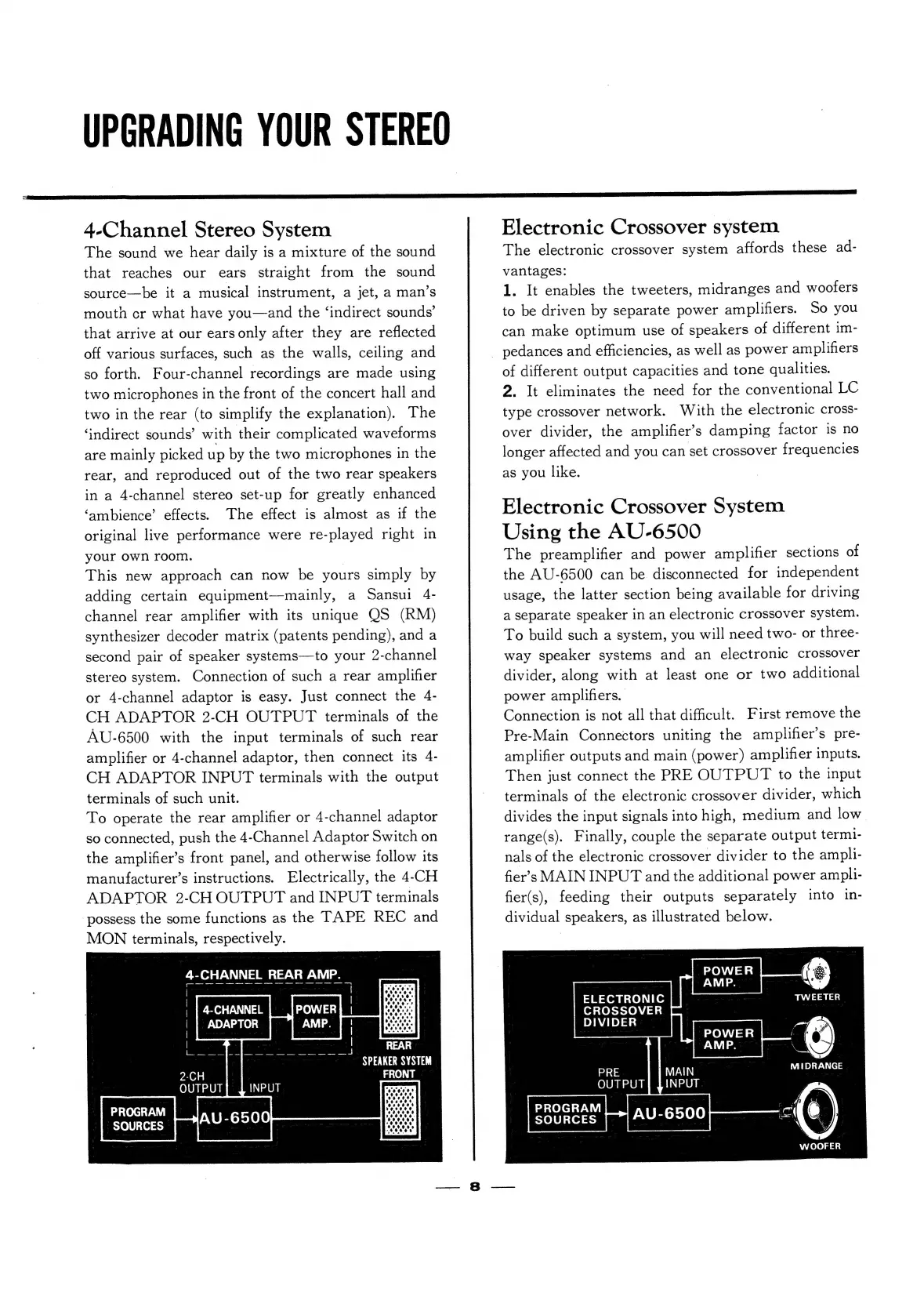
Connection
of
such
a
rear
amplifier
or
4-channel
adaptor
is
easy.
Just
connect
the
4-
CH
ADAPTOR
2-CH
OUTPUT
terminals
of
the
AU-6500
with
the
input
terminals
of
such
rear
amplifier
or
4-channel
adaptor,
then
connect
its
4-
CH
ADAPTOR
INPUT
terminals
with
the
output
terminals
of
such
unit.
To
operate
the
rear
amplifier
or
4-channel
adaptor
so
connected,
push
the
4-Channel
Adaptor
Switch
on
the
amplifier’s
front
panel,
and
otherwise
follow
its
manufacturer’s
instructions.
Electrically,
the
4-CH
ADAPTOR
2-CH
OUTPUT
and
INPUT
terminals
possess
the
some
functions
as
the
TAPE
REC
and
MON
terminals,
respectively.
4-CHANNEL
REAR
AMP.
4-CHANNEL
ADAPTOR
Electronic
Crossover
system
The
electronic
crossover
system
affords
these
ad-
vantages:
1.
It
enables
the
tweeters,
midranges
and
woofers
to
be
driven
by
separate
power
amplifiers.
So
you
can
make
optimum
use
of
speakers
of
different
im-
_
pedances
and
efficiencies,
as
well
as
power
amplifiers
of
different
output
capacities
and
tone
qualities.
2.
It
eliminates
the
need
for
the
conventional
LC
type
crossover
network.
With
the
electronic
cross-
over
divider,
the
amplifier’s
damping
factor
is
no
longer
affected
and
you
can
set
crossover
frequencies
as
you
like.
Electronic
Crossover
System
Using
the
AU-6500
The
preamplifier
and
power
amplifier
sections
of
the
AU-6500
can
be
disconnected
for
independent
usage,
the
latter
section
being
available
for
driving
a
separate
speaker
in
an
electronic
crossover
system.
To
build
such
a
system,
you
will
need
two-
or
three-
way
speaker
systems
and
an
electronic
crossover
divider,
along
with
at
least
one
or
two
additional
power
amplifiers.
Connection
is
not
all
that
difficult.
First
remove
the
Pre-Main
Connectors
uniting
the
amplifier’s
pre-
amplifier
outputs
and
main
(power)
amplifier
inputs.
Then
just
connect
the
PRE
OUTPUT
to
the
input
terminals
of
the
electronic
crossover
divider,
which
divides
the
input
signals
into
high,
medium
and
low
range(s).
Finally,
couple
the
separate
output
term1-
nals
of
the
electronic
crossover
divider
to
the
ampli-
fier’s
MAIN
INPUT
and
the
additional
power
ampli-
fier(s),
feeding
their
outputs
separately
into
in-
dividual
speakers,
as
illustrated
below.
ELECTRONIC
CROSSOVER
DIVIDER
PROGRAM
70)
8]
£69
WOOFER

Related product manuals