The MiniTRACE CSDF is a multifunctional contamination and survey meter developed by Saphymo GmbH, designed for use in nuclear plants, reprocessing sites, research centers, hospitals, and by occupational groups such as armed forces, police, or fire departments. It offers ease of use for identifying possible contamination quickly and can also function as a survey meter.
Function Description:
The MiniTRACE CSDF is equipped with an energy-compensated Geiger-Mueller pancake detector, allowing it to determine the ambient dose rate equivalent (H*(10)) in µSv/h. It is also suitable for food measurements and wipe tests. The device can measure alpha (α), beta (β), and gamma (γ) radiation. With the lid closed, it primarily measures gamma radiation and provides energy-compensated dose rate readings. When the protective lid is open, the pancake detector is exposed, enabling the measurement of α-, β-, and γ-radiation.
The instrument offers several operation modes:
- Rate mode (RATE): Displays dose rate in µSv/h. Requires the lid to be closed for correct energy compensation to H*(10). This mode reacts quickly to changes in radiation levels.
- Rate mean mode (RMEAN): Displays the mean dose rate in µSv/h. Also requires the lid to be closed for correct H*(10) compensation. Used for higher precision measurements in stable radiation environments; accuracy increases with longer measurement times. The calculated mean value can be reset by pressing the mode button.
- CPS mode (CPS): Displays count rate in counts per second (cps). This mode reacts quickly to changes in radiation levels and is used to check surface contamination. With the lid closed, only γ-radiation is measured. With the lid open, α-, β-, and γ-radiation can be measured.
- CPS mean mode (CMEAN): Displays the mean count rate in cps. Similar to RMEAN, it provides higher precision in stable radiation environments. The mean value can be reset by pressing the mode button.
- Bq mode (BQ): Measures activity in Bq, based on 4π-calibration. Users can select different radionuclides (Am-241, C-14, Cl-36, Co-60, Cs-137, Sr-90, U-238, or a user-defined factor) via the mode button, each with appropriate calibration factors.
- Bq/cm² mode (BQCM2): Measures surface contamination in Bq/cm², based on ISO 7503-1 calibration. Similar to BQ mode, users can select different radionuclides (Am-241, C-14, Cl-36, Co-60, Cs-137, I-131, Sr-90, U-238, or a user-defined factor).
- Count up mode (CNTUP): Counts pulses over a selected time interval (60, 120, 300, 600, 1800, or 3600 seconds). The end of the measurement is indicated by an acoustic signal.
- Food mode (FOOD): Measures food contamination in Bq/L, calibrated for Cs-137. This mode requires a background (control) measurement and then the food sample measurement, both with the lid closed. Results are precise only if the food is contaminated with Cs-137 and the specified procedure is followed.
The MiniTRACE CSDF does not identify radionuclides; the user must select the appropriate radionuclide for Bq and Bq/cm² measurements.
Important Technical Specifications:
- Display Unit: µSv/h, cps, Bq, Bq/cm², Bq/l.
- Display and Measurement Range:
- Dose rate: 0.00 µSv/h to 5,000 µSv/h.
- Pulses: 0.0 to 10,000 cps.
- Activity: 0 to max. 100,000 Bq (radionuclide-dependent).
- Surface activity: 0 to approx. 5,000 Bq/cm² (radionuclide-dependent).
- Food: 500 to 100,000 Bq/L (related to Cs-137, 30% statistical uncertainty for 1 Sigma, at 0.1 µSv/h background radiation).
- Gamma Sensitivity (Cs-137): 4.3 Counts/sec./µSv/h.
- Energy Response for Dose Rate Measurements: 24 keV to 1,253 keV +/- 40% (lid closed, GM tube energy compensated).
- Detector: Geiger-Mueller pancake, max. diameter 53.6 mm; active diameter 44.5 mm; active counter tube surface 15.55 cm²; window 2.0 mg/cm².
- Grid: 0.8 mm thick stainless steel, easily removable, 80% transparent.
- Distance between grid and detector surface: 3.6 mm.
- Measurement Intervals: Automatic adjustment from 1 to 60 seconds. Adjustable in Count up mode by buttons.
- Display: 6-digit 7-segment LCD display plus 5-digit alphanumeric display for alarm and status reports.
- Alarm Thresholds: User-configurable via software for dose rate, cps, activity, and surface contamination.
- Alarm: Visual and acoustic. The frequency of the beep increases with the level of the alarm threshold.
- Acoustic Registration of Impulses: Can be activated by buttons and MiniTRACE Software.
- Reference Source: Co-60 (DIN ISO 8769 DKD certified) and Cs-137 (Source number: CDC 7915).
- User Calibration: Possible using infrared interface.
- Battery Life: Typically 2,000 hours.
- Energy Supply: 2 batteries (type: LR6, AA, MN 1500), protected against changes to polarity.
- Operational Temperature Range: -10°C to +40°C (14°F to 104°F).
- Weight; Dimensions: 320 g incl. batteries; 82 mm x 24 mm x 139 mm.
- Compatibility: IEC 60325, IEC 60846 (partially), IEC 61000-3.
- Accessories (optional): User software for changing settings by infrared communication, infrared reader, accessories for food and wipe tests.
Usage Features:
- Display Information: The display shows measurement results, units (cps, Bq, Bq/cm², µSv/h, counts, Bq/l), and status reports (e.g., CAPT for detector error, SAT for saturation, battery warning, statistical uncertainty E < %).
- Alarm Function: One alarm threshold can be set for each unit (µSv/h, cps, Bq, Bq/cm²) via software. The alarm can be activated or deactivated using the mode button.
- Contamination Measurements: For surface contamination, a two-step process is recommended:
- Measure γ-contamination with the lid closed.
- Measure α-, β-, and γ-contamination with the lid open.
- To isolate β-contamination, measure with the lid open and a sheet of paper on the detector, then subtract this from the γ-contamination measurement.
- To isolate α-contamination, subtract the measurement with paper from the measurement without paper (both with lid open).
- For higher precision, background radiation should be measured and subtracted.
- Wipe Test: A common indirect method for measuring non-adherent surface contamination. Involves taking a wipe sample, placing it in a supplied measuring cup, and measuring with the MiniTRACE CSDF positioned on a measurement device with the lid open. Background measurement is crucial for accuracy.
- Food Measurement: Requires a specific procedure:
- Determine background radiation (control measurement) with an empty cup in the measurement device. This measurement takes about 2 hours for optimal accuracy.
- Fill the measuring cup precisely to 0.6 L with the food sample (mashed for solid food) and measure with the lid closed.
- The calibration is only valid with the supplied measuring cup and holder.
- Results are given in Bq/L and can be converted to Bq/kg using the food's net weight and the cup's volume.
- Test Source: A small U-238 test source (25 Bq) is provided for function checks. The procedure involves measuring environmental background, then measuring with the test source in the measurement device (lid open, CMEAN mode), and subtracting the background. This should be done upon delivery and every six months.
- Protective Rubber Casing: Increases the distance between the counter and the surface by approximately 2 mm, which can influence measurement precision. Calibration factors for contamination measurements are valid for a 3 mm distance between the grid and surface.
- Accessories: Various accessory sets are available for wipe tests, food measurements, test source use, and communication. These include a communication kit (IR transmitter, adapter, software), wipe test kit (measurement device, sample dishes, wipe samples), food measuring kit (measuring cup, holder), tweezers, rubber gloves, pen, test source, belt case, Peli Box, and transportation box.
Maintenance Features:
- Changing Batteries: The instrument uses 2 AA batteries (MN 1500, LR6). Batteries are changed by opening the battery compartment on the back. The instrument is protected against incorrect polarity.
- Cleaning (Decontaminating):
- Removing the Grid: The protective grid can be removed by loosening two screws. It is crucial to close the protective lid first to avoid damaging the counter tube.
- Cleaning the Case: The case should be cleaned with a damp cloth; solvents should not be used.
- Calibration: The instrument is factory-calibrated using a Co-60 plane source (DKD certified, DIN ISO 8769) and Cs-137 for ambient dose rate equivalent. Users can perform their own calibration and set individual user calibration factors via the optional MiniTRACE software. Recalibration frequency depends on national law and requirements, typically every six months in Germany.
- Warranty: 12 months from delivery, voided by improper handling, water immersion, damage to the counter tube, dropping, unauthorized opening (except for grid removal or battery change), improper air transport (without appropriate box), or treatment with detergents/solvents.

 Need help?
 General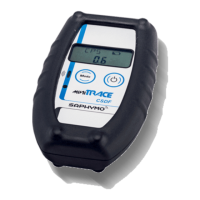

 To Next Page