Schaeffler Technologies
MON 100
15
Fitting
Checking the dimensional and
running accuracy of
the bearings
To check the dimensional tolerances D and d, loosen the retaining
screws used to secure the bearing during transport.
The data supplied for the bearing diameter in TPI 120, High Precision
Bearings for Combined Loads, and in Catalogue HR 1, Rolling
Bearings, are mean values.
The running accuracy of the bearings can only be measured on
a bearing that is already fitted, screw mounted and fully supported.
The full bearing running accuracy can only be transmitted to
the complete assembly if there is a clearance-free fit on the rotating
bearing ring.
Locating the bearing rings
In order to facilitate fitting, the bearings can be heated.
Heating by between 10 K and 20 K is generally sufficient.
Allow the bearings to cool before tightening the screws.
Mounting forces must only be applied to the bearing ring to be fitted
and never through the rolling elements. Avoid direct blows on
the bearing rings in all cases. Bearing rings must be fitted without
the use of external loads.
When fitting the inner ring, direct forces only through the inner ring.
When fitting the outer ring, direct forces only through the outer ring.
Bearing components must not be separated or interchanged during
fitting and dismantling.
Locating the bearing inner ring
The seating surfaces for the bearing inner rings on the adjacent
construction should be lightly oiled or rubbed with solid lubricant.
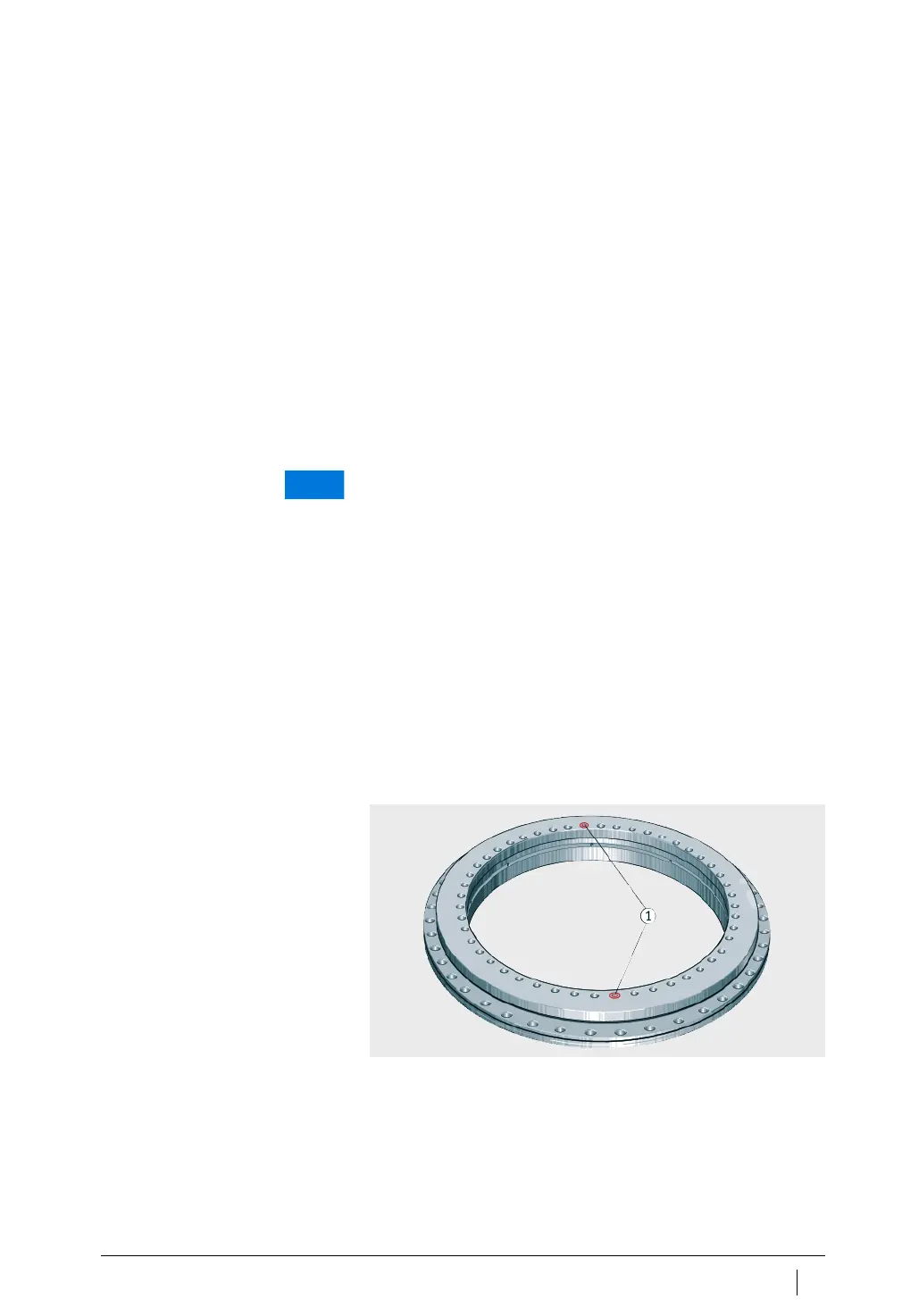
Loosen the retaining screws (2 or 3, depending on the bearing)
by between half a revolution and one full revolution.
For ZKLDF bearings, loosen the retaining screws so that the two
inner rings can centre themselves in relation to each other.
Once the retaining screws have been removed, the bearing
arrangement is no longer self-retaining.
Retaining screws
Figure 7
Loosening the retaining screws


 To Next Page