33
4 Working with the TITRONIC
â
ââ
â
universal Piston Burette
Note: The signs as used in the text have the following meaning:
!
= note on possible danger
<< ... >> = contents of the display
< ....... > = key
& = please refer to, for instance, figure, chapter, operating instructions
During sucking in of dosing and titration solution one has to take care that the suction hose is immersed in
the bubble-free solution in the storage bottle. If the TITRONIC
â
ââ
â
universal Piston Burette is already filled
with ready-for-use solution, working can start right away.
If the TITRONIC
â
ââ
â
universal Piston Burette has to be filled first, & “Rinsing and initial filling“ chapter, this
function is to be triggered using the <FILL> key. The display will signal the respective status of the current
function.
4.1 Keys and contrast
MODE
F4
FILL
F1
F2
F3
F5
START
STOP
All functions of the TITRONIC
â
ââ
â
universal Piston Burette
are triggered using the keyboard. In dialogue mode, the
display shows which active keys can be pressed for further
work. The manual key button is used to start the
„START/STOP“ and the „FILL“ function and to output the
results.
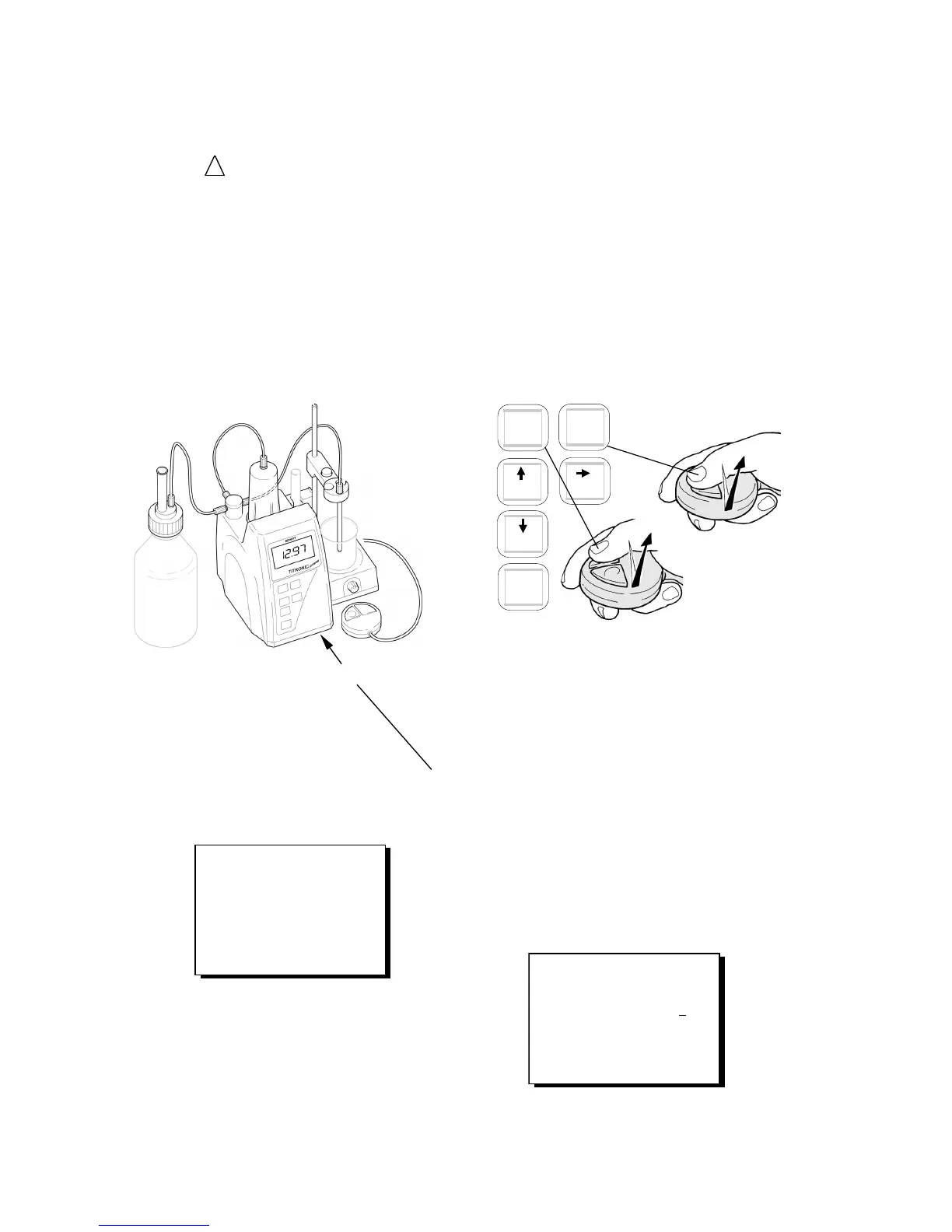
You can adjust the contrast of the display text using the
knurled wheel on the right side of the burette’s front panel.
4.2 Switch-on image, setting the filling time
Fig. 10
TITRONIC universal
Ver.: 99.14
Cylinder volume 20 ml
Rins./init. fill. <F1>
Filling 30 (s) <F2>
System <F3>
Menu <Mode>
After switching the TITRONIC
â
ââ
â
universal
Piston Burette on, the switch-on image
shows you the cylinder size and the software
version. The switch-on image is shown for
15 seconds during which you can select a
function.
Using the <F1> key you select „Rinsing/initial filling“, the
<Mode> key selects a function such as „Dosing“, „Titration“,
„Incremental dosing“. The <F2> key serves to select the
setting for the filling time. Subsequently, the following dis-
play will appear:
Fig. 11
Setting filling time
Filling time: 030 s
Change digits: <
↑↓
>
Next digit <
→
>
OK:<F1> ESC:<F4>
Fig. 9
Adjusting contrast
Fig. 8


 To Next Page