EN
38
►
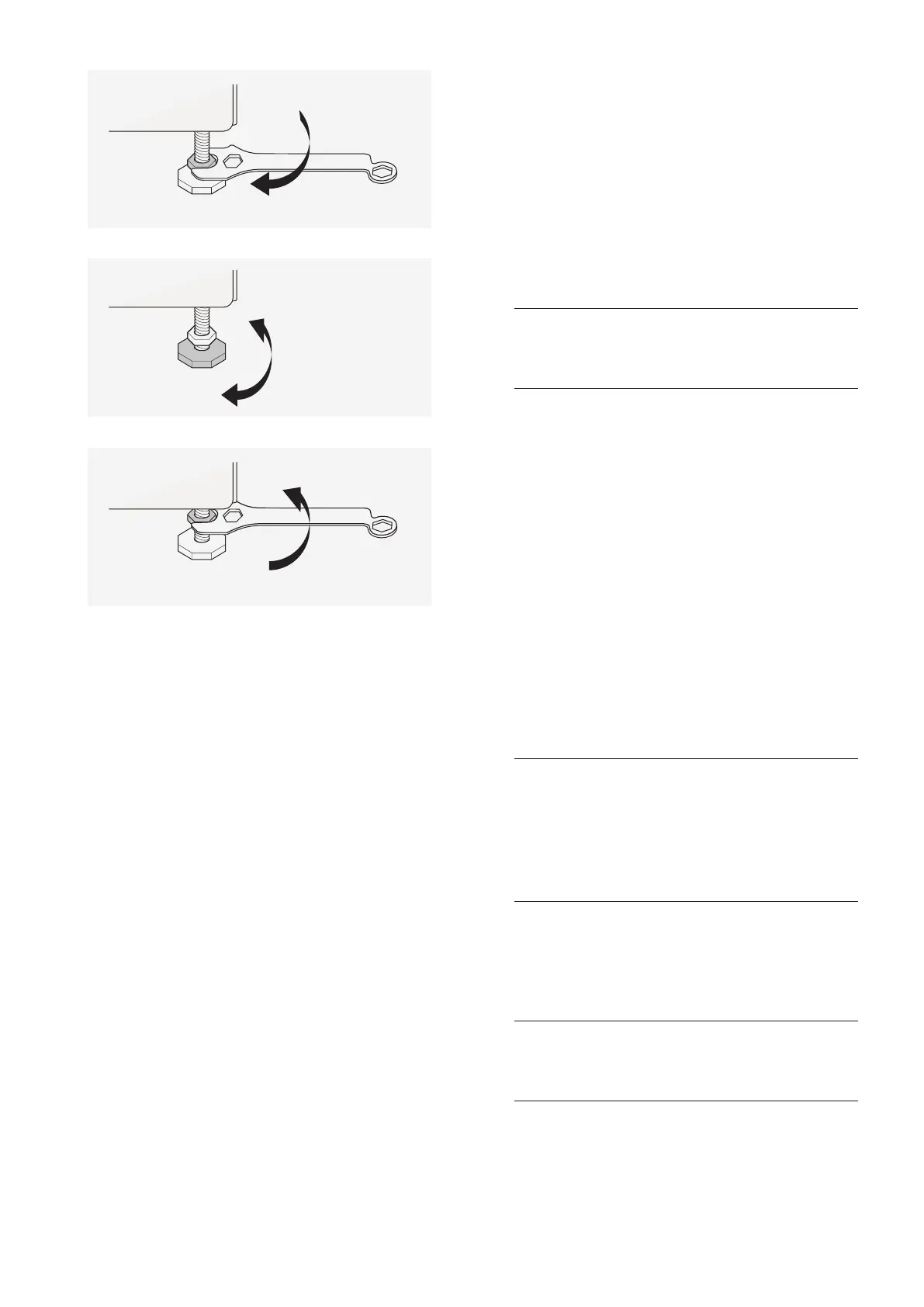
Loosen the counternuts with a screw wrench.
►
Correct the height of the feet.
►
Screw the counter nuts back up. Hold the appliance
feet firmly while doing so to prevent the height shift-
ing.
Fresh air connection (Option)
A fresh air pipe with a diameter of 160 mm or 200
mm can be connected if there is a fresh air connec-
tion (with overflow opening). The following conditions
must be satisfied so that fresh air can be supplied to
the appliance:
Air pressure at the air intake
►
Maximum 0 Pa (no excess pressure)
►
Minimum – 20 Pa (under-pressure)
Exhaust air duct
For the exhaust air duct you can use all normal propri-
etary products, such as:
• Plastic tubes
• Flexible ducts or tubes
• Galvanised metal ducts or tubes
• Connecting, transition or deflection pieces for flat duct
and tube systems
• Wall boxes for exhausting into the open air or into a
ventilation shaft.
Notice
The material must be moisture-resistant and ther-
mally stable up to 80 °C.
Pressure loss
The nature and length of the exhaust air duct, in parti-
cular knee pieces or curves with small radii, impede
the
flow of air.
►
Be sure to obstruct the air flow as little as possible
and keep pressure loss (resistance) minimal.
Depending on the material used, the air is hindered
substantially or less substantially as a result of fricti-
on on the inside of the tubing.
►
Use tubes with a large inner diameter, smooth inner
surface and the shortest possible overall length .
Additional fittings, such as curves, bends, elbows and
wall boxes with grids or backpressure flaps increase
the resistance.
Notice
You will achieve optimal performance of the exhaust
air duct by observing the following points:
• Large internal diameter
• Short overall length
• Avoid tube bends/elbow joints
Calculating the pressure loss
Calculate the loss of pressure using the correspon-
ding values for your appliance type.
Notice
To ensure the minimum required air flow, the total
pressure loss must not exceed the value of 200 Pa.



 To Next Page