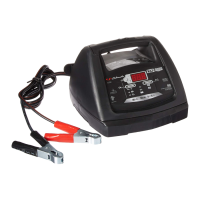
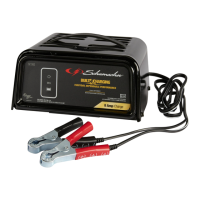
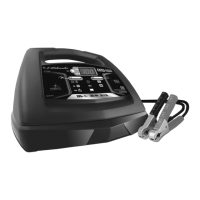
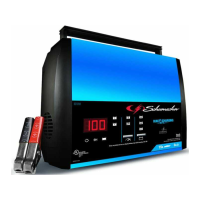
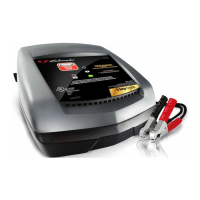
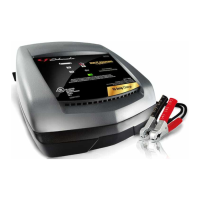
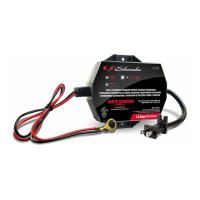
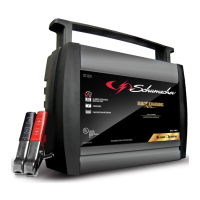
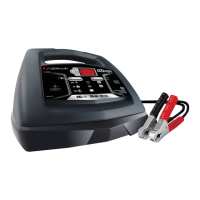
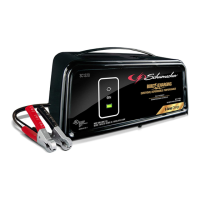
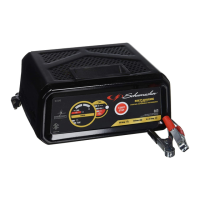
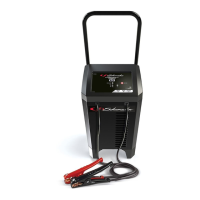
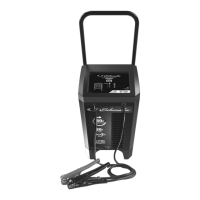
The Schumacher SC1364 is an automatic battery charger designed for safe and effective charging and maintenance of lead-acid batteries. This device serves multiple functions, including charging, boosting, and engine starting, making it a versatile tool for automotive and marine applications.
Function Description
The primary function of the SC1364 is to charge 12V lead-acid (STD or AGM) rechargeable batteries with recommended rated capacities of 22-59Ah. It offers different charging rates to accommodate various battery sizes and conditions. Beyond standard charging, the device features a "Boost" mode for quickly adding energy to severely discharged or large-capacity batteries, and an "Engine Start" feature that provides 150 amps to crank an engine with a weak or run-down battery. This engine start function is designed to be used in conjunction with a battery, not as a standalone power source for starting.
The charger operates automatically, switching to a "Maintain" mode once the battery is fully charged. In this mode, it delivers a small current as necessary to keep the battery at full charge, preventing overcharging and ensuring the battery remains ready for use. The device also includes a "Desulfation" mode, which can take 8 to 10 hours to attempt to reverse sulfation, a common cause of battery failure. If desulfation is unsuccessful, the charging process will abort, and an indicator will light up.
Safety is a key aspect of the SC1364's design. It incorporates several precautions to prevent electric shock, fire, and battery explosion. Users are advised to follow specific connection procedures, especially when working near a lead-acid battery, due to the risk of explosive gases. The charger is not intended for charging dry-cell batteries, which could burst and cause injury or damage.
Usage Features
The SC1364 features a user-friendly control panel with an ON/OFF switch and a Rate Selection button. The ON/OFF switch allows users to select between "OFF," "Boost or Charge/Maintain," and "Engine Start" modes. The "Boost or Charge/Maintain" position enables the selection of either a 6<>2A Charge/Maintain rate for small and large batteries or a 20A Boost setting for rapid energy addition. When in "Engine Start" mode, an LED illuminates to indicate that the feature is active and connected to a battery.
LED indicators provide clear status updates during operation. A yellow/orange "ON" LED indicates that the charger is properly connected and the battery is receiving power. A green "CHARGED/MAINTAINING" LED signifies that the battery is fully charged and the charger has entered maintain mode. In case of connection issues or battery problems, a red "CLAMPS REVERSED/BAD BATTERY" LED will flash for reversed connections or remain solid if a problem with the battery is detected.
The charger is designed for use with batteries both installed in a vehicle and those removed from a vehicle. When charging a battery in a vehicle, users must first turn off all accessories, keep the hood open, and clean the battery terminals. The AC/DC cables should be positioned away from moving engine parts. For both in-vehicle and out-of-vehicle charging, specific connection procedures must be followed based on the battery's grounding (negative or positive). Disconnecting the charger also requires a specific sequence to minimize the risk of sparks.
For the "Engine Start" feature, the charger must be connected to the vehicle's battery and plugged into an AC outlet. Users are instructed to crank the engine for no more than 5 seconds, waiting 45 seconds between attempts. If the engine does not start within 3 minutes in "Engine Start" mode, the unit will enter a 180-second "COOL-DOWN" period to protect the charger and battery. It's important to note that using the "Engine Start" feature without a battery installed in the vehicle can damage the vehicle's electrical system.
The manual also provides estimated battery charging times for various battery sizes and applications (powersports, automotive, marine) at different charge rates (2A, 6A, 8A, 10A). These times are based on a 50% discharged battery and may vary depending on the battery's age and condition.
Maintenance Features
Maintaining the Schumacher SC1364 is straightforward and helps ensure its longevity and proper function. Users are advised to clean the clamps each time after charging to remove any battery fluid that may have come into contact with them, preventing corrosion. The charger's case should be occasionally wiped with a soft cloth to keep the finish shiny and prevent corrosion.
Proper storage is also crucial. The input and output cords should be neatly coiled to prevent accidental damage. The charger should be stored unplugged from the AC power outlet, in an upright position, and in a cool, dry place. It is explicitly stated not to store the clamps on the handle, clipped together, on or around metal, or clipped to the cables, as this could lead to damage or safety hazards.
The manual emphasizes the importance of monitoring the battery and charging process, even with the automatic maintain mode. While the maintain mode technology allows for safe, extended charging, problems with the battery, electrical issues in the vehicle, or improper connections could lead to excessive current draws. Therefore, occasional monitoring is recommended to ensure a healthy battery and charging process.
In case of troubleshooting, the manual provides a comprehensive table outlining common problems, possible causes, and solutions. This includes issues like the charger not turning on, the engine start feature not working, or the red "BAD BATTERY" LED being lit. Solutions range from checking AC outlets and connections to having the battery checked or replaced, or allowing the charger to cool down if it has overheated.


 To Next Page
 General