_______________________________________________________________________________________
schunk.com XND.00046.002_A – 08/2022 6
Description of the clamping device 3
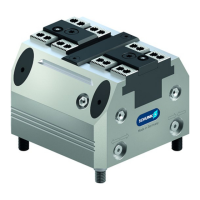
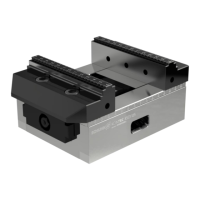
The KSC3 has been designed for centric clamping of raw parts and finished workpieces.
The force is generated mechanically and the power gear ratio is linear across the whole
clamping range.
3.1 Function
The KSC3 is a direct vise with a mechanical drive via a capsuled thread.
The force is generated directly and without a force amplifier.
Both jaws and carriages close respectively open synchronously and are symmetrical with
respect to the position holes in the base plate.
The vise is also suitable for workpiece clamping from the inside to the outside.
Operation (standard operation) 4
4.1 Clamping / aligning
Important:
When using the Schunk quick-change palleting system, only the clamping pins VERO-S
SPA 40-K (ID: 0432369), SPB 40-K (ID: 0432370) with short screw and the indexing bolt
VERO-S IXB V1-K (ID: 0432371) may be used.
Important:
All tolerances are without nickel layer of 5µm per surface.
4.2 Jaw change
The reliable function of the clamping device is significantly affected by the selection of the
correct top jaws.
4.3 Clamping
Important:
The clamping force must be adapted to the jaw width / workpiece width.
4.4 Jaw change
Release cylinder screws and remove the jaws.
Clean and oil the contact surfaces, e.g. with MOTOREX Supergliss 68 K to ISO VG 68.
Changing the jaws or moving them in the carriages, tightened the cylinder screw to the
prescribed torque:
Failure to comply with this rule can result in insufficient workpiece clamping and hence to
workpieces loss and damage.
4.5 Maximum carriages opening
The clamping range depends on the type of vise and the selected system / top jaws.
There is therefore a marking on the carriages when the maximum opening of the
carriages is reached. If this range is exceeded, one leaves the encapsulated area and
contamination can occur under the carriages and in the bearing area due to chips
penetrating.
Workpiece clamping outside the specified markings can lead to workpiece loss and
damage the vise.
Servicing, cleaning and maintenance 5
Make sure that the sliding surface between the system jaws as well as the
spindle is free of chips when adjusting the clamping range.
For cleaning under the carriages, the KSC3 80 and KSC3 125-160 vises can be
opened above the maximum and flushed.
Clean and oil the running surfaces and guides of the vise regularly,
e.g. with MOTOREX Supergliss 68 K to ISO VG 68.
The KSC3 160 has a lubrication nipple in the carriage groove. It is recommended that a lubrication
nipple be applied monthly. The carriages must be completely closed.
Troubleshooting, eliminating faults 6
Device is hard to operate
Disassemble system jaws and clean the entire devices.
If this does not result in an improvement of the function, the device can
be further dismantled in accordance with the description below.
6.1 Removal
The carriages can be completely removed from the base plate by turning the spindle
to the left with a T20 Torx-Screwdriver.
KSC3 125-235, KSC3 125-300 and KSC3 160:
The circlip must be removed from the spindle before.
The inner wipers are usually pulled out of the carriages and remain positioned on the
inside of the spindle.
(If the wipers are pulled over the thread, they must be carefully returned to the inside
of the spindle).
Important:
The high degree of precision of the KSC3 is achieved using a processing step while it is
mounted.
The components of different vises must not be interchanged.
Both carriages and the base plate must have the identical serial number.
This is imperative in order to ensure the consistent central position of the system and the
fitting of the guide between the carriages and base plate.
Further dismantling by the user is not permitted but can be carried out by the manufacturer or an
authorised service agent.
Non-compliance with this rule invalidates the warranty.
KSC3 125-160 KSC3 125-235


 To Next Page
 Loading...