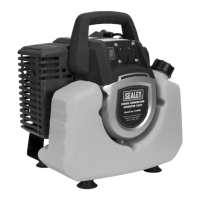
3500W INVERTER GENERATOR 230V
4-STROKE ENGINE
MODEL NO: G3500I
Thank you for purchasing a Sealey product. Manufactured to a high standard, this product will, if used according to these
instructions, and properly maintained, give you years of trouble free performance.
IMPORTANT: PLEASE READ THESE INSTRUCTIONS CAREFULLY. NOTE THE SAFE OPERATIONAL REQUIREMENTS, WARNINGS & CAUTIONS. USE
THE PRODUCT CORRECTLY AND WITH CARE FOR THE PURPOSE FOR WHICH IT IS INTENDED. FAILURE TO DO SO MAY CAUSE DAMAGE AND/OR
PERSONAL INJURY AND WILL INVALIDATE THE WARRANTY. KEEP THESE INSTRUCTIONS SAFE FOR FUTURE USE.
1. SAFETY
WARNING! THE GENERATOR IS SHIPPED WITHOUT OIL. CHECK OIL LEVEL AND FILL AS REQUIRED BEFORE USE.
WARNING! Ensure any Health & Safety, Government, or local authority regulations are adhered to when using this equipment.
9 Familiarise yourself with the application and limitations, as well as the potential hazards, of the generator.
9 Maintain the generator in good condition (use an authorised service agent). Replace or repair damaged parts. Use genuine parts only.
Unauthorised parts may be dangerous and will invalidate the warranty.
9 This generator is designed and manufactured for specific applications. DO NOT attempt to modify the unit or use it for any application
for which it is not designed. If you have any questions regarding the application of the unit please contact your local Sealey stockist.
WARNING! DO NOT exceed the Wattage/Amperage capacity of the generator. Add rated wattage of all devices intended for
connection at any one time, the total must not exceed rated wattage of generator (see specifications).
WARNING! Generator exhaust gases contain deadly carbon monoxide which must not be inhaled. Always allow sufficient ventilation.
WARNING! Engine exhaust gases are toxic. Do not use indoors.
WARNING! If you decide to use an Earth Leakage Circuit Breaker (also referred to as an RCD or Ground Fault Circuit Interrupter),
it is imperative that the neutral end of the power winding is connected to the frame of the generator set and that the earth lug on the
frame is connected with a low impedance connector to the local earth via an earth spike or local protective earth conductor. This
connection should only be attempted by a qualified electrician, after first having consulted your local stockist.
9 Protect children by keeping them at a safe distance from the generating set.
▲ DANGER! This generator is designed for outdoor use only. To use the generator inside any building or enclosure, including the
generator compartment of a caravan, may result in fire or an explosion. No user performed modifications, including venting of the
exhaust and/or cooling ventilation, will eliminate the danger.
▲ DANGER! If this unit is used for back-up power in the event of a commercial power failure, the following steps must be taken.
Before connecting the generator to the electrical system, open the main circuit breaker to isolate the generator and system from the
commercial electric supply. Failure to do this may result in damage to the generator and may result in serious injury or fatality, due to a
back-feed of electrical energy.
▲ DANGER! The generator produces a very powerful voltage that can cause a severe electrical shock. Avoid contact with bare wires,
terminals etc. Never allow any unqualified person to operate or service the generator.
WARNING! Petrol is highly flammable and petrol vapour is explosive. Do not permit smoking, naked flames, sparks or heat in the
vicinity while handling petrol. Avoid spilling petrol onto a hot engine.
9 Switch off engine before refuelling.
9 Comply with all laws regulating storage and handling of fuels.
WARNING! Some parts of the internal combustion engine are hot and may cause burns. Pay attention to the warnings on the
generating set.
WARNING! Risk of burns. DO NOT touch the exhaust system or the drive unit.
WARNING! NEVER refuel when the engine is running or when the engine is hot. Allow cool down time.
9 Operate the generator only on level surfaces (maximum allowable tilt is 10º) and where it will not be exposed to excessive moisture, dirt
or corrosive vapours or be in the proximity of combustible material (flammable liquids, solids or gases).
8 DO NOT tip or change the generator’s position whilst it is operating.
9 Remove ill fitting clothing, ties, watches, rings and other loose jewellery and contain long hair. Wear appropriate protective clothing.
9 Keep non-essential persons and children away from the working area.
WARNING! Never start or stop the generator while electrical loads are connected. Start the engine, let it stabilise, then connect the
electrical load. To stop engine, disconnect the electrical load and let engine stabilise before switching off.
WARNING! DO NOT use worn, bare, frayed or otherwise damaged electrical cables with the generator. Electric shock may occur.
8 DO NOT use the generator for any purpose other than that for which it is designed.
8 DO NOT operate the generator if any parts are missing or damaged, as this may cause failure and/or personal injury.
8 DO NOT over-fill fuel tank. Always leave room for fuel to expand.
8 DO NOT operate in the rain or damp conditions.
▲ DANGER! DO NOT tamper with the engine governed speed setting. Higher operating speeds are dangerous and increase the risk
of personal injury and/or equipment damage. The generator supplies the correct rated frequencies and voltage only when running at the
correct governed speed. Incorrect frequency and/or voltage can damage some connected electrical loads.
Operating at excessively low speeds may result in shortened engine life. Over-speeding will invalidate the warranty.
8 DO NOT operate the generator when you are tired, or under the influence of alcohol, drugs or intoxicating medication.
G3500I Issue 1 10/02/23
Original Language Version
© Jack Sealey Limited
Refer to
instructions
Electrical
shock
hazard
Hot surfaces Do not cover
Do not use in
non ventilated
area
Switch off the engine before refuelling

 Need help?
 General

 To Next Page