Need help?
Do you have a question about the Sealey SA21/S and is the answer not in the manual?
Connect wrench to air supply, ensuring correct pressure and clean air for operation.
Use leader hoses with couplings to prevent vibration-induced failure. See connection diagrams.
Operate tool correctly, ensure proper alignment, avoid ill-fitting sockets, and use secure grip.
Proper maintenance, lubrication, and cleaning reduce vibration exposure and tool wear.
Monitor operators for early symptoms of vibration injury to adjust management procedures.
Wear appropriate clothing for warmth and dryness; prevention is key.
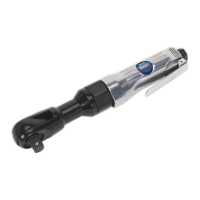
The Sealey Air Ratchet Wrench, available in models SA20/S and SA21/S, is a pneumatic tool designed for various workshop tasks, particularly in engine bays where space is limited for hand-operated ratchets. This air-powered ratchet wrench features a hardened steel anvil and a twist-to-reverse mechanism, allowing for easy direction changes. Its trigger-operated power control provides precise operation, making it suitable for a range of applications.
The primary function of the Sealey Air Ratchet Wrench is to tighten or loosen nuts and bolts using compressed air. It operates by converting pneumatic energy into rotational force, which is then applied to a socket attached to the hardened steel anvil. The twist-to-reverse mechanism allows the user to quickly switch between forward (tightening) and reverse (loosening) modes, enhancing efficiency and versatility. The trigger-operated power control enables the user to regulate the air flow and, consequently, the speed and torque applied to the fastener. This precision control is particularly useful in delicate applications or when working with various fastener types. The wrench is designed to be used with impact sockets, which are specifically engineered to withstand the forces generated by ratchet and impact wrenches, ensuring durability and safety.
To ensure safe and effective operation, several usage features and guidelines must be followed. Before connecting the wrench to the air supply, the air valve or trigger must be in the "off" position. The wrench requires an air pressure of 90 psi and an air flow according to its specifications. It is crucial to maintain a clean air supply and ensure that the air pressure does not exceed 90 psi during operation, as excessive pressure can lead to premature wear and potential damage or injury. The air tank should be drained daily to prevent water from entering the air line, which can damage the wrench. The air inlet filter should be cleaned weekly to maintain optimal performance.
For connection, a leader hose is recommended to prevent vibration from causing failure if a quick-change coupling is connected directly to the wrench. The leader hose connects to the wrench, and a quick-change coupling can then be used to connect the leader hose to the air line recoil hose. This setup helps to mitigate vibration and extend the life of the tool. The air hose itself should be kept away from heat, oil, and sharp edges, and its condition should be checked for wear before each use, ensuring all connections are secure.
When operating the wrench, only sockets specifically designed for use with a ratchet wrench should be used. The socket is placed over the nut, and the trigger is depressed to operate the wrench. To change the ratchet direction, the switch on the tool head is turned to 'F' for forward or 'R' for reverse. It is important not to apply additional force to the wrench to remove a nut, as this can damage the tool. The air flow can be regulated by turning a screw located above the trigger, allowing for fine-tuning of the wrench's power. To prolong the wrench's life, it should not be allowed to run in "idle rotation" for extended periods.
Safety is paramount during use. All workshop safety rules, regulations, and conditions should be observed. The wrench must be disconnected from the air supply before changing accessories or performing any servicing. It is essential to maintain correct balance and footing, ensuring the work area is not slippery and wearing non-slip shoes. Children and unauthorized persons should be kept away from the working area. The wrench should not be used for tasks it is not designed for, nor should it be used if damaged or faulty. Users should be instructed in its proper use by a qualified person. The wrench is a precision tool and should not be dropped, thrown, or abused. It should never be carried by the hose or yanked from the air supply. Operation should be avoided if tired or under the influence of alcohol, drugs, or intoxicating medication. To prevent unintentional starting, the wrench should not be carried with a hand on the power lever. Air from the hose should never be directed at oneself or others. When not in use, the wrench should be disconnected from the air supply and stored in a safe, dry, childproof location.
Proper maintenance is crucial for prolonging the life and ensuring the continued performance of the Sealey Air Ratchet Wrench. Before any maintenance, servicing, or accessory changes, the wrench must be disconnected from the air supply. Only genuine parts should be used for replacements or repairs, as non-authorized parts can be dangerous and will invalidate the warranty.
Lubrication is a key aspect of daily maintenance. A few drops of Sealey air tool oil should be dripped into the air inlet daily to ensure smooth operation and extend the wrench's lifespan. After each use, the wrench should be cleaned. It is important not to use worn or damaged sockets, as this can negatively impact performance and potentially cause damage.
Loss of power or erratic action can often be attributed to several factors. These include excessive drain on the air line, moisture or restriction in the air pipe, or incorrect size or type of hose connectors. To address these issues, the air supply should be checked, and the instructions in the "Preparing Wrench for Use" section should be followed. Grit or gum deposits within the wrench can also reduce performance. If the model has an air strainer near the air inlet, it should be removed and cleaned. The wrench can then be flushed out with gum solvent oil or an equal mixture of SAE No. 10 oil and paraffin. After flushing, the wrench should be allowed to dry before use. If problems persist, contacting a local Sealey service agent for a full service is recommended.
Regular lubrication of the drive shaft and checking/topping up the gearbox (if fitted) will help reduce friction and increase the tool's power and longevity. When not in use, the wrench should be disconnected from the air supply, cleaned, and stored in a safe, dry, childproof location. Adhering to these maintenance guidelines will help ensure the wrench remains in optimal working condition for many years.
 General
| Model | SA21/S |
|---|---|
| Type | Air Saw |
| Stroke Length | 10mm |
| Air Consumption | 4cfm |
| Air Inlet | 1/4" BSP |
| Operating Pressure | 90psi |
| Weight | 0.6kg |

 To Next Page