Need help?
Do you have a question about the Sealey VS779 and is the answer not in the manual?
Process for breaking motorcycle chains by pressing out the link pin, including tip selection and tool assembly.
Procedure for installing and riveting chain link pins using the tool, stressing special pins and proper alignment.
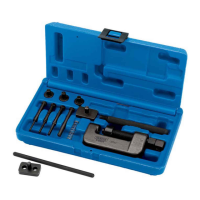
The Sealey Professional Tools Model No. VS779 is a motorcycle chain breaker and riveter designed for quickly and easily breaking and rejoining various types of drive and cam chains. Manufactured to a high standard, this product aims to provide years of trouble-free performance when used according to its instructions and properly maintained.
The primary function of the VS779 is to facilitate the breaking and riveting of motorcycle chains. It achieves this by allowing users to press out link pins to break a chain and then flare new link pins to rejoin a chain. The tool is designed to handle a wide range of chain sizes, from #35 to #630, including O-ring chains.
*   Always adhere to Health and Safety, local authority, and general workshop practice regulations.
*   Do not use the tool if it is damaged.
*   Maintain the tool in good and clean condition for optimal performance and safety.
*   Keep the work area clean, uncluttered, and adequately lit.
*   Maintain correct balance and footing, wearing non-slip shoes.
*   Keep children and unauthorized persons away from the work area.
*   Always wear eye protection when using the tool.
*   **Assembly:** Assemble the tool as shown in fig.1, ensuring the anvil is not used for this operation.
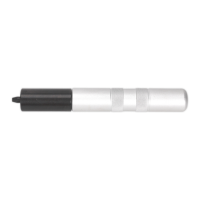
*   **Tip Selection:** Select the correct size breaking tip (Ø2.20mm, Ø2.90mm, or Ø3.80mm) based on the chain size. Insert the tip into the alignment bolt, ensuring the spring is under the head of the breaker pin, and then replace the push (extractor) bolt.
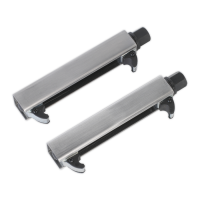
*   **Guide Usage:** If using the 2.2mm tip, the upper and lower guides must be used to prevent tip breakage.
*   **Chain Positioning:** Place the tool over the chain. The breaker pin tip must be withdrawn at least 2mm into the alignment bolt. The chain rivet should be held by the tool's alignment bolt on one end and by the tool body on the other. Tighten the alignment bolt securely against the chain.
*   **Pin Extraction:** Tighten the push (extractor) bolt with a 14mm wrench or lever bar until the chain pin is completely pushed out and drops through the hole in the tool's bottom.
*   **Important Note:** If working on heavy-duty 530 to 630 chains, it is recommended to grind off the rivet head first to prevent damage to the breaking tip. For cam chains, cover the chain tunnel with a rag to prevent parts from dropping.
*   **Troubleshooting:** If the tip does not push down smoothly, check alignment. Misalignment can break the tip.
*   **Anvil and Rivet Tip:** Ensure the rivet tip and anvil are in place in the tool.
*   **Chain Assembly:** Assemble the chain with the new link to be riveted. Special rivet link pins must be used; original pushed-out pins are not recommended due to potential weakening. Avoid split pin type connecting links.
*   **Pin Insertion:** Push the new pin all the way through the chain link. If it's stiff, the pin can be pushed into place by positioning the chain in the tool with the rivet tip withdrawn 2mm into the alignment bolt, then tightening the alignment bolt until the pin is pushed through. Ensure equal pin length on both sides of the link.
*   **Riveting Process:** Position the tool over the pin to be riveted. Ensure the rivet tip is withdrawn 2mm into the alignment bolt. Tighten the alignment bolt securely against the chain. Then, tighten the push (extractor) bolt to flare the chain pin. Both ends of the link pin should be flared to securely hold the pin. Repeat for other link pins.
*   **Verification:** After removing the tool, visually check that both chain link pins show the same flared ends.
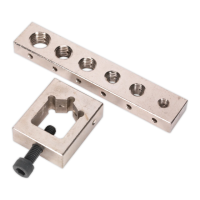
*   **Alternative Riveting Methods:** The press plates can also be used to flare pin ends (fig.4), using the plate with two holes in the upper jaw and the grooved plate in the lower jaw. A combination of the rivet pin and lower press plate can also be used (fig.5).
This tool is a specialized device for motorcycle maintenance, requiring careful adherence to instructions for safe and effective operation.

 To Next Page
 General